

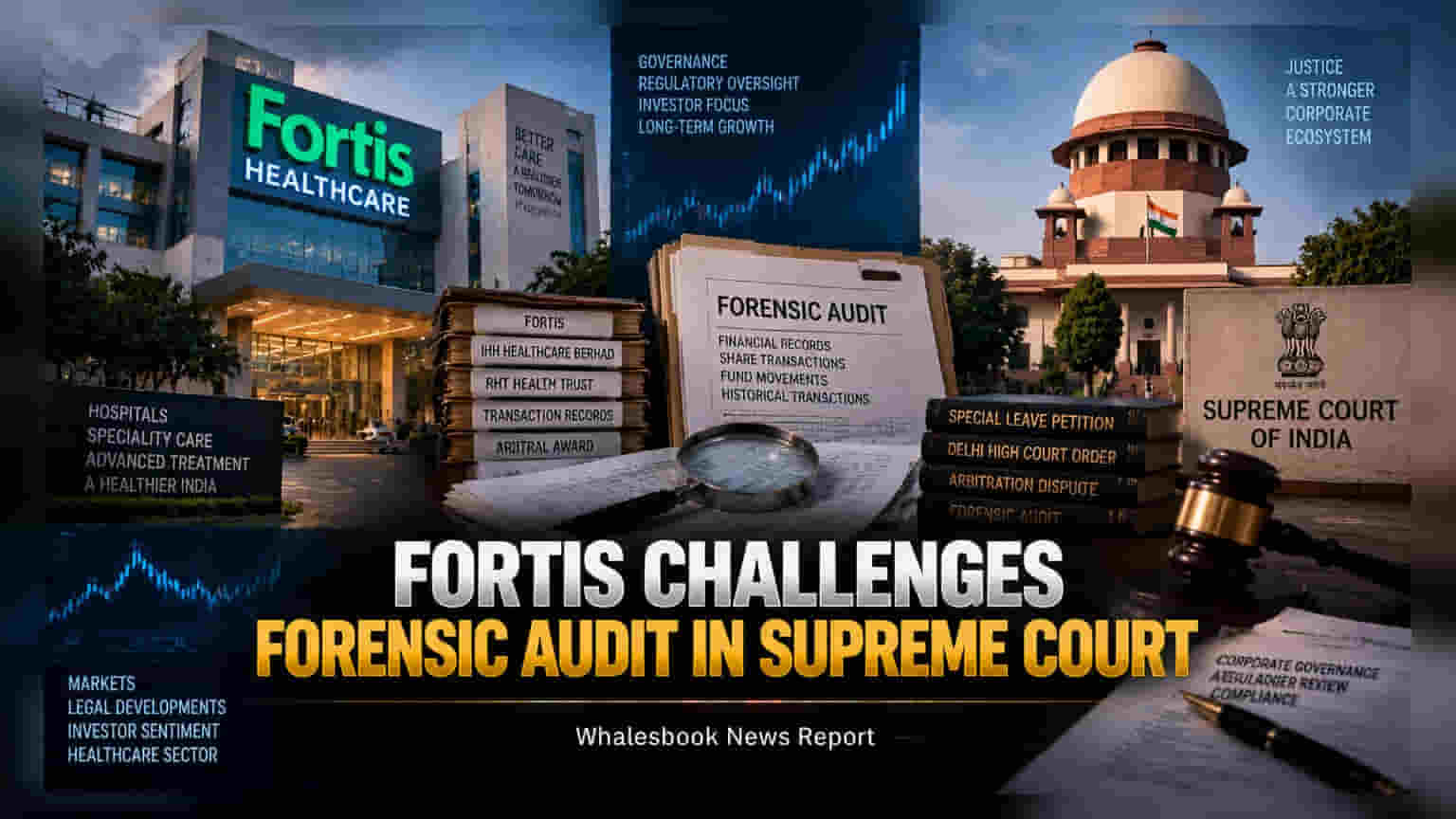
Fortis Healthcare has filed a petition in the Supreme Court challenging the Delhi High Court's directive for a six-month forensic audit of its historical transactions. The company maintains that it was not part of the original arbitration and that the audit is purely investigative. Investors are monitoring the court's response, as the case continues to create a long-term regulatory overhang.
Fortis Healthcare has moved the Supreme Court of India by filing a Special Leave Petition on September 16, 2026. This legal step is a direct challenge to the Delhi High Court’s August 31, 2026, order, which had directed the appointment of a firm to conduct a six-month forensic audit of the hospital chain's historical financial records.
The High Court audit order is linked to the ongoing enforcement proceedings regarding a long-running arbitral award won by Japanese drugmaker Daiichi Sankyo. The dispute involves the former promoters of Fortis, Malvinder Mohan Singh and Shivinder Mohan Singh. The forensic examination is tasked with investigating the movement of shares and funds, specifically looking at past transactions that involve Fortis, its historical connection to IHH Healthcare Berhad, and the RHT Health Trust.
Fortis Healthcare has maintained a consistent stance in its regulatory filings. The company emphasizes that it was not a party to the original arbitration dispute between Daiichi Sankyo and the former promoters. According to the company, the court-ordered audit is intended as an investigative exercise. Fortis has clarified that the High Court's direction does not, by itself, impose any fresh monetary liability, fine, or penalty on the company’s balance sheet.
For investors, this situation represents a persistent governance challenge. While the company continues to operate its core hospital business, the ongoing legal proceedings involving the former promoters create a regulatory cloud that persists over the stock. The primary risk for shareholders is not an immediate financial payout, but rather the potential for forensic findings to be used in future legal claims or to create extended management distraction, pulling focus away from current hospital operations and expansion strategies.
On the day of the announcement, the company's stock showed minimal reaction, trading around the ₹870 per share level. This muted movement suggests that the market may already be pricing in the long-standing nature of this legal battle, which has been ongoing for years.
The key for investors to monitor next is how the Supreme Court responds to the petition. The market will be watching for whether the apex court grants any interim relief, such as pausing the audit, or if it allows the six-month investigation to proceed as scheduled. Any further disclosures from the company regarding the scope of the audit or new court developments will be material to understanding whether this legal overhang will eventually dissipate or if it could evolve into a more significant financial risk.