 Whalesbook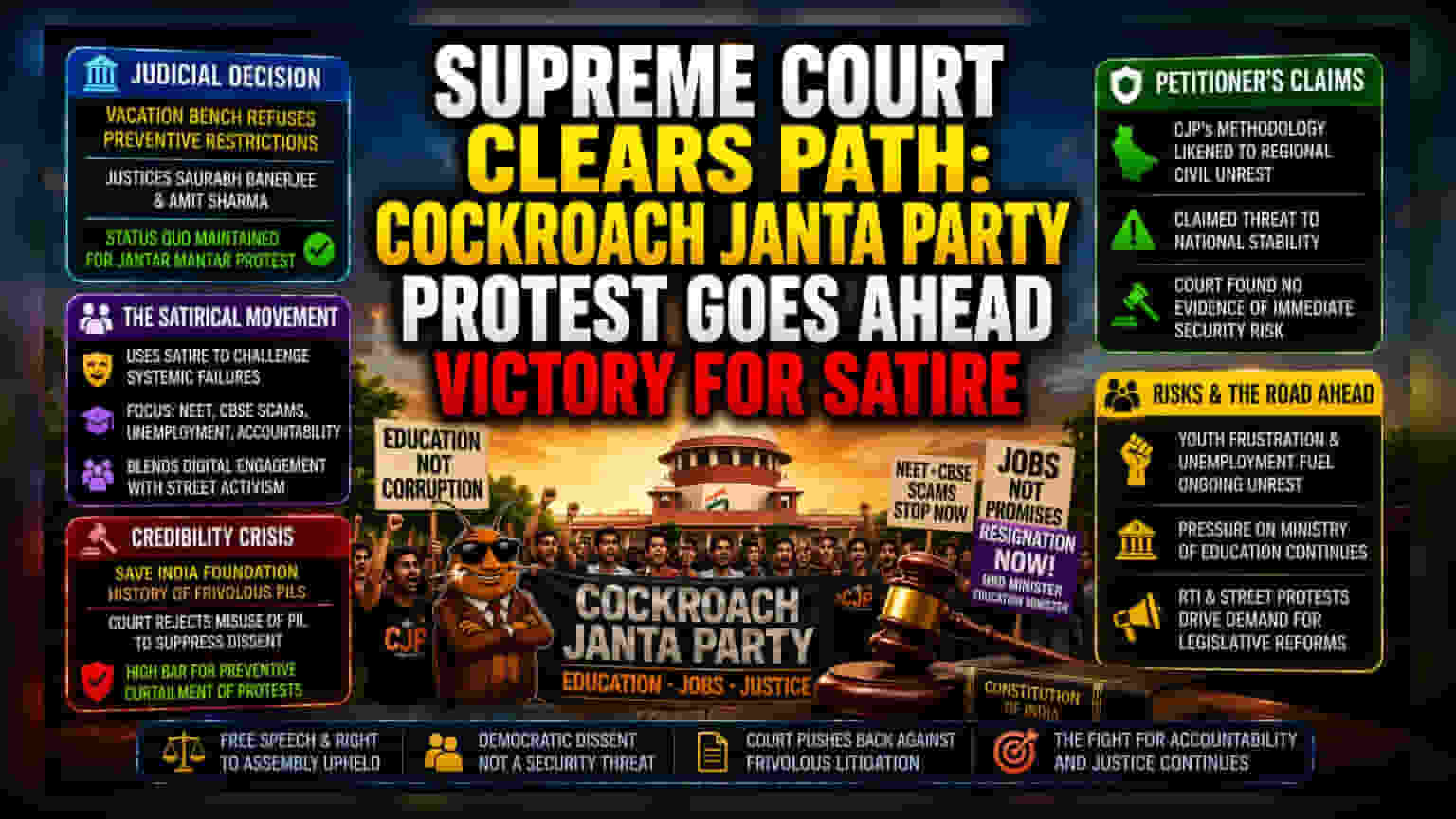


Judicial Deference to Assembly
The decision by a vacation bench, consisting of Justices Saurabh Banerjee and Amit Sharma, effectively maintains the status quo for the scheduled demonstration at Jantar Mantar. By refusing to fast-track the request for preventive crowd-control measures, the court has signaled a clear reluctance to intervene in planned political activities before they occur. This outcome serves as a procedural victory for the Cockroach Janta Party, allowing their public assembly to move forward without the court-mandated restrictions requested by the petitioner.
The Anatomy of a Satirical Movement
The Cockroach Janta Party movement functions primarily as a form of socio-political satire, utilizing the nomenclature of current judicial and political discourse to draw attention to systemic failures in domestic education and labor sectors. The group’s focus on the NEET and CBSE examination controversies mirrors broader public frustration regarding institutional accountability. By targeting high-level ministerial resignations, the organization has positioned itself within a tradition of protest that utilizes irony to bypass traditional media narratives. The movement's efficacy depends heavily on its ability to sustain digital engagement while transitioning into physical spaces, a strategy that the petitioner attempted to categorize as a threat to national stability.
The Credibility Gap in Litigation
The petition itself faces significant scrutiny due to the historical background of the Save India Foundation. Records indicate that this organization has previously incurred judicial reprimands for lodging what the court characterized as frivolous litigation, particularly regarding the status of religious sites. The decision to reject this specific plea aligns with an ongoing judicial pushback against the misuse of Public Interest Litigation to target ideological opponents or suppress public assembly. Legal observers suggest that the court’s refusal to treat the CJP protest as a security emergency indicates a high evidentiary bar for petitioners attempting to preemptively curtail democratic expression.
Structural Risks and Institutional Response
The controversy underscores a deepening friction between civil society activists and organizations that utilize the legal system to challenge dissent. While the Save India Foundation drew parallels between the CJP’s methodology and regional civil unrest in South Asia, the court’s inaction suggests a failure to accept these narratives as sufficient grounds for immediate intervention. The ongoing pressure on the Ministry of Education regarding examination integrity remains a primary driver of the underlying unrest, regardless of the judicial outcome of this specific plea. For stakeholders, the primary risk remains the volatility of the youth demographic, who continue to utilize both RTI mechanisms and street-level activism to demand legislative reforms in the face of persistent unemployment.