 Whalesbook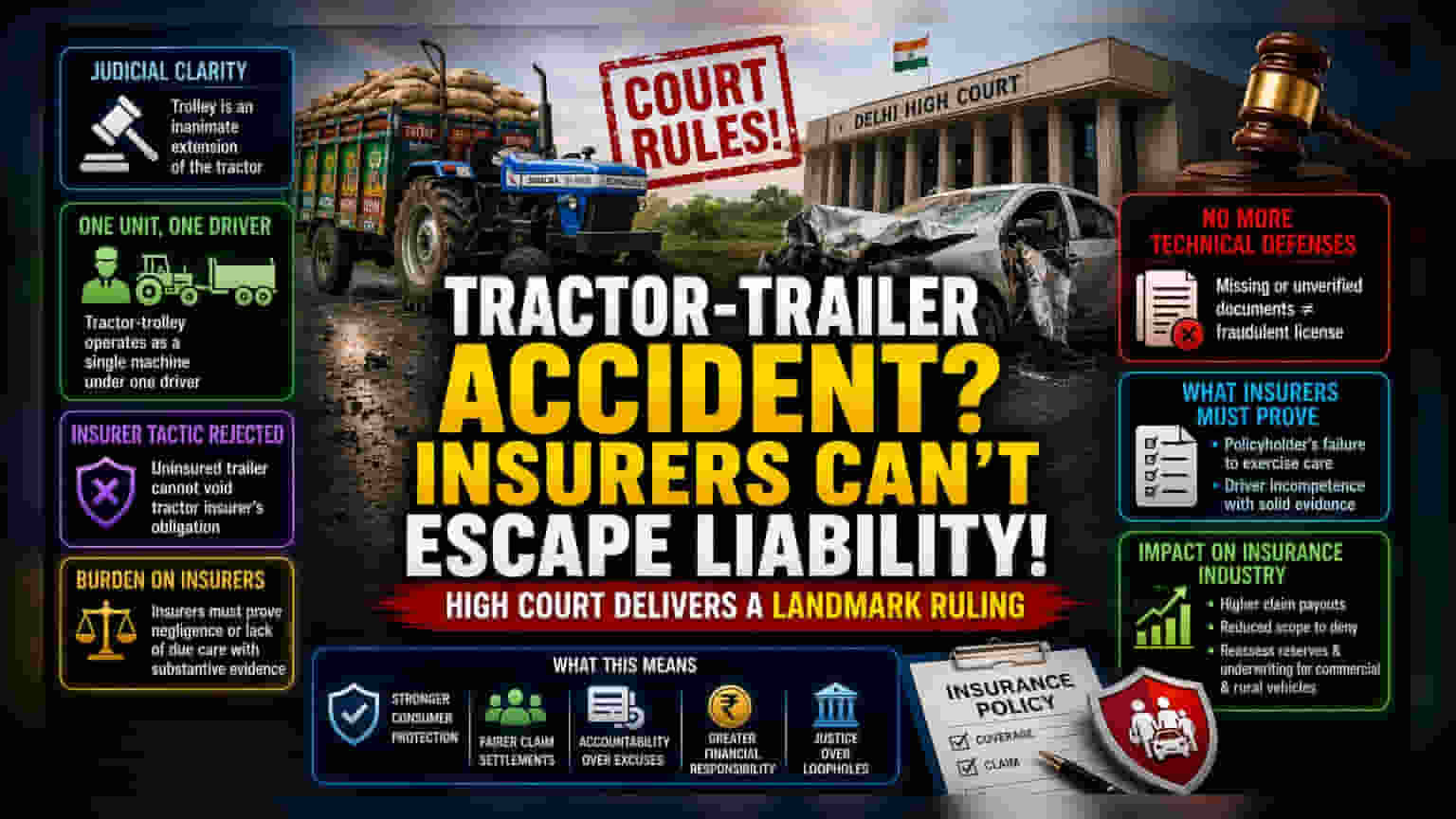


Judicial Pushback Against Coverage Denials
The judiciary is tightening its grip on insurance providers attempting to bifurcate liability in motor vehicle accidents. Recent findings from the Delhi High Court underscore a growing judicial impatience with the common insurer tactic of denying claims by isolating the status of a tractor from its attached trolley. When an accident involves a tractor-trailer unit, the legal focus must remain on the mechanical operation of the tractor rather than the secondary insurance status of the towed load.
The Operational Reality of Liability
At the center of this determination is the understanding that a tractor-trolley functions as a cohesive machine under the control of a single driver. When litigation emerges, insurance firms have frequently argued that an uninsured trailer constitutes a fundamental breach of policy, thereby nullifying their obligation to indemnify the insured. The High Court has dismantled this defense by clarifying that the trolley is an inanimate extension of the tractor. Unless the trailer is found to be the specific, independent cause of a collision—such as through detachment or abandonment on a roadway—it cannot be used as a shield to deflect financial responsibility from the tractor's insurer.
Reversing the Burden of Proof
Beyond the trailer dispute, the ruling serves as a broader signal regarding the evidentiary requirements insurers must meet when alleging fraudulent licensing. In many contested claims, providers attempt to evade payouts by flagging missing or unverified driver records. The court has now explicitly shifted the burden back to the insurance firm, ruling that administrative voids in record-keeping are not synonymous with a fraudulent license. To escape liability on grounds of driver negligence or incompetence, an insurer must provide substantive proof of the policyholder’s failure to exercise reasonable care. Mere speculation or missing documentation is no longer sufficient to overturn compensation awards set by the Motor Accident Claims Tribunal.
The Industry Impact
This legal stance forces a paradigm shift for companies like Reliance General Insurance and the broader motor insurance sector. Historically, technical obfuscation served as a primary mechanism to manage loss ratios. With the court now affirming that negligence is tied to the operator of the entire unit, insurers face an increased probability of paying out on claims that were previously disputed. Investors should monitor how these judicial precedents influence claims management reserves and the underwriting rigor for rural and commercial vehicle policies, as the margin for denying such claims continues to shrink under judicial scrutiny.