

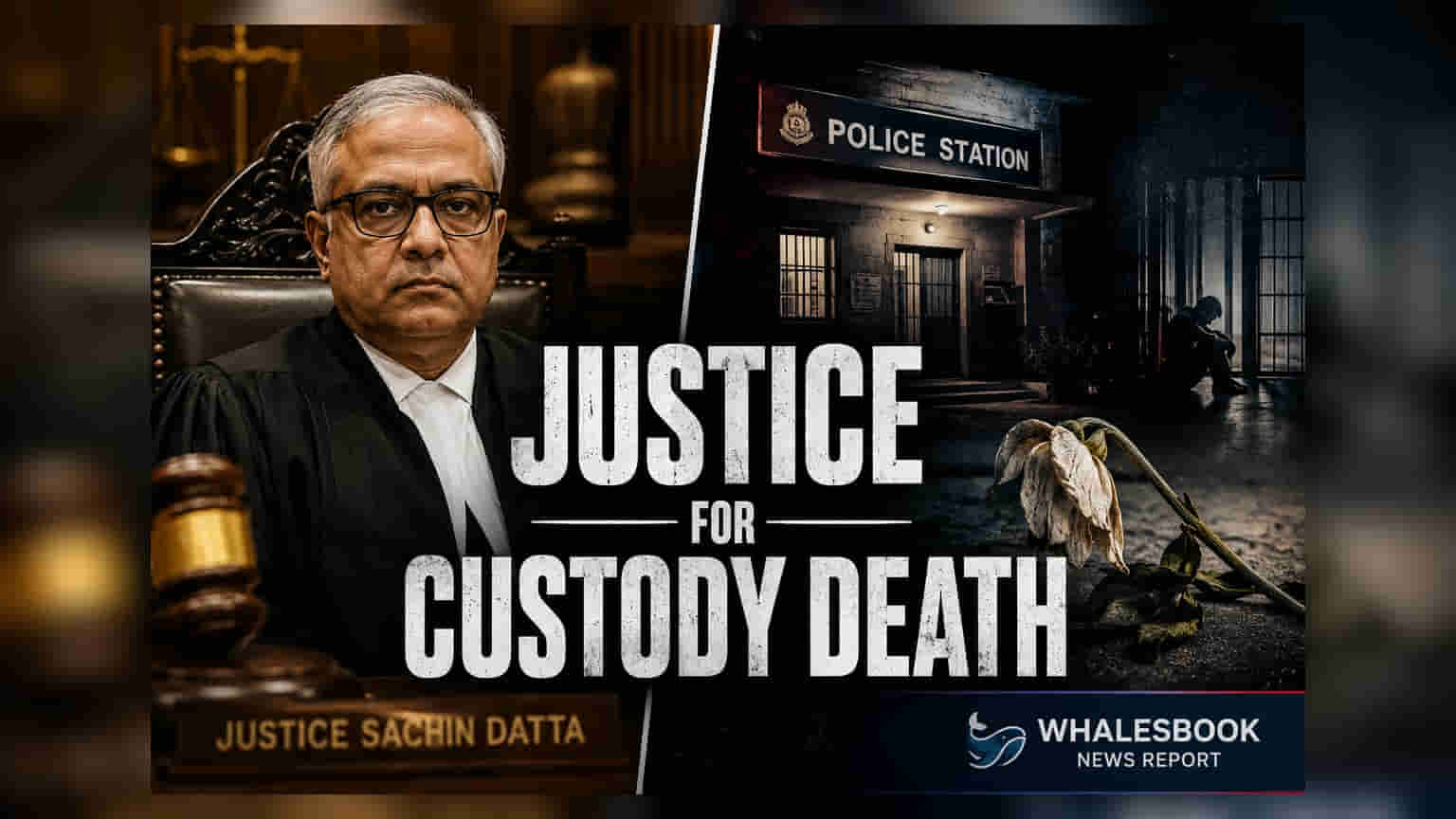
The Delhi High Court has directed the state government to pay ₹18.44 lakh to the father of a 19-year-old who died in police custody. Justice Sachin Datta ruled that such deaths, even if by suicide, violate Article 21 and represent a failure of the state's duty of care. This decision emphasizes the principle of public law liability when individuals are under state protection.
What Happened
The Delhi High Court has ordered the Delhi government to pay a compensation of ₹18.44 lakh to the father of a 19-year-old youth who died in police custody. The incident occurred at the Karawal Nagar Police Station in January 2018. Presiding over the case, Justice Sachin Datta highlighted that the death of an individual while in the custody of the state is not a private matter, but a clear reflection of the state’s failure to fulfill its responsibility to protect those under its charge.
The Court’s Reasoning on State Liability
Justice Datta emphasized that custodial deaths, regardless of the cause—whether violence, negligence, or suicide—constitute a violation of Article 21 of the Indian Constitution, which guarantees the right to life and personal liberty. The court rejected the state government's argument that compensation is not automatically applicable in every custodial death. Instead, the ruling underscored that when a person's liberty is curtailed and they are placed under state care, the authorities bear an elevated duty of care. Failing this duty creates public law liability, which the state cannot evade by citing statutory technicalities.
Background of the Case
The petition was filed by Shyam Sunder, whose adopted son, Deepak, was arrested on January 15, 2018, and taken to the Karawal Nagar Police Station. Sunder alleged that both he and his son were subjected to assault at the station and that police officers demanded money for Deepak's release. Subsequently, Deepak was taken to the Guru Tegh Bahadur Hospital, where he was declared dead on arrival. The post-mortem report indicated the cause of death as asphyxia due to ante-mortem hanging, which the police identified as suicide. This court ruling addresses the legal accountability for the loss of life while the individual was in custody.
How the Compensation Was Determined
To calculate the appropriate compensation, the court utilized the multiplier method, a standard legal approach for assessing loss of dependency. The court assessed Deepak's monthly income at ₹12,000 and applied a 40% addition to account for future financial prospects. A multiplier of 18 was used to determine the total figure. After including additional amounts for funeral expenses and loss of estate, the court fixed the total compensation at ₹18.44 lakh. The state government has been ordered to complete the payment within eight weeks.
Legal Implications for State Authorities
This judgment serves as a reminder of the judicial stance on the accountability of state agencies. By classifying custodial death as a systemic failure rather than just a private tragedy, the court has reinforced that the justice system must review such cases to maintain its credibility. This decision sets a precedent for how state liability is interpreted when authorities fail to ensure the safety of individuals in their custody, ensuring that violations of fundamental rights are met with appropriate judicial recourse.