

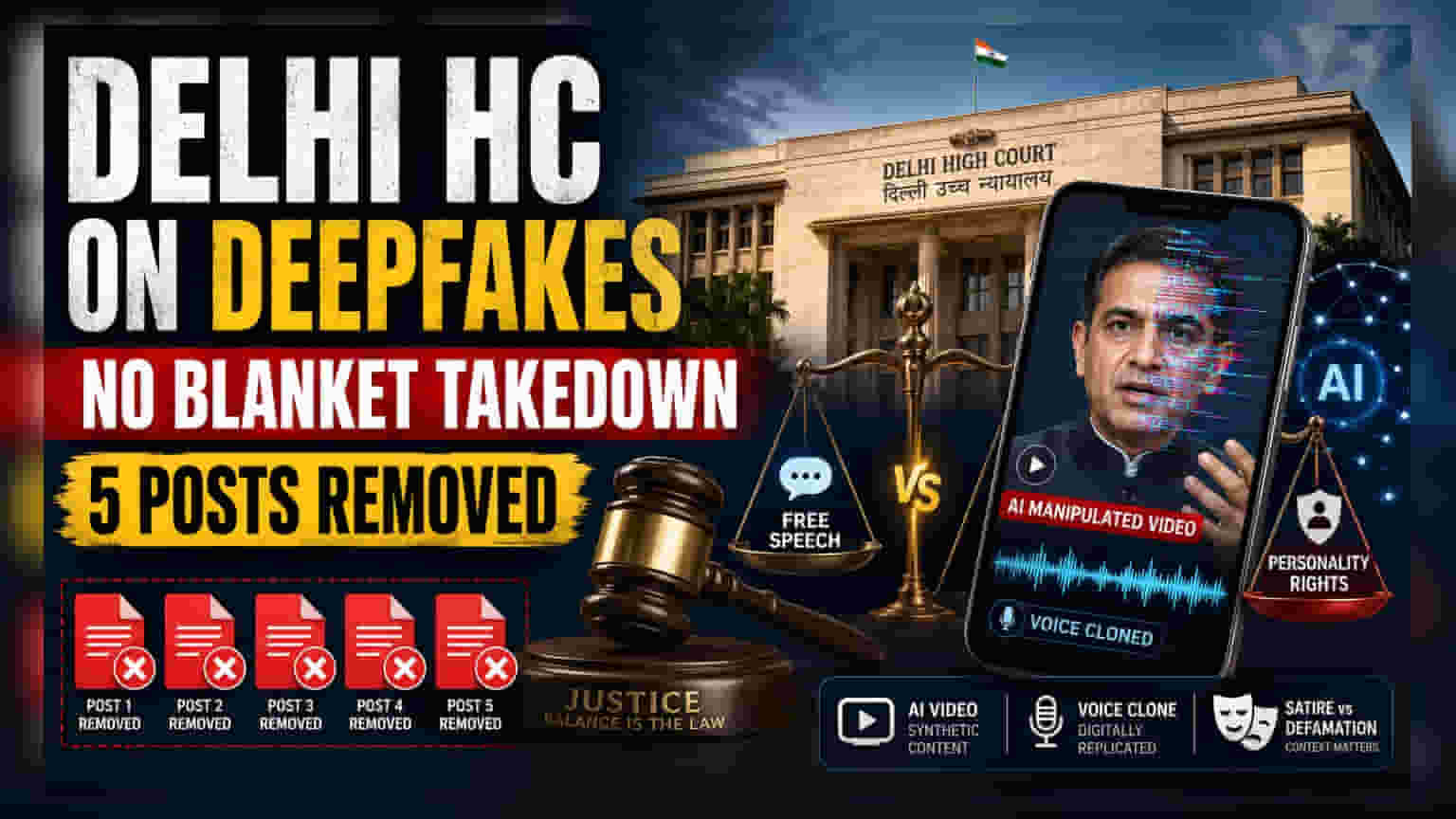
The Delhi High Court has refused a blanket ban on online content regarding Aam Aadmi Party (AAP) leader Raghav Chadha’s personality rights, but ordered the removal of five specific defamatory documents. The ruling highlights the legal distinction between political criticism and the misuse of AI-generated content, setting a clear boundary for online speech.
What Happened
The Delhi High Court on Wednesday rejected a broad request to remove all online content flagged by Aam Aadmi Party (AAP) leader Raghav Chadha for allegedly violating his personality rights. While the court refused to impose a blanket takedown of the materials, Justice Subramonium Prasad ordered the immediate removal of five specific documents identified by Chadha’s legal team as defamatory.
The case centered on a petition filed by Chadha, who had sought an injunction against various forms of digital content, including AI-generated deepfakes, voice cloning, and manipulated videos. His legal team argued that such material was profane and portrayed him in compromising situations, effectively damaging his integrity for financial or political motives.
The Legal Distinction
During the proceedings, the court made a clear distinction between protected political commentary and the infringement of personality rights. Justice Prasad noted that criticism, even when intensified by the reach of social media, often falls within the realm of acceptable political discourse. The court emphasized that public figures must expect a certain level of scrutiny, and not all unfavorable content qualifies as a violation of legal rights.
This decision clarifies the threshold for what constitutes defamatory material. The court suggested that while individuals have rights regarding their image and voice, these rights cannot be used to suppress general political criticism or satire, which are integral parts of the democratic process.
AI and Content Regulation
The case is significant for its focus on the use of artificial intelligence in political narratives. Chadha’s petition had specifically highlighted the risks of manipulated videos and voice cloning, which can spread misinformation rapidly. By ordering the removal of only the specific documents deemed defamatory rather than granting a blanket ban, the court has signaled a cautious approach to digital censorship.
This ruling aligns with a growing judicial trend of balancing the protection of individual reputation against the freedom of expression and the realities of modern digital communication. For platform operators and digital content creators, the order underscores that while specific defamatory content can be ordered removed, courts remain hesitant to restrict broader online discourse.
Why This Matters for Digital Platforms
The legal stance taken by the Delhi High Court provides a benchmark for how similar disputes regarding AI and personality rights might be handled in the future. It establishes that courts will likely evaluate contested content on a case-by-case basis rather than issuing sweeping orders that could lead to the removal of legitimate criticism or political commentary.
As the use of AI tools for content creation grows, both digital platforms and public figures will likely watch how these legal boundaries are defined. The outcome suggests that the Indian judiciary is prioritizing a nuanced approach, ensuring that safeguards against deepfakes do not inadvertently become tools for silencing political dissent.