 Whalesbook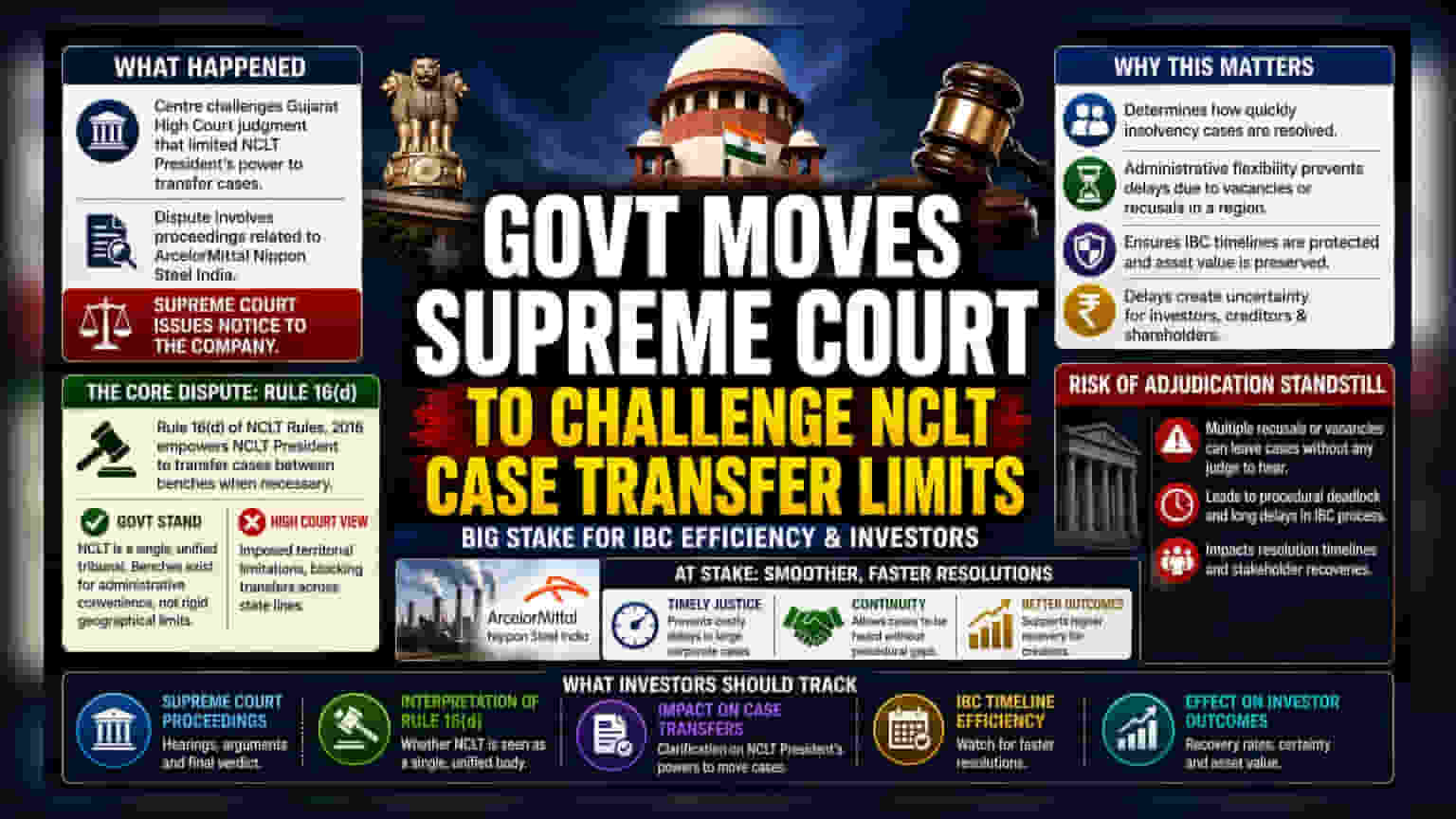


The Central government is challenging a Gujarat High Court order that restricts the NCLT President's authority to transfer cases between different benches. This legal dispute, which involves ArcelorMittal Nippon Steel India, centers on Rule 16(d) of the NCLT Rules, 2016. For investors, the final outcome is significant as it affects the speed and certainty of corporate insolvency proceedings and ensures the tribunal can function without delays caused by judicial recusals or vacancies.
What Happened
The Union government has approached the Supreme Court of India to challenge a judgment delivered by the Gujarat High Court. This judgment had previously limited the power of the National Company Law Tribunal (NCLT) President to transfer cases between different NCLT benches. The dispute involves specific proceedings related to ArcelorMittal Nippon Steel India. The Gujarat High Court had ruled that the NCLT President could not transfer cases to benches outside their specific territorial jurisdiction. The Supreme Court has now issued a notice seeking a response from the company regarding the government's plea.
The Core Dispute Over Rule 16(d)
At the center of this legal challenge is Rule 16(d) of the NCLT Rules, 2016. This rule provides the NCLT President with the discretion to transfer cases from one bench to another when necessary. The government argues that the NCLT is intended to function as a single, unified tribunal across the country, and that the various regional benches are established for administrative convenience rather than to create rigid geographical boundaries. By contrast, the Gujarat High Court's interpretation imposed a territorial limitation on these transfers, effectively blocking the movement of cases across state lines.
Why This Matters For Investors
For investors and creditors, the legal framework governing the NCLT is vital because it dictates how quickly insolvency and bankruptcy cases are resolved. When large corporate cases are stuck in legal limbo, it can lead to uncertainty for shareholders and creditors. The government argues that administrative flexibility is essential to keep the system moving. Without the power to transfer cases, if benches in a specific region face vacancies or if judges recuse themselves due to conflicts of interest, cases could be left without a hearing for extended periods. This efficiency is critical for the Insolvency and Bankruptcy Code (IBC) process, where time is often a major factor in preserving asset value.
The Risk Of Adjudication Standstill
The primary concern highlighted by the government is the risk of an adjudication standstill. If the High Court’s restriction remains in place, and multiple benches in a specific region face recusals or vacancies simultaneously, cases could effectively come to a halt. This would create a procedural deadlock where no judge is available to hear the matter, forcing a delay in the resolution process. This risk is particularly relevant in complex corporate disputes where continuity in judicial oversight is necessary to ensure fair and timely outcomes for all stakeholders.
What Investors Should Track
Investors should monitor the upcoming proceedings in the Supreme Court. The key monitorable will be the apex court’s final interpretation of Rule 16(d) and whether it validates the government’s stance that the NCLT operates as a single, unified body. A ruling in favor of the Centre would likely clarify the NCLT President’s administrative powers, providing more certainty regarding the transfer of cases and reducing the risk of procedural delays. Conversely, any sustained restriction on these transfers could imply that future cases facing regional judicial bottlenecks might encounter similar hurdles, requiring investors to account for potentially longer timelines in insolvency resolutions.