

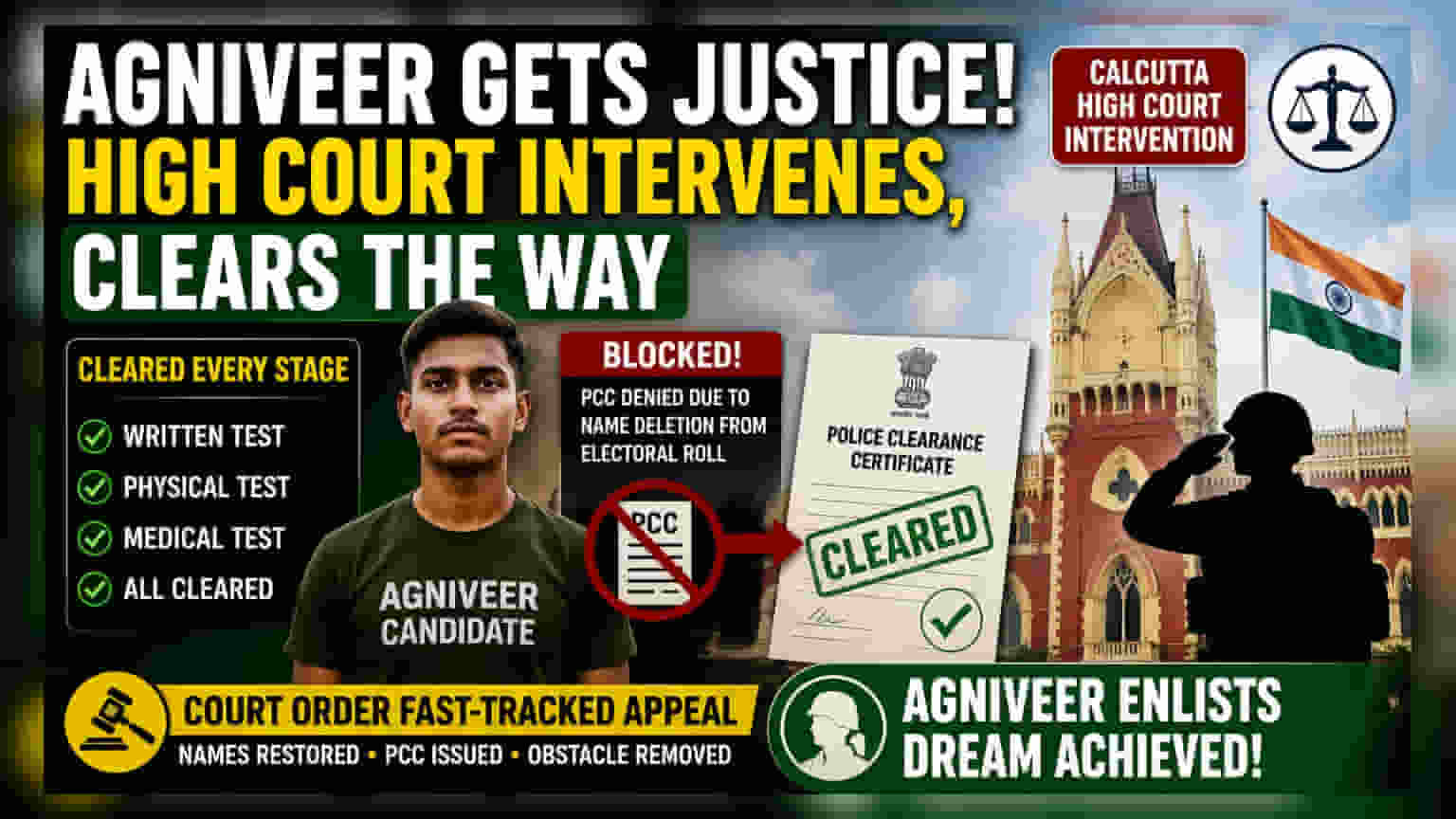
The Calcutta High Court has facilitated the entry of an Agniveer recruit into the Indian Army by resolving a dispute over his name's removal from the electoral roll. The court directed an appellate tribunal to fast-track the appeal, which cleared the way for the candidate to receive his mandatory police clearance. The case underscores how administrative delays in government records can impact critical employment timelines.
What Happened
An Agniveer candidate, Akash Sarkar, successfully secured his position in the Indian Army after receiving urgent intervention from the Calcutta High Court. The candidate had cleared all standard recruitment stages, including medical and physical evaluations, for the Agniveer (General Duty) role. However, his enlistment faced a critical roadblock when he could not obtain a fresh police clearance certificate (PCC). Local authorities had denied the request, citing the deletion of his and his father's names from the electoral roll during a government-led revision exercise in West Bengal.
The Administrative Hurdle
The denial of the police clearance certificate essentially paused the candidate's career progression. Because the deletion was part of a Special Intensive Revision (SIR) exercise, the police cited the ongoing status of the electoral record as a reason for withholding the clearance. In India, administrative processes often require clean documentation across multiple government databases. When a mismatch occurs—such as a name appearing as deleted in a voter database—it can trigger an automatic rejection of sensitive clearances like those required for military service.
How The Court Resolved The Issue
Approaching the High Court, the candidate argued that the deletion from the electoral roll, which was currently under appeal, should not prevent the issuance of a clearance certificate, noting that electoral record changes do not equate to a loss of citizenship. The state authorities maintained that they could not issue the certificate until the appeal regarding the voter list was resolved.
Justice Bivas Pattanayak intervened by directing the appellate tribunal to expedite the hearing on the appeal. Following this directive, the tribunal reinstated the names of the candidate and his father to the electoral roll on June 25, 2026. This legal step removed the obstacle, allowing the police to issue the required clearance certificate immediately thereafter.
Why This Matters For Administrative Efficiency
This incident highlights a broader reality regarding the intersection of government documentation and professional opportunities. In many sectors, including defense, security, and regulated industries, an individual's background verification is heavily dependent on the accuracy of government databases. When databases are not synced or when administrative revisions cause unexpected errors, it creates operational bottlenecks. For investors and the public, the case serves as a reminder of the critical role the judiciary plays in resolving procedural gaps that prevent qualified individuals from entering the workforce or fulfilling professional commitments.