 Whalesbook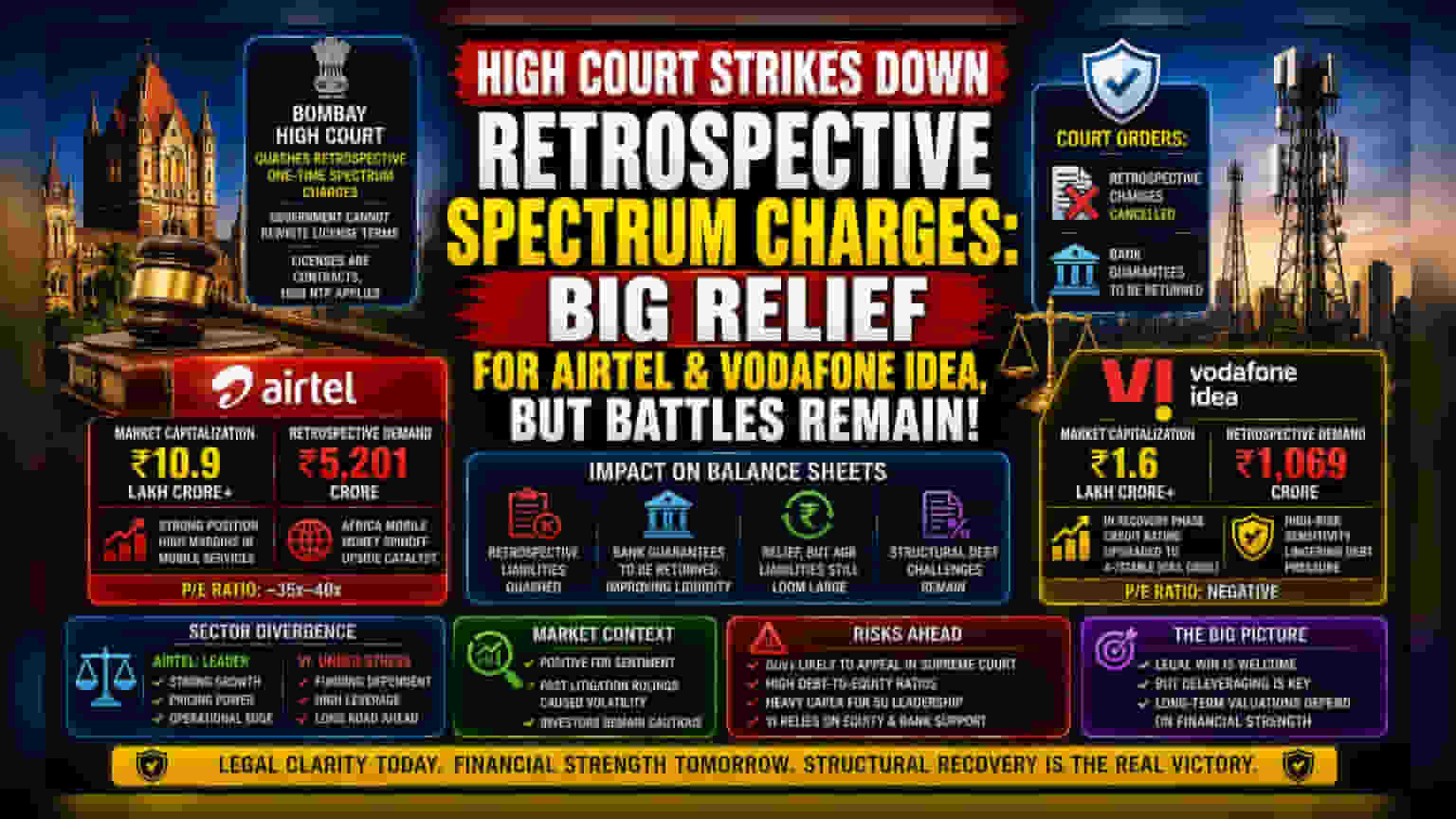


A Legal Rejection of Retrospective Policy
The Bombay High Court has issued a decisive ruling against the Department of Telecommunications, quashing retrospective one-time spectrum charges that have burdened major telecom operators for over a decade. By declaring that the government lacks the authority to unilaterally rewrite the financial terms of existing telecom licenses, the court has effectively dismantled a key pillar of past revenue maximization strategies. The judgment, delivered by a division bench, explicitly underscored that licenses are contractual arrangements, preventing the state from imposing additional levies long after the initial agreement was settled under the 1999 National Telecom Policy.
The Impact on Balance Sheets
For Bharti Airtel and Vodafone Idea, this outcome provides much-needed relief. Bharti Airtel, which recently held a market capitalization exceeding ₹10.9 lakh crore, faced a significant retrospective demand of approximately ₹5,201 crore. Vodafone Idea, navigating a more precarious financial path with a market cap of roughly ₹1.6 lakh crore, faced a similarly disruptive demand of ₹1,069 crore. Beyond the immediate cancellation of these liabilities, the court’s order to return bank guarantees provides a marginal improvement to corporate liquidity. However, institutional observers note that while this ruling clears one regulatory hurdle, it does not erase the broader, structural debt challenges—including lingering Adjusted Gross Revenue (AGR) liabilities—that continue to weigh on the sector’s long-term profitability metrics.
Sectoral Divergence and Market Context
The ruling arrives at a time when the telecom sector is witnessing a distinct split in performance. Bharti Airtel maintains a robust position, trading at a P/E ratio around 35x-40x, bolstered by high margins in its mobile services and an upcoming spinoff of its African mobile money unit. Conversely, Vodafone Idea remains in a recovery phase; despite recent credit rating upgrades to A-/Stable by agencies like ICRA and CRISIL, it continues to operate under high-risk sensitivity. While the court’s decision is fundamentally positive for industry sentiment, investors are tempering expectations. Historical precedents show that the market has often reacted with volatility to telecom litigation, as seen when previous Supreme Court rulings on AGR dues intensified financial stress for these exact players.
Risks and Structural Headwinds
Despite this legal win, the bear case for the sector persists. Regulatory and litigation risks remain high, with the government frequently appealing adverse high court decisions in the Supreme Court. Management teams at both companies face the ongoing pressure of high debt-to-equity ratios and the intensive capital expenditure requirements needed to maintain 5G leadership. Unlike competitors with stronger cash reserves, Vodafone Idea’s reliance on continuous equity infusion and bank financing makes its share price highly sensitive to any shift in legal or regulatory favor. The legal clarity provided here is an isolated victory, yet the broader requirement for structural deleveraging remains the defining constraint for future valuations.