

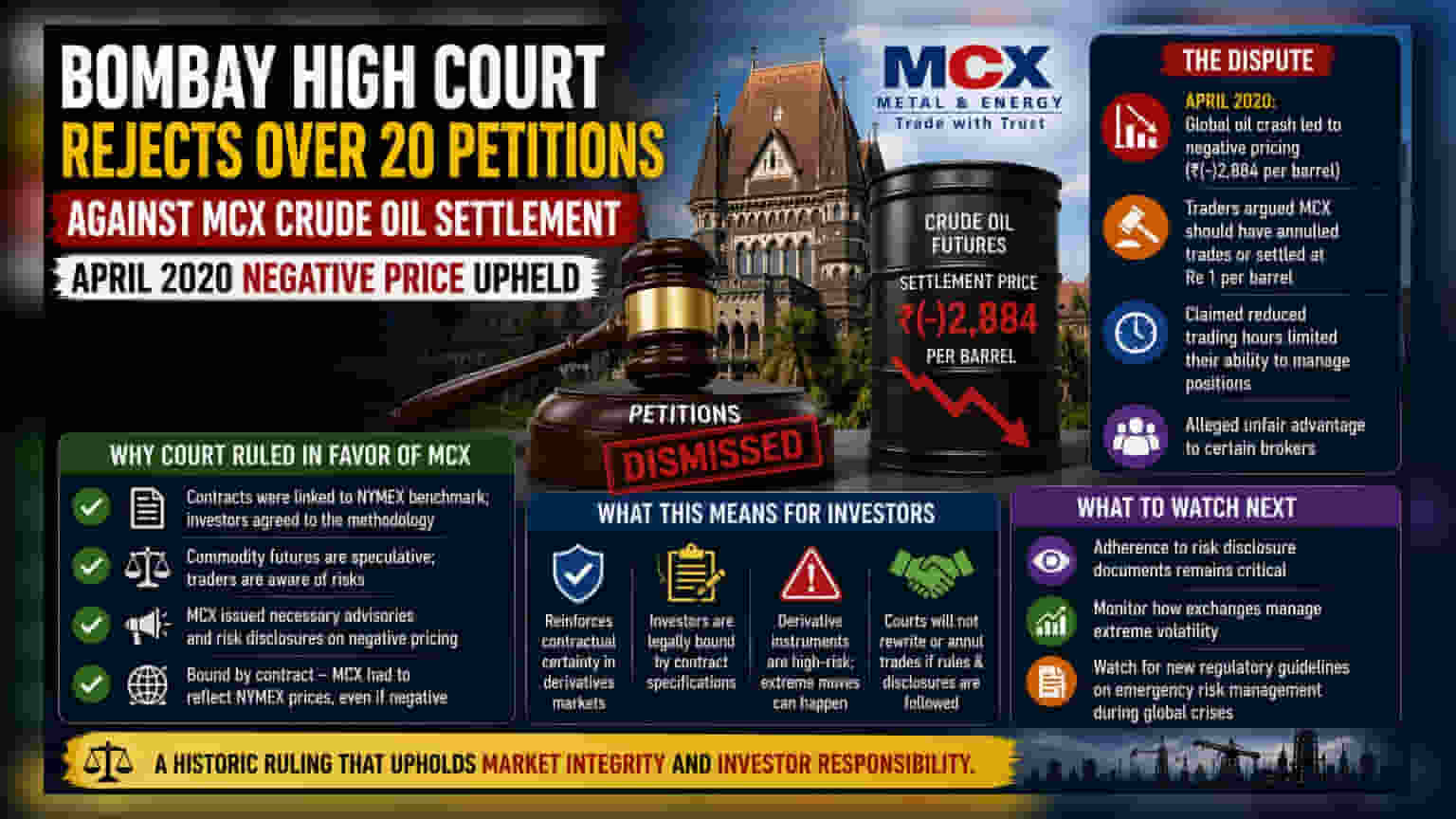
The Bombay High Court has dismissed over 20 petitions challenging the Multi Commodity Exchange’s (MCX) April 2020 settlement of crude oil futures at a negative price of Rs (-)2,884 per barrel. The court ruled that traders, having accepted the risks of NYMEX-linked contracts, are bound by the terms regardless of market volatility. This decision reinforces the legal finality of exchange-settled derivative contracts.
What Happened
The Bombay High Court has officially rejected over twenty petitions filed against the Multi Commodity Exchange (MCX) regarding the settlement of crude oil futures contracts in April 2020. The court dismissed claims from traders who sought to annul the settlement price of Rs (-)2,884 per barrel. This specific price was set during the unprecedented global oil market collapse at the start of the COVID-19 pandemic. A division bench, led by Justices R I Chagla and Advait M Sethna, ruled that the exchange acted correctly and in accordance with the contractual agreements.
The Dispute Over Negative Pricing
The legal battle centered on whether a commodity price could legally drop below zero. Petitioners, including entities like Dhanera Diamonds, argued that negative pricing was unprecedented in the 15-year history of crude oil trading on MCX. They contended that MCX should have intervened using emergency powers to annul trades or settle the contracts at Re 1 per barrel instead of allowing the negative settlement. Traders also claimed that reduced trading hours during the pandemic hindered their ability to manage their positions effectively. They suggested that the sudden price movement unfairly benefited certain brokers at the expense of other market participants.
Why The Court Ruled In Favor Of MCX
MCX and the Securities and Exchange Board of India (SEBI) argued that the crude oil contracts were explicitly linked to the NYMEX (New York Mercantile Exchange) benchmark. Investors had agreed to this methodology when entering the trades. The court found that commodity futures are speculative by nature, and traders are fully aware of the associated risks before participating. The judges emphasized that the exchange had provided necessary advisories and risk disclosures regarding the potential for negative pricing. Because the MCX contract was bound to the performance of the NYMEX benchmark, the exchange was contractually required to reflect those international prices, even if they turned negative.
What This Means For Commodity Investors
The court’s decision establishes a firm precedent regarding contractual certainty in Indian derivatives markets. It confirms that when investors participate in exchange-traded products, they are legally bound by the contract specifications, regardless of whether market conditions turn into an extreme, historical anomaly. For investors, this serves as a reminder that derivative instruments are high-risk and that contracts are designed to function even during severe market stress. The ruling clarifies that courts are unlikely to intervene to rewrite or annul trades simply because the market moves against the trader, provided the exchange followed the agreed-upon rules and disclosure norms.
What To Watch Next
The key monitorable for investors going forward is the adherence to risk disclosure documents. While this case concludes the dispute over the April 2020 settlement, it reinforces the need for investors to understand the underlying benchmarks of their trades. Investors may continue to track how exchanges manage extreme volatility and whether any new regulatory guidelines emerge regarding emergency risk management protocols during global market crashes.