

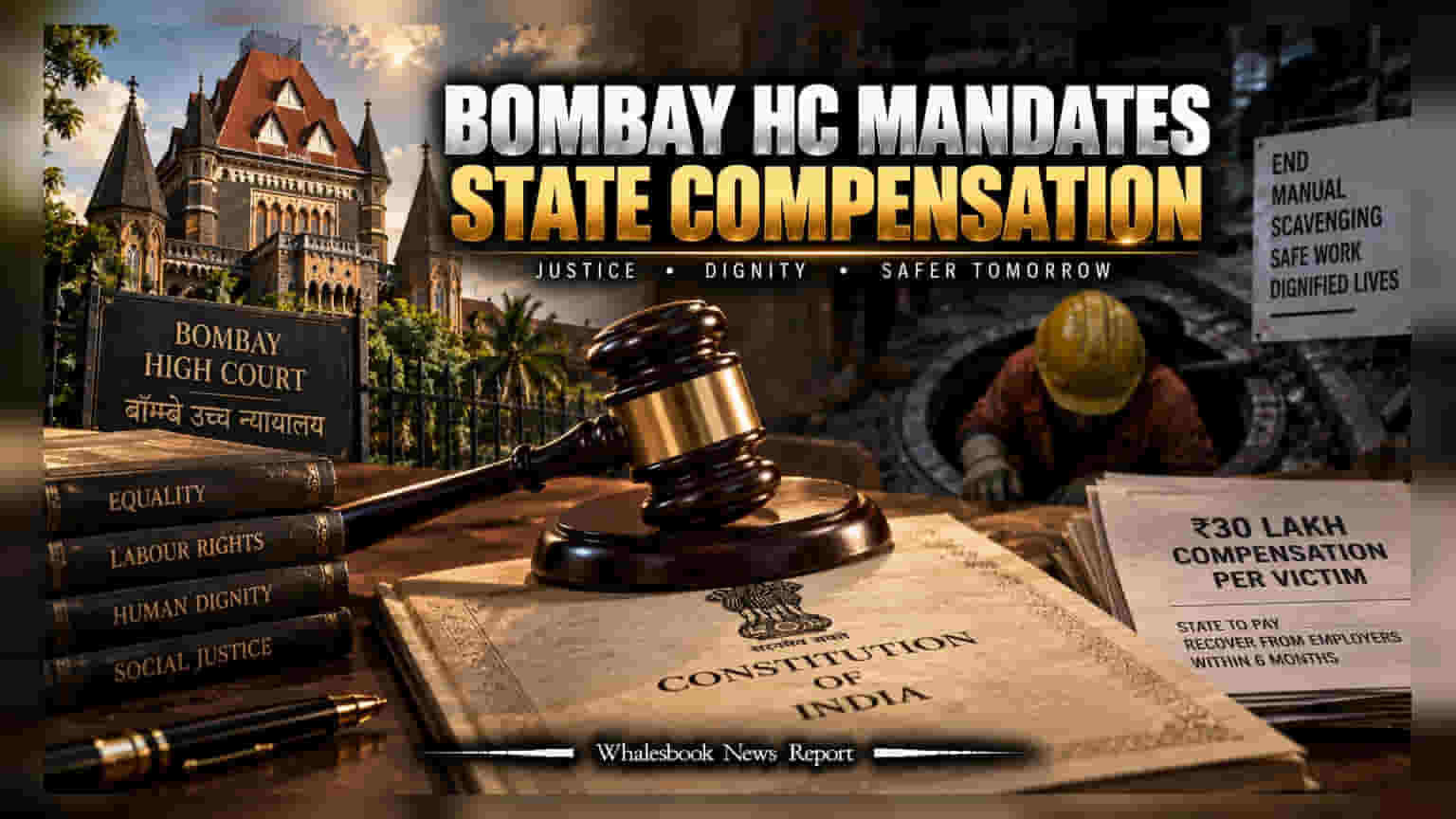
The Bombay High Court has struck down a Maharashtra government policy that shifted the liability for compensation in manual scavenging deaths to private employers. The court mandated the state to pay ₹30 lakh immediately to victims' families, retaining the right to recover funds later. This ruling reinforces state accountability for hazardous cleaning deaths under the 2013 Act.
The Bombay High Court has ruled against a long-standing practice of the Maharashtra government that assigned the financial burden of compensation for deaths during hazardous cleaning to private employers and housing societies. A division bench comprising Justices Bharati Dangre and Manjusha Deshpande has invalidated government resolutions from 2019 and 2025, which had effectively shifted this liability away from the state administration.
Under the court's new directive, the Maharashtra government is now required to assume immediate responsibility for payment. The state must disburse ₹30 lakh to the families of each deceased worker who perished during hazardous cleaning, as defined by the Prohibition of Employment as Manual Scavengers and their Rehabilitation Act, 2013. While the state is required to provide the initial payment, the ruling permits the administration to subsequently pursue recovery of these funds from the private employers or housing societies responsible for the work.
The court’s decision addresses petitions filed by the Shramik Janata Sangh, which argued that forcing private entities to pay initial compensation hindered justice for victims' families. In its critique, the bench emphasized that the state’s previous policy of shifting liability was a violation of the constitutional right to equality. The court noted that, despite scientific and technological advancements, the practice of manual scavenging persists, and the state's legal framework must ensure that the enforcement of safety laws remains a priority over administrative convenience.
This judicial intervention is significant for governance and administrative compliance. By mandating immediate payout, the court aims to ensure that families receive relief without being caught in prolonged disputes regarding liability. The ruling forces a procedural shift where the state acts as the primary guarantor of compensation, ensuring that funds are not withheld due to administrative or legal disagreements between the government and private parties.
The court has set a six-month timeline for the state government to identify all such cases and execute the payment mandate. The success of this policy will now depend on the state's ability to efficiently identify cases and follow through with its recovery mechanisms against responsible entities. Investors and policy watchers may observe this as a shift toward stricter state enforcement of the 2013 Act, which remains a critical component of the regulatory framework governing hazardous employment in the country.