

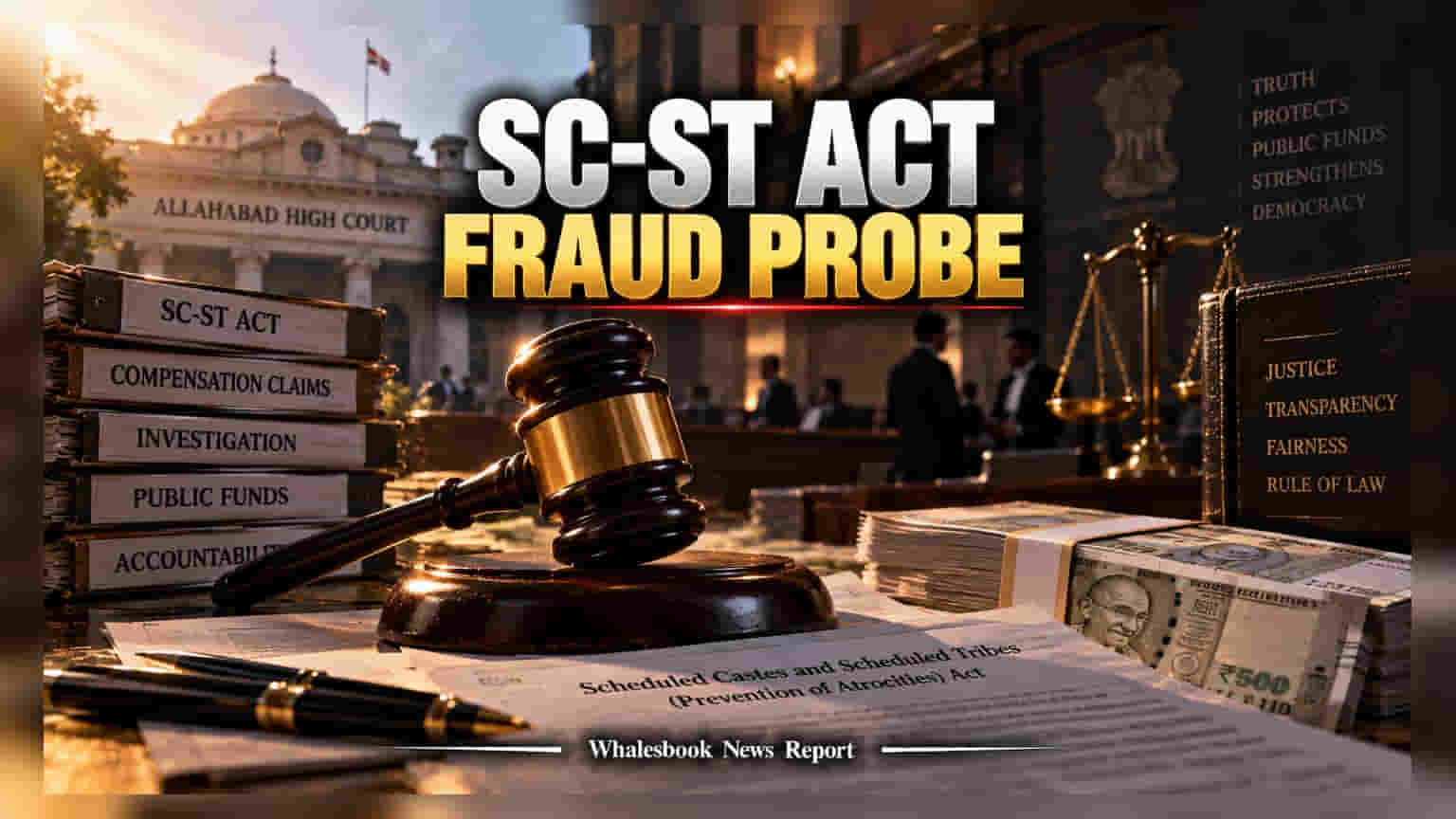
The Allahabad High Court has ordered a statewide inquiry in Uttar Pradesh into the distribution of relief funds under the SC-ST Act. This directive follows the discovery of an advocate and his family receiving over ₹23 lakh in compensation across multiple cases. The court has called for tighter administrative checks to ensure public funds are used only for genuine victims of caste-based violence.
The Allahabad High Court has directed a comprehensive investigation into the distribution of government compensation under the Scheduled Castes and Scheduled Tribes (Prevention of Atrocities) Act across Uttar Pradesh. This judicial directive aims to ensure that financial relief intended for victims of caste-based atrocities is not misused through systematic, repeated claim filings.
The court’s intervention was triggered by the case of an advocate, Santosh Kumar Dohrey, based in Jhansi. Records presented to the court indicated that the advocate and his family had collectively received ₹23.36 lakh in government relief across several criminal cases. With approximately 10 to 12 additional claims still pending, the court noted that the frequency and scale of these payouts warranted closer inspection. Justice Santosh Rai clarified that the presence of multiple claims does not automatically prove wrongdoing or fraud, but it does necessitate a rigorous verification process to protect the public exchequer.
The ruling emphasizes that while the SC-ST Act is a vital social legislation designed to provide rapid rehabilitation to victims through staged payouts—upon the registration of an FIR, the filing of a charge-sheet, and conviction—the administrative mechanism for disbursing these funds must be robust. The court has directed the Jhansi District Magistrate and the Senior Superintendent of Police to conduct a time-bound inquiry into the veracity of the claims in this specific instance, while extending the need for oversight statewide.
For the Uttar Pradesh government, the order highlights the broader challenge of managing government welfare schemes where transparency is essential. The directive serves as a push for stricter administrative and supervisory mechanisms. By mandating enhanced scrutiny of compensation claims, the court is advocating for a system where public funds are directed only toward those who are legally and genuinely entitled to support. This focus on administrative efficiency and the prevention of the misuse of public money remains a critical aspect of state governance, which observers often track as a proxy for the quality of fiscal oversight and the effectiveness of public fund management.