 Whalesbook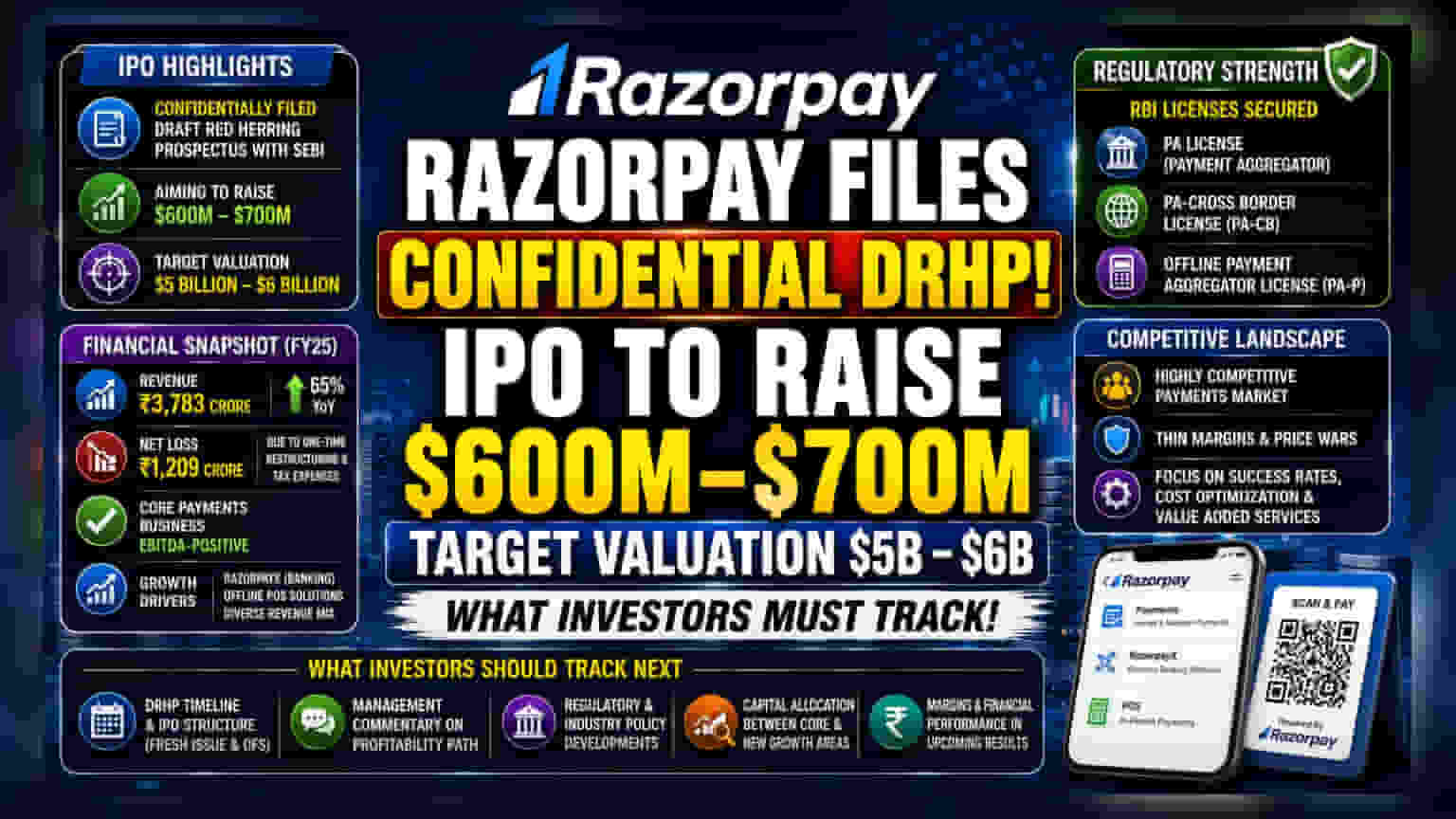


Fintech major Razorpay has confidentially filed draft IPO papers, aiming to raise $600–$700 million at a valuation of $5–$6 billion. The company reported a 65% revenue jump in FY25, highlighting its focus on scaling payments and financial infrastructure, though it remains in a loss-making position due to restructuring. Investors will watch how its move toward profitability, regulatory compliance, and intense payment sector competition shape its market debut.
What Happened
Razorpay Software has confidentially filed its Draft Red Herring Prospectus (DRHP) with the Securities and Exchange Board of India (SEBI). This confidential filing route allows the company to keep its financial details private until the formal public launch. According to reports, the fintech company is aiming to raise between $600 million and $700 million through this initial public offering. The company is targeting a valuation in the range of $5 billion to $6 billion. This move comes as the Indian primary market sees increased interest from major fintech and technology companies.
The Financial Picture
Razorpay has seen significant growth in its top line, reporting consolidated revenue of ₹3,783 crore for the financial year ending March 2025 (FY25), a 65% increase compared to the previous year. While its revenue is growing, the company reported a net loss of ₹1,209 crore for the same period. The company has clarified that this loss is largely driven by one-time expenses related to corporate restructuring and tax liabilities following its move to redomicile its operations back to India. Despite the net loss, the company’s core online payments business has turned EBITDA-positive, meaning the primary segment is generating operating profit. The firm has been diversifying its income through newer business lines like its business banking platform, RazorpayX, and its offline point-of-sale (POS) solutions.
Regulatory and Competitive Landscape
Razorpay operates in a highly competitive and regulated environment. As a key player in India's digital payments ecosystem, it has secured multiple licenses from the Reserve Bank of India (RBI), including the Payment Aggregator (PA) license, the PA-Cross Border (PA-CB) license, and the offline Payment Aggregator (PA-P) license. These authorizations are essential for operating in the Indian payment market, which is under strict regulatory oversight. The payment gateway industry faces intense competition and thin profit margins. With the rise of digital payments and UPI dominance, companies are under constant pressure to optimize costs, improve success rates, and offer value-added services to merchants to stay profitable. Investors often monitor these firms closely for their ability to manage regulatory changes and maintain stable margins amid price wars in the sector.
Why This Matters for Investors
For the broader market, Razorpay’s entry into the public domain would be a significant development, as it represents a core part of India’s digital financial infrastructure. The company’s ability to transition from a venture-funded startup to a public entity depends on several factors. While its revenue growth is strong, investors will be examining the path to sustained net profitability. The company has moved from being a simple payment gateway to a full-stack financial services platform, which adds complexity to its business model. Understanding how each of these verticals—payments, banking, and offline solutions—contributes to the bottom line will be a key area for analysis.
What Investors Should Track Next
Investors should keep an eye on several monitorables as the IPO process progresses. First, the timeline for the formal DRHP filing, where final details on the fresh issue and offer-for-sale (OFS) components will be disclosed, is crucial. Second, market participants will likely focus on management’s commentary regarding profitability, especially how they plan to offset restructuring costs and improve net margins. Third, any updates on regulatory compliance or shifts in payment industry policies will be vital, as the sector is sensitive to changes from the RBI. Finally, how the company balances its capital allocation between its mature, cash-generating payment business and its newer, high-growth segments will define its long-term financial health.