

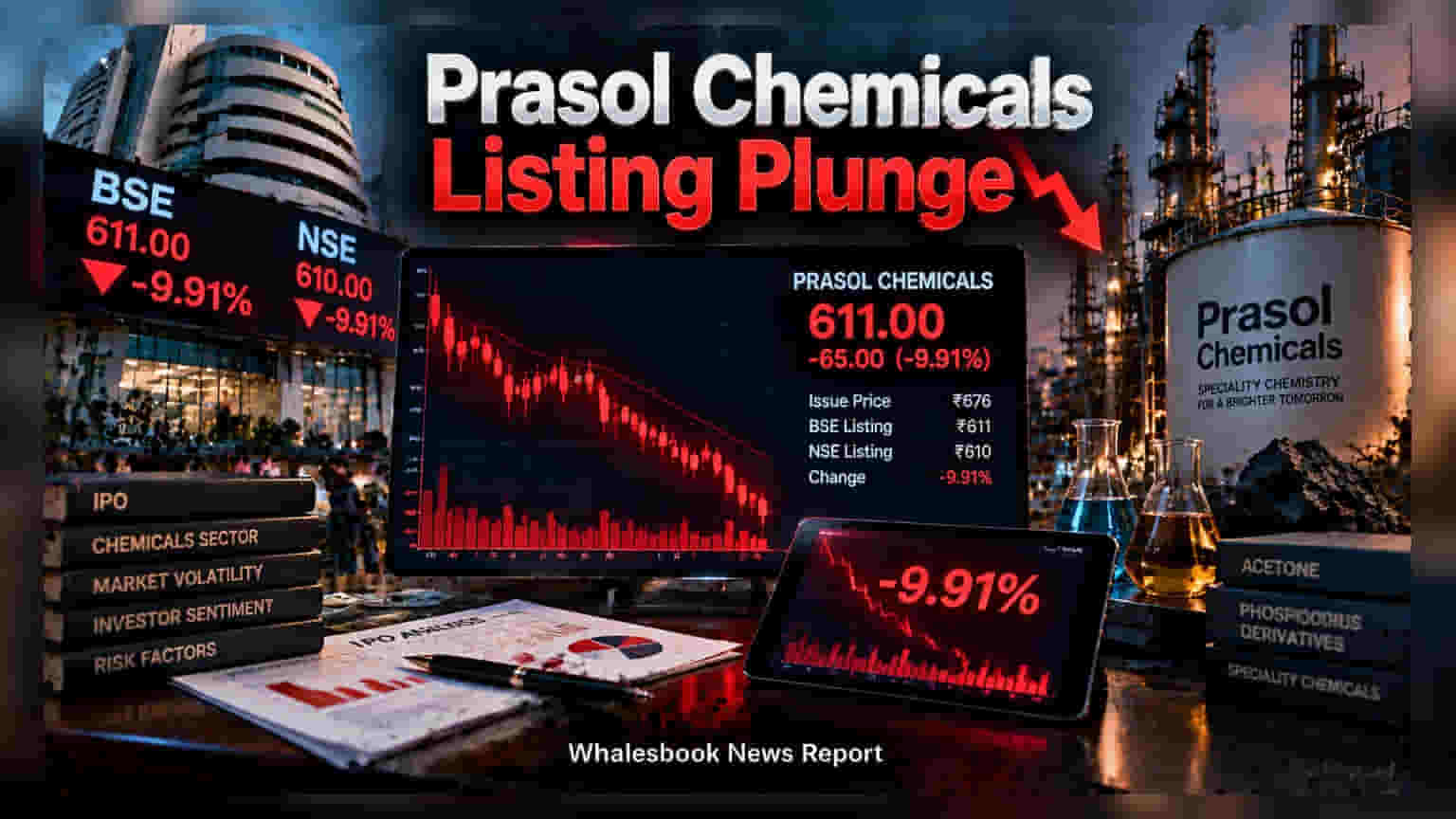
Prasol Chemicals had a weak market debut on Wednesday, September 16, opening at a nearly 10% discount to its IPO price of ₹676. The stock touched ₹611 on the BSE as investors remained cautious over its valuation and specific business risks. The company’s focus on debt reduction through IPO proceeds will be a key factor for shareholders to monitor in coming quarters.
Prasol Chemicals witnessed a disappointing market entry on Wednesday, as shares opened at a significant discount to their issue price. The stock debuted at ₹611 on the BSE and ₹610 on the NSE, marking a drop of nearly 10% against the final offer price of ₹676 per share. This weak performance reflected the cooling sentiment toward the specialty chemicals sector and concerns raised during the bidding process.
The ₹500 crore initial public offering (IPO) had garnered lukewarm interest compared to recent market favorites. Total subscription for the issue stood at 3.3 times, with qualified institutional buyers providing the bulk of the support at 7.22 times. In contrast, retail and non-institutional investor categories saw limited enthusiasm, subscribing 1.70 and 1.80 times, respectively. Market analysts had previously pointed to the IPO’s valuation—which was approximately 47 times its FY2026 earnings—as a point of contention for potential investors.
Prasol Chemicals is a manufacturer of complex chemistries, including acetone and phosphorus-based derivatives. A primary stated goal of the IPO was to utilize ₹60 crore from the fresh issue component to address outstanding debt obligations with HDFC Bank and Kotak Mahindra Bank. While debt reduction is typically viewed as a positive signal for cash flow, the market price action suggests that participants are more focused on the risks associated with the company’s business model and financial history.
Investors looking at the company should be aware of several material risks. The manufacturer is highly dependent on imported raw materials like acetone and yellow phosphorus, making its profit margins sensitive to price volatility in global commodity markets. Furthermore, the company’s financial disclosures have faced scrutiny, with auditors flagging concerns regarding internal controls in the past. As of March 2026, the company also reported significant contingent liabilities of approximately ₹109 crore, which acts as a potential burden on its financial flexibility.
Another point of concern for some market observers is the structure of the IPO itself. Of the ₹500 crore total size, ₹420 crore was part of an Offer for Sale (OFS), meaning the majority of the proceeds went to existing shareholders rather than into the company’s balance sheet for expansion. Additionally, the chemical sector faces ongoing operational risks, including the potential for safety incidents at manufacturing facilities, which can impact output and regulatory standing.
The key monitorable for investors moving forward will be the company's ability to demonstrate stability in its profit margins despite fluctuating raw material costs. Shareholders will likely focus on the upcoming quarterly results to see if the company can deliver on its growth promises and effectively manage the debt reduction plan it outlined during the IPO.