

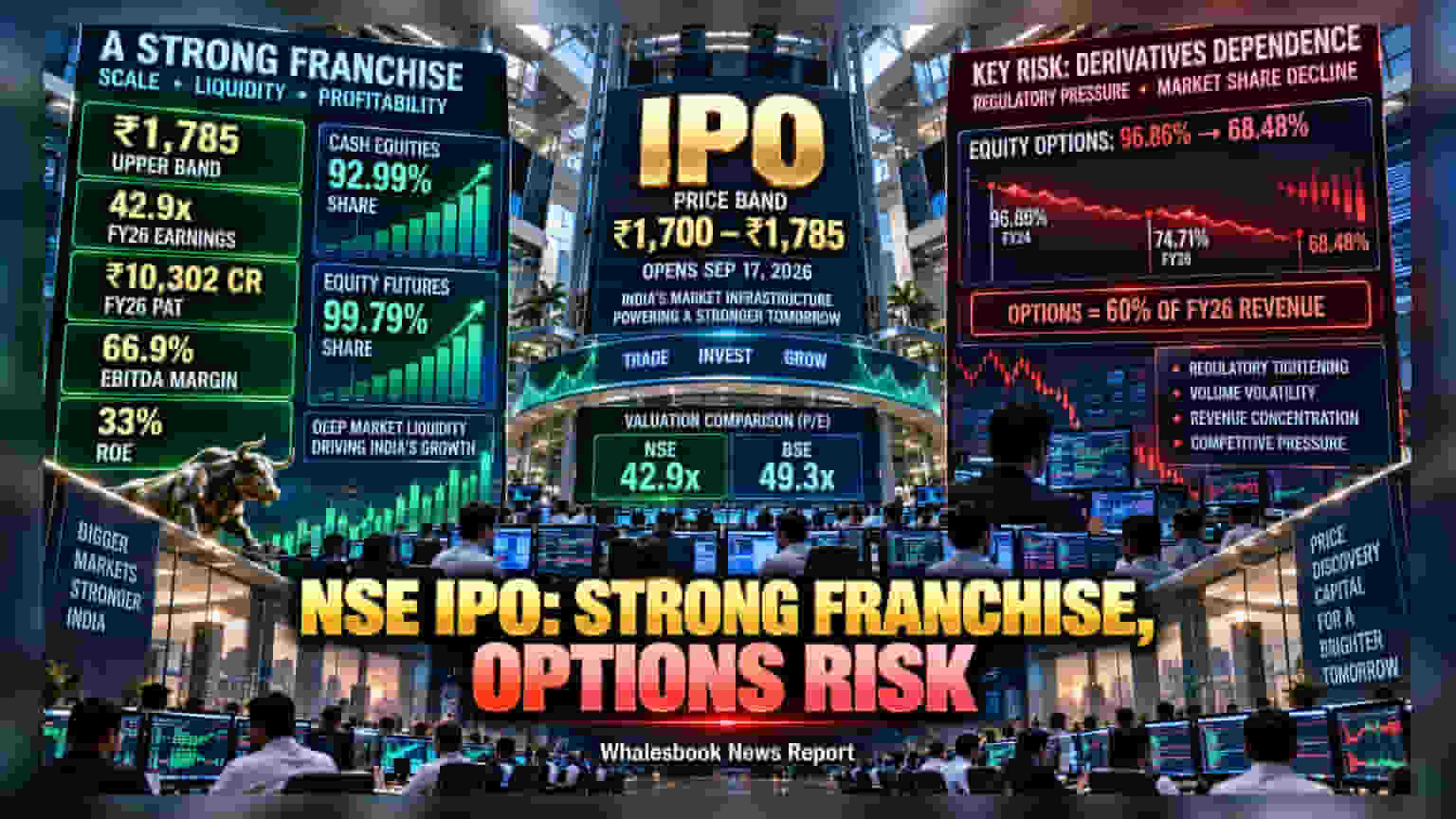
The National Stock Exchange (NSE) launches its IPO on September 17, 2026, with a price band of ₹1,700–₹1,785 per share. While brokerage firms highlight its near-monopoly in cash equities and strong financial scale, investor sentiment is balancing this dominance against a sharp decline in equity options market share and heightened regulatory scrutiny on speculative trading.
The National Stock Exchange of India (NSE) is set to open its initial public offering (IPO) on September 17, 2026, with a price band set between ₹1,700 and ₹1,785 per share. This highly anticipated listing is expected to raise between ₹21,494 crore and ₹22,569 crore, offering investors a direct stake in the country's primary trading infrastructure.
Scale and Market Dominance
Financial intermediaries and brokerages are highlighting the exchange's massive scale as its primary strength. NSE holds a near-monopoly in the cash-equity market with approximately 93% market share. Its financial performance reflects this dominance, with the company reporting consolidated revenue of ₹16,601 crore and a profit after tax (PAT) of ₹10,302 crore in FY26. While the PAT figure represented a 15.47% decline compared to FY25, the exchange remains a highly profitable franchise with an operating EBITDA margin of 66.9% and a return on equity of 33%.
At the upper price band of ₹1,785, the IPO values the exchange at approximately 42.9 times its FY26 earnings. This is notably lower than the valuation multiples observed for BSE Limited, which trades at roughly 49.3 times earnings. This valuation discount is a key point of discussion for institutional investors who are evaluating the exchange's growth potential against the backdrop of its established market position.
The Derivatives Concentration Risk
While the business model is robust, the primary concern raised by market analysts is the concentration risk within the equity options segment. This segment generated 60% of the exchange's operating revenue in FY26, making the company’s bottom line highly sensitive to fluctuations in speculative trading volumes.
Regulatory intervention is the most significant factor affecting this segment. Increased oversight designed to curb excessive retail participation in derivatives has contributed to a decline in NSE’s equity-options market share, which fell from 96.86% in FY24 to 74.71% in FY26. Investors are now closely monitoring whether the exchange can maintain its volume levels if regulations tighten further or if transaction costs increase.
Future Growth and Monitorables
Beyond transaction volumes, the company is attempting to expand its ecosystem through NSE Clearing, NSE Indices, and analytics services, which currently account for about 12% of revenue. The sustainability of the IPO valuation will likely depend on how effectively the exchange can grow these non-transaction business lines to reduce its dependence on derivatives trading.
For investors, the key monitorables moving forward include quarterly derivatives volume trends, the impact of any potential new regulatory changes, and the company's ability to diversify its revenue mix away from speculative trading segments. The IPO timeline and subscription data from retail and institutional investors will provide the first real test of market sentiment regarding these competing factors.