

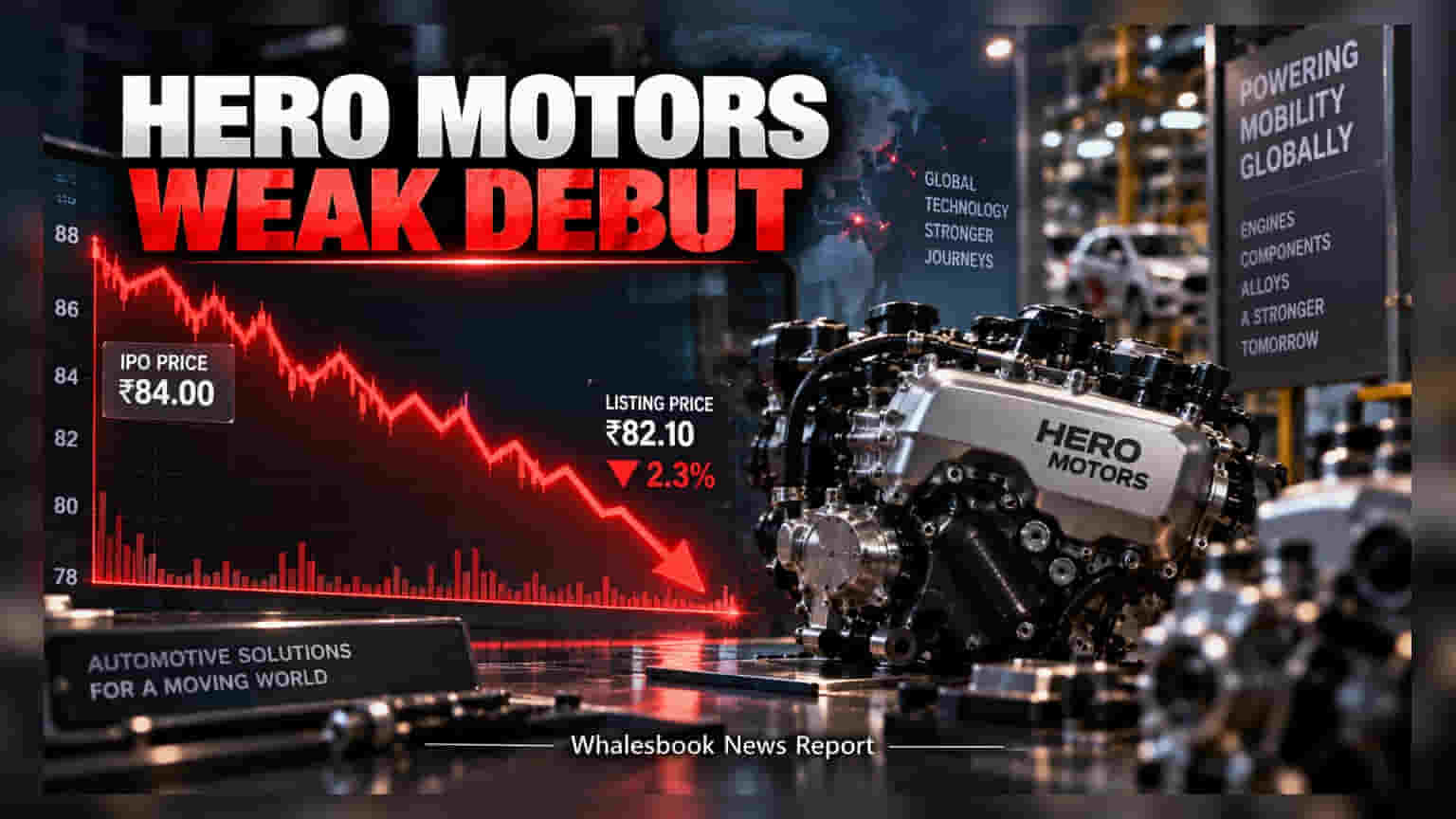
Shares of auto-tech firm Hero Motors debuted on the stock exchanges at a discount, opening at ₹82.10 against the IPO price of ₹84. Despite a 6.66x subscription, the weak listing reflects investor caution regarding valuation and sector dynamics.
Hero Motors, a company focused on automotive technology and components, saw a challenging market debut on Wednesday. The company’s stock opened at ₹82.10 on the BSE and ₹82 on the NSE, marking a 2.3% discount compared to its initial public offering (IPO) price of ₹84 per share. This performance indicates that the market remains cautious about the valuation and the near-term prospects of the company.
The IPO had concluded on September 18 with an overall subscription of 6.66 times. While retail individual investors showed moderate interest with an 8.23 times subscription, the response from institutional investors was more measured, with their portion being subscribed 1.49 times. Non-institutional investors were the most active, subscribing 9.86 times.
Hero Motors operates primarily in the powertrain solutions and alloys segments. In fiscal 2026, powertrain solutions contributed about 53.67% of the total revenue, while alloys and metallics made up the remaining 46.33%. With six manufacturing facilities spread across India, the United Kingdom, and Thailand, the company supplies components to global automotive brands, including BMW, Ducati, and Formula Motorsport. This international client base is a significant part of the company's business model.
The IPO involved a fresh issue of shares worth ₹600 crore, alongside an offer for sale by existing promoters, O P Munjal Holdings and Hero Cycle, amounting to ₹400 crore. Prior to the public subscription, the company raised ₹244.98 crore from anchor investors at the upper price band of ₹84.
For investors, the primary monitorable moving forward will be how the company utilizes the ₹600 crore of fresh capital to drive growth or reduce debt. Additionally, because the company relies heavily on global automotive clients like BMW and Ducati, its financial performance is linked to the demand cycles of the international automotive sector. Fluctuations in global vehicle production or a shift in automotive technology trends could influence future profit margins and revenue. Market participants will likely track the company's upcoming quarterly financial results and management commentary on capital spending to assess whether it can maintain its operational efficiency and client base in a competitive automotive landscape.