

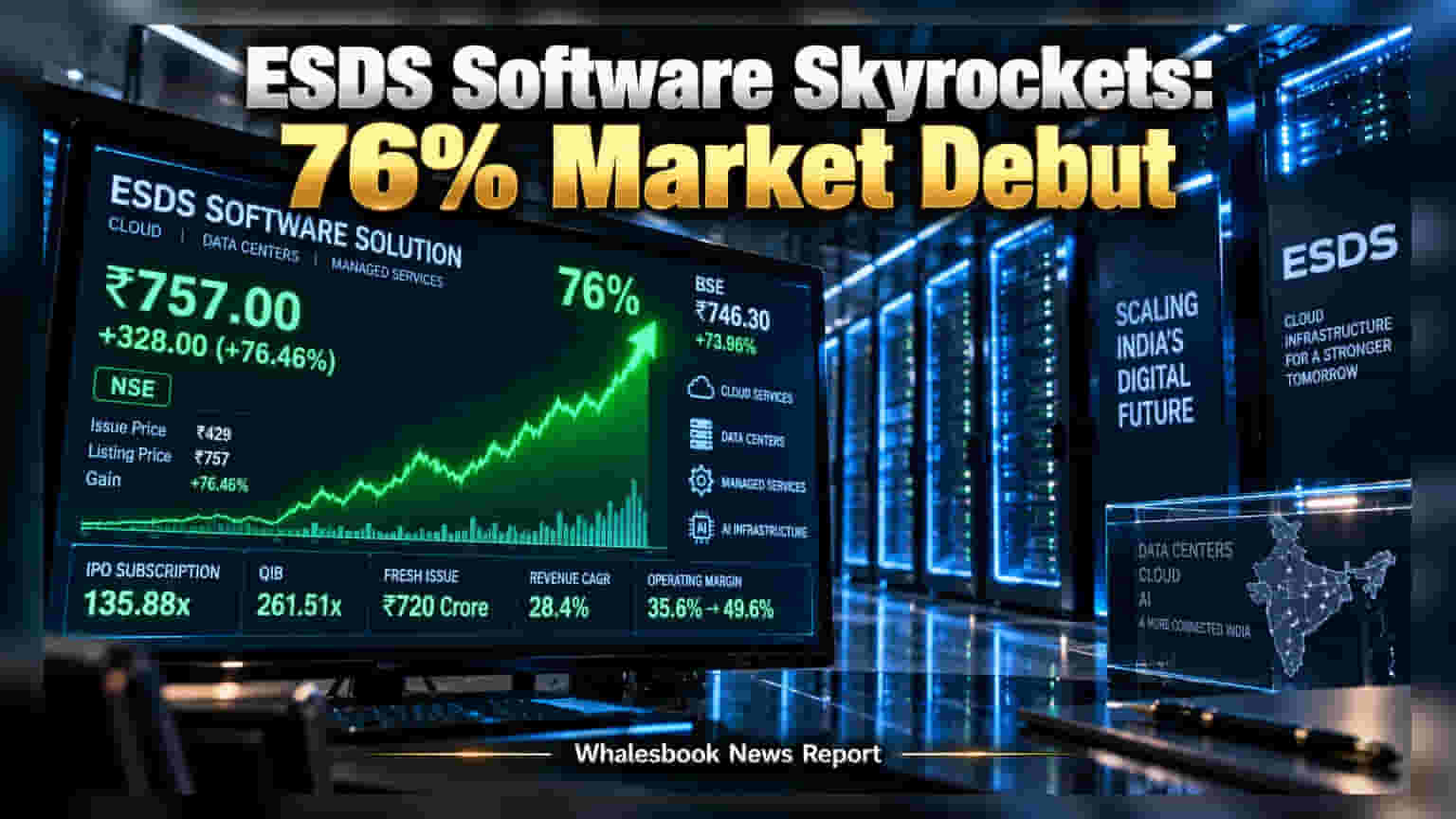
ESDS Software Solution made a strong stock market entry on Friday, with shares listing at ₹757 on the NSE—a 76.46% premium over the issue price of ₹429. The company's ₹720 crore IPO saw massive demand, subscribed 135 times. Investors are now focused on whether the company can maintain its rapid growth and high margins while scaling its cloud and AI infrastructure.
ESDS Software Solution started its stock market journey on a high note on Friday. Shares opened at ₹757 on the National Stock Exchange (NSE), delivering a 76.46% return to allottees against the issue price of ₹429. On the Bombay Stock Exchange (BSE), the stock opened at ₹746.30, marking a gain of nearly 74%.
This strong market performance follows an intense bidding period that concluded earlier this week. The IPO received immense interest from the investment community, getting subscribed 135.88 times. Qualified institutional buyers led the demand, covering their portion 261.51 times, which signaled significant confidence in the company’s business model.
ESDS operates in the cloud, managed services, and data center space, riding the wave of domestic demand for digitization. With the ₹720 crore raised through the fresh issue, the company plans to increase its data center capacity and purchase new infrastructure hardware. These funds are intended to support the company's goal of expanding its footprint in the sovereign cloud and AI infrastructure segments.
For investors examining the company's underlying strength, the recent financial data provides an important starting point. ESDS has reported a 28.4% revenue growth (CAGR) over the recent period and a significant improvement in operating margins, which climbed from 35.6% in FY24 to 49.6% in FY26. This margin expansion has been a key factor behind the investor interest during the subscription phase.
However, participants should also weigh the valuation reality against the excitement. The sharp listing-day jump has pushed the stock to a high P/E valuation, which essentially means the market is already pricing in significant future growth. As is common with stocks that list with such high premiums, there is often a phase of profit booking, where short-term traders sell their shares to secure their initial returns, which can cause stock price volatility in the coming days.
Furthermore, the cloud and data center business is capital-intensive. This means the company must continuously invest in high-cost hardware and infrastructure to stay competitive and relevant. Investors should closely track whether the company can deploy the new funds efficiently without increasing debt pressure. Maintaining these high margins will also be challenging as the sector becomes more crowded and competition in the Indian cloud infrastructure space grows.
The next important update for shareholders will be the management’s progress on the promised capacity expansion. Monitoring how these investments translate into actual revenue growth in upcoming quarterly results will be essential for understanding if the company can justify its current market valuation.