

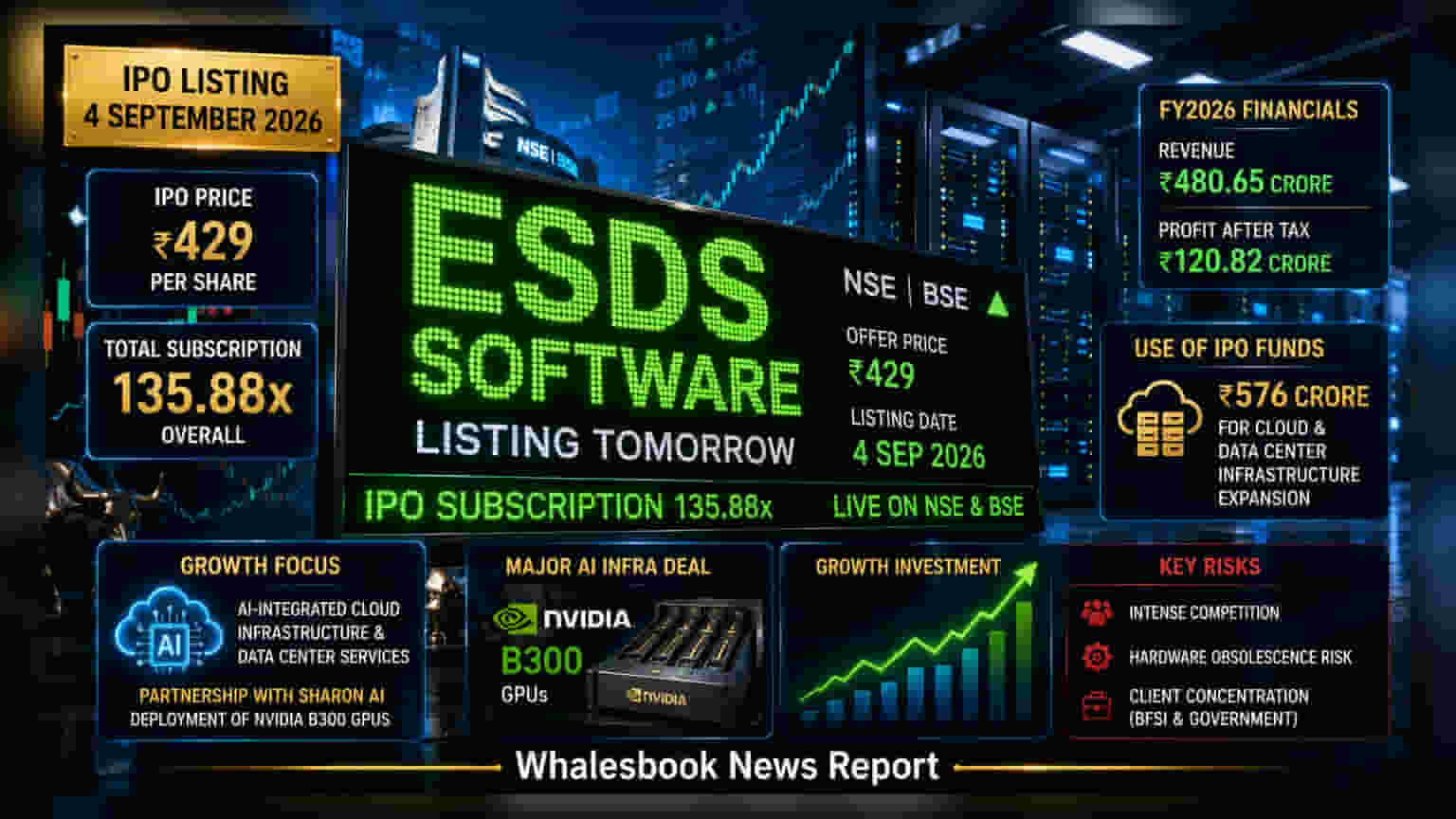
ESDS Software Solution is scheduled to debut on the stock exchanges on September 4, 2026, with an issue price of ₹429 per share. The IPO saw massive demand, subscribed 135.88 times. While the company’s focus on AI-integrated cloud infrastructure is a key growth area, investors should watch for execution challenges, high competition in the data center sector, and the actual revenue impact of its infrastructure commitments.
ESDS Software Solution is set to list its shares on the National Stock Exchange (NSE) and Bombay Stock Exchange (BSE) on September 4, 2026. The initial public offering (IPO), which concluded on September 1, 2026, was priced at ₹429 per share. The public offer drew significant interest from various categories of investors, with the total subscription reaching 135.88 times the offered amount.
For the financial year 2026, the company reported revenue of ₹480.65 crore and a profit after tax of ₹120.82 crore. These financial results provide a baseline for investors as the stock enters the secondary market for price discovery.
The company’s business strategy heavily focuses on expanding its footprint in AI-integrated cloud infrastructure and data center services. A major highlight of its recent activity is a long-term agreement with Sharon AI, which involves the deployment of NVIDIA B300 GPUs. Investors should carefully distinguish between contract size and revenue; the large value often cited regarding this deal refers primarily to committed costs and infrastructure obligations. Understanding this distinction is important to assess the company’s actual cash flow and profit potential.
To drive future growth, the company plans to use ₹576 crore from the funds raised in the IPO specifically for expanding its cloud computing and data center infrastructure. This heavy spending on hardware and data capacity is central to its plan to compete with larger, established global and domestic rivals.
Despite the strong subscription numbers, the business faces several challenges. The cloud and data center sector is marked by intense competition and the need for continuous investment. Because the industry moves quickly, hardware technology can become outdated in a short period, creating a risk of frequent obsolescence. Furthermore, the company has a high concentration of business from specific sectors, such as banking, financial services, insurance (BFSI), and various government contracts. Any slowdown in spending from these specific clients or delays in executing large projects could affect the company’s revenue stability. Investors may watch how the stock price moves post-listing and how management balances its ambitious infrastructure expansion with operational risks in the coming quarters.