

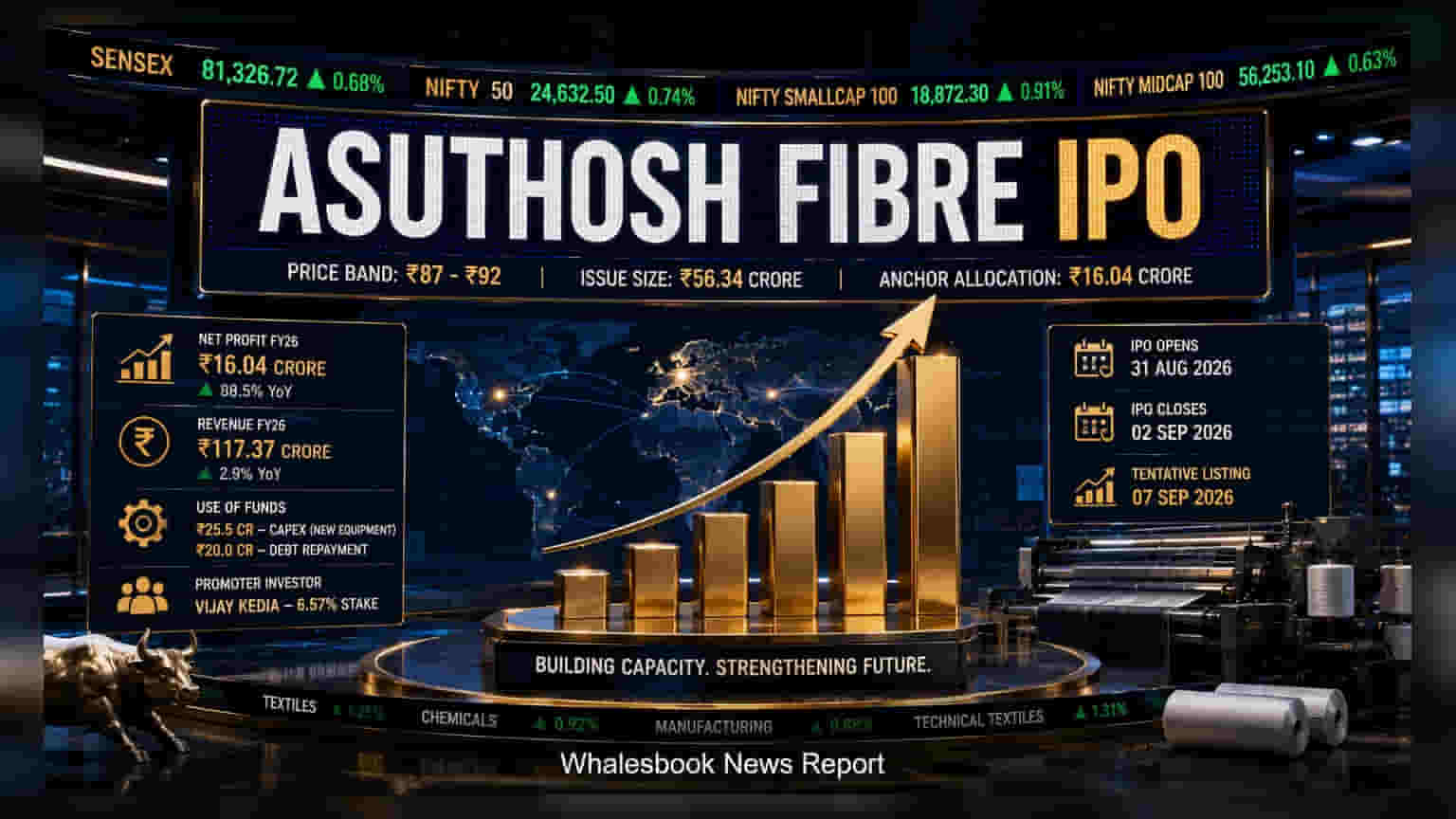
Technical textile maker Asuthosh Fibre has secured Rs 16.04 crore from five anchor investors at Rs 92 per share. The company is set to launch its Rs 56.34 crore IPO for subscription between August 31 and September 2, 2026. Funds will be directed toward machinery upgrades and debt repayment.
Asuthosh Fibre, a technical textile manufacturer based in Gujarat, has successfully secured Rs 16.04 crore from institutional investors. This anchor allocation was finalized on August 28, 2026, ahead of the company’s Rs 56.34 crore initial public offering (IPO). The shares for these participants were allotted at Rs 92 each, which represents the upper limit of the company's price band of Rs 87 to Rs 92 per share.
The public subscription for the IPO is scheduled to open on August 31 and will close on September 2, 2026. The company’s pre-IPO cap table has drawn interest from market observers due to the presence of veteran investor Vijay Kedia, who holds a 6.57% stake in the firm. Investors typically watch such associations to understand the long-term confidence in the company’s operational direction.
Financial performance for the fiscal year ended March 2026 shows a sharp increase in profitability. The company reported a net profit of Rs 16.04 crore, up 88.5% from the previous year’s Rs 8.5 crore. During the same period, revenue grew by 2.9% to Rs 117.37 crore. The management has outlined a clear plan for the fresh capital: Rs 25.5 crore is earmarked for purchasing new manufacturing equipment to expand capacity, and Rs 20 crore will be utilized for debt repayment to improve the balance sheet.
While the company is expanding, investors should be aware of specific business risks. Asuthosh Fibre operates as a single-segment manufacturer, which makes it vulnerable to supply chain issues within the technical textile sector. A major risk factor is customer concentration; the business relies on a limited number of buyers, meaning the loss of a key client could significantly impact revenue. Furthermore, the company does not have long-term contracts for its raw materials. With raw materials accounting for roughly 68.5% of total expenses, the business is exposed to price volatility, which can put pressure on profit margins if costs rise suddenly.
Additionally, the company deals with operational risks linked to export-obligation schemes. Failure to meet the targets set under these schemes can lead to financial penalties, which could affect cash flow. Investors should monitor how the company manages these costs and customer relationships as it scales up. Following the subscription period, the next key update for the company will be its stock market listing, which is tentatively expected around September 7, 2026.