

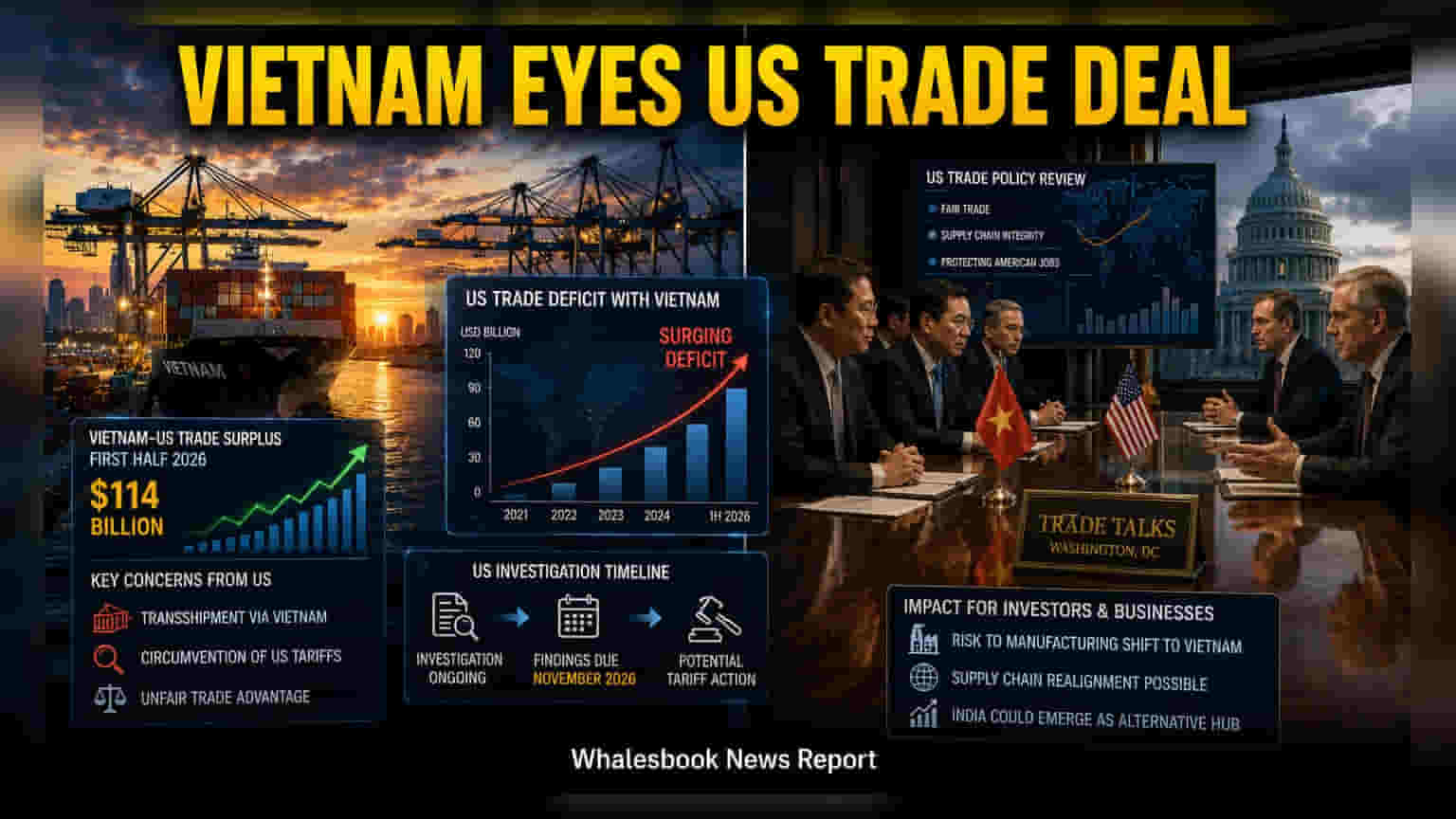
Vietnam is negotiating to resolve trade disputes with the US to avoid potential new tariffs. With investigations into trade practices and the routing of Chinese goods due in November, companies in Vietnam face supply chain uncertainty. This situation is significant for investors monitoring the 'China+1' manufacturing shift and potential impacts on competing export hubs like India.
Vietnam’s Deputy Prime Minister Nguyen Van Thang is in Washington this week to restart talks on a trade agreement with the United States. The goal is to address US concerns regarding trade practices before the results of ongoing investigations are released in November 2026. This situation has created uncertainty for multinational companies that have moved manufacturing operations from China to Vietnam.
The core of the issue lies in US government investigations into Vietnam’s trade practices. American officials are particularly concerned about 'transshipment,' a practice where goods manufactured in China are routed through Vietnam to avoid existing US tariffs. US regulators argue that this obscures the origin of the products and gives Vietnam an unfair trade advantage. In the first half of 2026 alone, Vietnam recorded a trade surplus of $114 billion with the US, a figure that has drawn significant scrutiny from Washington.
The pressure on Vietnam is mounting as the US reviews its trade policies. If investigators conclude in November that Vietnam is violating trade rules or allowing illegal routing of goods, the US could impose punitive tariffs. Such a move would be a major setback for companies that have invested heavily in Vietnam as a reliable alternative to China. These companies, including global electronics and manufacturing firms, rely on stable trade terms to export finished goods to the American market.
For Indian investors, these developments carry important implications. Vietnam and India are often seen as the two primary destinations for global companies looking to diversify their supply chains away from China. If Vietnam becomes a riskier location for manufacturing due to potential US tariffs or stricter trade monitoring, global companies may re-evaluate their expansion plans.
This shift in the global trade environment could impact India in two ways. On one hand, if international companies seek more stable environments, India’s push to become a global manufacturing hub could gain momentum. On the other hand, a sudden disruption in a major regional trade partner can signal broader volatility in global export markets, which often affects emerging economies.
Investors should monitor the findings of the US trade investigation due in November. The outcome will likely dictate whether Vietnam maintains its status as a preferred manufacturing hub or if trade barriers will force a reshuffling of supply chains in Southeast Asia. The focus for businesses and observers will be on any new commitments from Hanoi to tighten border controls and prove that goods exported from the country are genuinely Vietnamese-made.