

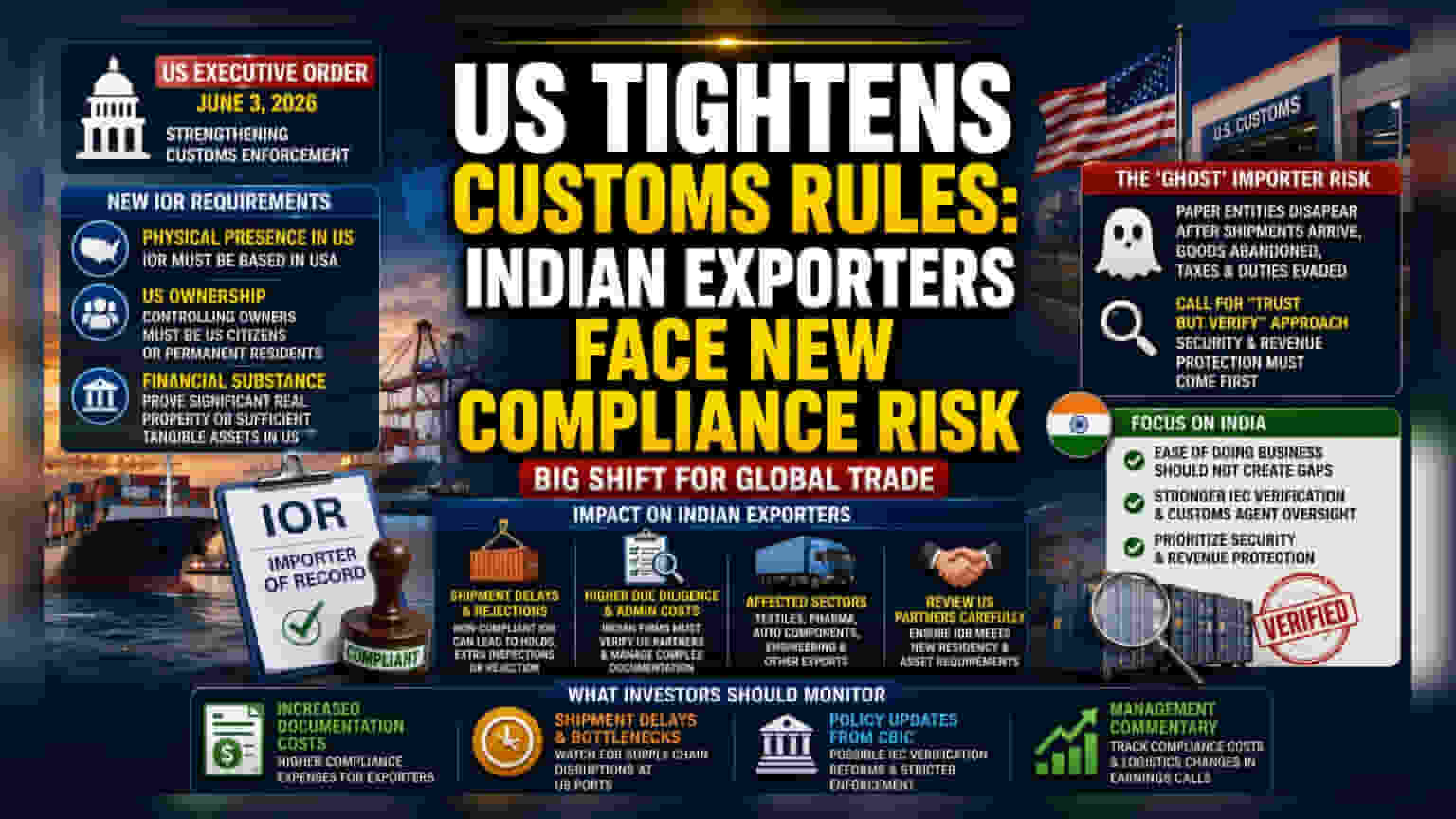
The US has introduced strict new requirements for Importers of Record, mandating local presence and asset proof to combat customs loopholes. For Indian businesses, this implies a need for tighter compliance checks and potential delays for goods entering the US market. The move has also sparked a debate about whether India’s current customs administration should strengthen verification to address the issue of 'ghost' importers.
What Happened
On June 3, 2026, the United States government issued an executive order focused on strengthening customs enforcement. The directive introduces much stricter rules for the Importer of Record (IOR), which is the party responsible for ensuring imported goods comply with all local laws, duties, and safety regulations.
Under the new requirements, an IOR must now prove a physical presence in the US. For entities, the IOR must be based in the US, with controlling owners who are US citizens or permanent residents. Furthermore, these entities are required to demonstrate that they possess significant real property or sufficient tangible assets within the country. The US move is designed to ensure that the entity handling imports is accountable and capable of paying duties, rather than being an offshore shell company that can evade responsibility.
The Impact On Indian Exporters
This development directly affects Indian companies that export physical goods to the US, such as textile, pharmaceutical, auto component, and engineering firms. Historically, many Indian exporters have relied on US-based partners or third-party logistics providers to act as the IOR for their shipments.
If the US partner or the IOR used by the Indian exporter does not meet the new residency or asset requirements, the shipments could face significant delays, extra inspections, or even rejection at US ports. Indian businesses may now need to conduct more thorough due diligence on their US counterparts to ensure they comply with these new rules, which could lead to higher administrative costs and more complex documentation processes for export transactions.
The 'Ghost' Importer Risk
The US initiative has drawn attention to customs practices in other countries, including India. There is a growing debate about whether the push for 'ease of doing business'—which has prioritized faster clearance and lower paperwork—might have inadvertently created gaps in security.
One specific concern is the issue of 'ghost' importers in India. These are entities that exist on paper but often disappear once shipments arrive, leaving goods abandoned at ports and evading tax or regulatory inquiries. Currently, the system relies on cross-verification between tax databases and identification documents. Critics and industry observers, including former CBIC Chairman Najib Shah, have suggested that while facilitating trade is important, it should not come at the cost of strict verification. There is a call for adopting a 'trust but verify' approach where security and revenue protection are prioritized before goods are allowed to enter the trade channel.
What Investors Should Monitor
Investors should keep an eye on how these global customs shifts affect Indian sectors that are heavily dependent on US exports.
Key monitorables include:
- Potential for increased documentation costs for Indian export-oriented companies.
- Any signs of shipment delays or supply chain bottlenecks for Indian goods arriving in the US.
- Future policy updates from the Central Board of Indirect Taxes and Customs (CBIC) regarding import-export code (IEC) verification or stricter oversight of customs agents.
- Management commentary from export-heavy companies on whether they are seeing higher compliance costs or changes in their logistics arrangements due to these new US regulations.