 Whalesbook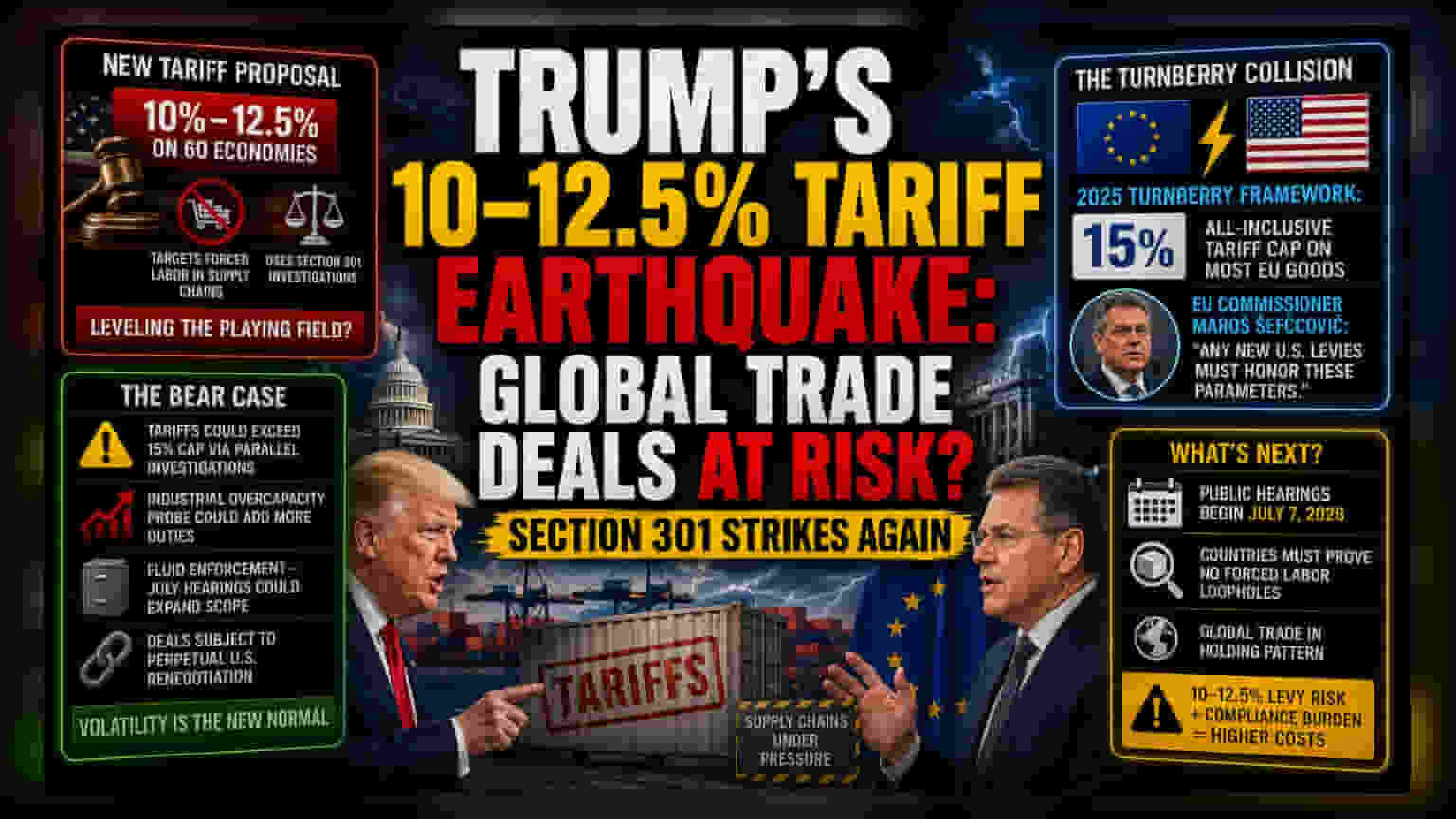


The Catalyst: Section 301 and Supply Chain Enforcement
The Trump administration has launched an aggressive trade maneuver, proposing new tariffs ranging from 10% to 12.5% on 60 economies. This action, driven by findings from Section 301 investigations into forced labor, targets countries the U.S. deems insufficient in policing their import supply chains. The U.S. Trade Representative’s office argues that this regulatory failure creates an unlevel playing field, burdening American commerce. However, the move is widely viewed as a mechanism to rebuild tariff pressure following the February 2026 Supreme Court ruling that invalidated previous blanket "reciprocal tariffs."
The Turnberry Collision Course
The proposed duties create immediate friction with the 2025 "Turnberry" framework agreement between the U.S. and the European Union. That pact, intended to provide a predictable trade floor, capped tariffs on most EU goods at an all-inclusive 15%. Brussels has maintained a firm stance, with Trade Commissioner Maroš Šefčovič asserting that any new U.S. levies must honor these parameters. The technical complexity arises because the U.S. views the new forced labor duties as separate from the original framework, while the EU—and other key partners like Japan—argue that any cumulative tariff rate exceeding 15% constitutes a breach of the negotiated deal.
The Forensic Bear Case: Structural Vulnerability
Investors should note that these investigations carry risks beyond immediate import costs. First, the enforcement mechanism remains fluid; public comments and hearings scheduled for July could alter the scope, yet the underlying administration strategy is clearly aimed at circumventing previous judicial constraints. Second, while the EU and Japan have secured commitments to protect their industries, the U.S. simultaneously maintains a separate, ongoing investigation into industrial overcapacity. Analysts warn that a final ruling in that parallel probe could be combined with forced labor duties to push effective tax rates well beyond existing caps. Unlike competitors that operate within more stable regulatory environments, companies reliant on trans-Atlantic supply chains face a volatile landscape where "deals" are subject to perpetual renegotiation via administrative law.
Future Outlook and Market Reaction
The U.S. administration is effectively using labor standards as a tool for economic leverage, a move that provides a defensive legal facade against domestic trade courts. With hearings starting July 7, 2026, the global trade community remains in a holding pattern. While the administration claims it can accommodate existing agreements, the reality is a fragmented trade architecture. For multinational corporations, the risk is not just the potential 10%–12.5% levy, but the administrative burden of demonstrating compliance to avoid these tariffs entirely. Guidance from Washington suggests that unless countries can prove they have effectively closed loopholes for forced labor goods, the "unlevel playing field" rhetoric will continue to dictate U.S. trade posture.