

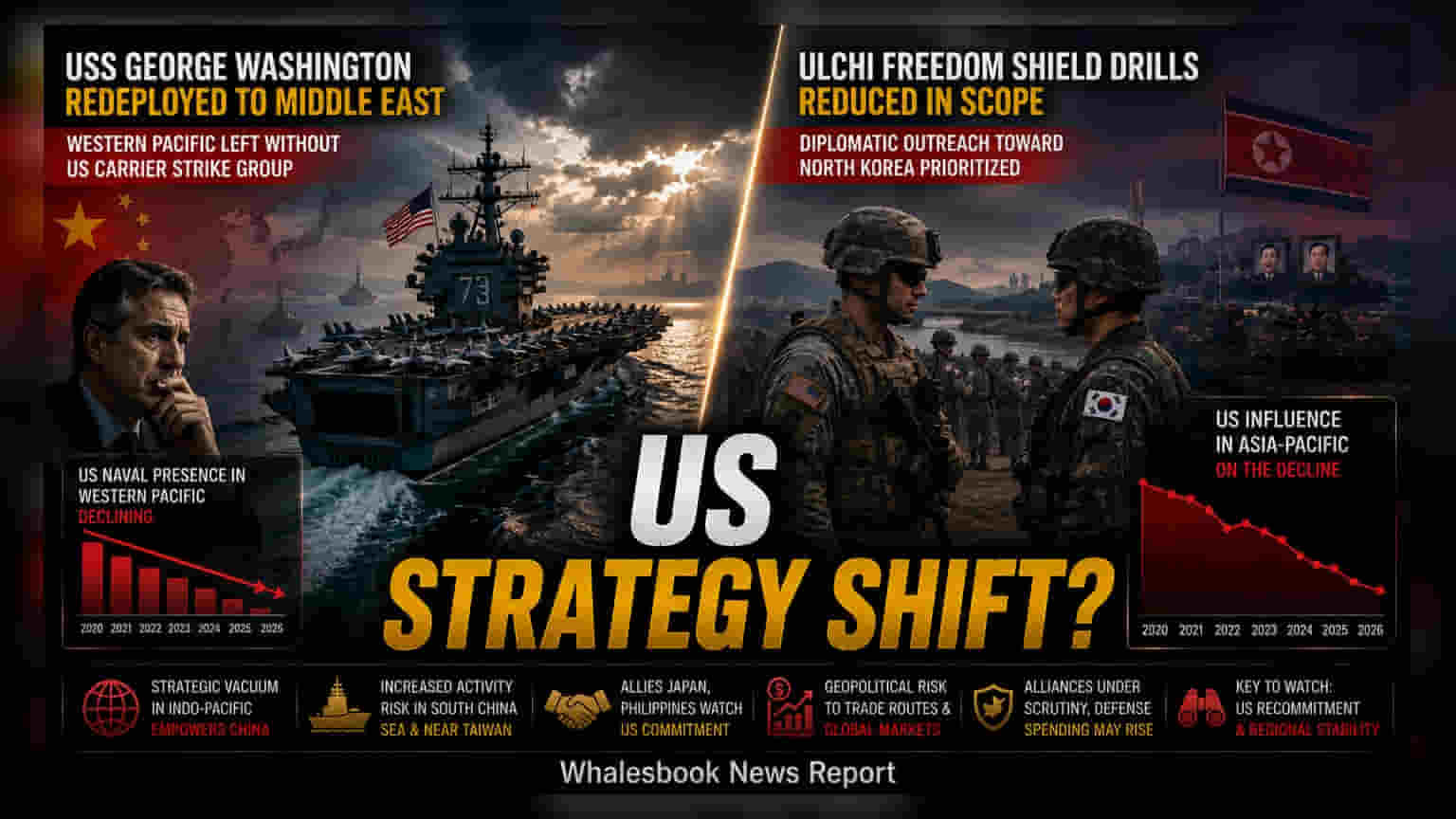
The US has redeployed the USS George Washington to the Middle East, leaving the western Pacific temporarily without a carrier, while also cutting short military drills with South Korea. These strategic shifts have raised concerns among analysts about a potential security vacuum in the Indo-Pacific, impacting regional stability and alliance reliability.
The United States is recalibrating its global military posture, a move that has significant implications for security and stability in the Indo-Pacific region. The USS George Washington, the last US aircraft carrier operating in the western Pacific, is being redeployed to the Middle East. It will replace the USS Abraham Lincoln, which has been engaged in long-term operations against Iran. This relocation leaves the western Pacific region without a US carrier strike group for the time being, marking a major departure from the strategic focus on this area.
Simultaneously, the administration has ordered a reduction in the scope of the Ulchi Freedom Shield military exercises with South Korea. These joint drills, which were scheduled to continue for several more days, are now being cut short. Official reports suggest this decision stems from disagreements regarding South Korea’s support for US operations in the Iran conflict, alongside President Donald Trump’s distinct diplomatic approach toward North Korean leader Kim Jong Un, whom he has previously praised.
These policy adjustments have sparked intense debate among security analysts and regional observers. The primary concern is the creation of a strategic vacuum in the Indo-Pacific. With the US military presence scaled back, experts warn that regional adversaries, particularly China, may feel emboldened to increase their activity in the South China Sea and near Taiwan. The uncertainty surrounding US military commitment is also reverberating through other key alliances. Partners such as Japan and the Philippines, which rely heavily on US defense guarantees, are monitoring these developments closely to see how they might affect their own security arrangements.
From an investor and economic perspective, this shift introduces a layer of geopolitical risk for the Asia-Pacific region. Trade routes passing through the South China Sea are vital to the global economy. Any increased tension or instability in these waters could disrupt supply chains or impact shipping insurance and logistics costs. Furthermore, if key allies perceive the US as an unreliable security partner, it may trigger an acceleration in regional defense spending or, in extreme scenarios, fuel debates about the need for independent nuclear capabilities to deter potential threats.
The long-term impact of these maneuvers will likely depend on how quickly the US can restore its naval presence in the Pacific and how it manages relationships with its treaty partners. For now, market participants and policy observers are tracking the potential for rising tensions in Asia. The stability of existing alliances and the ability of the US to maintain a balanced deterrent against both Pacific and Middle Eastern threats remain the key areas to watch in the coming months.