

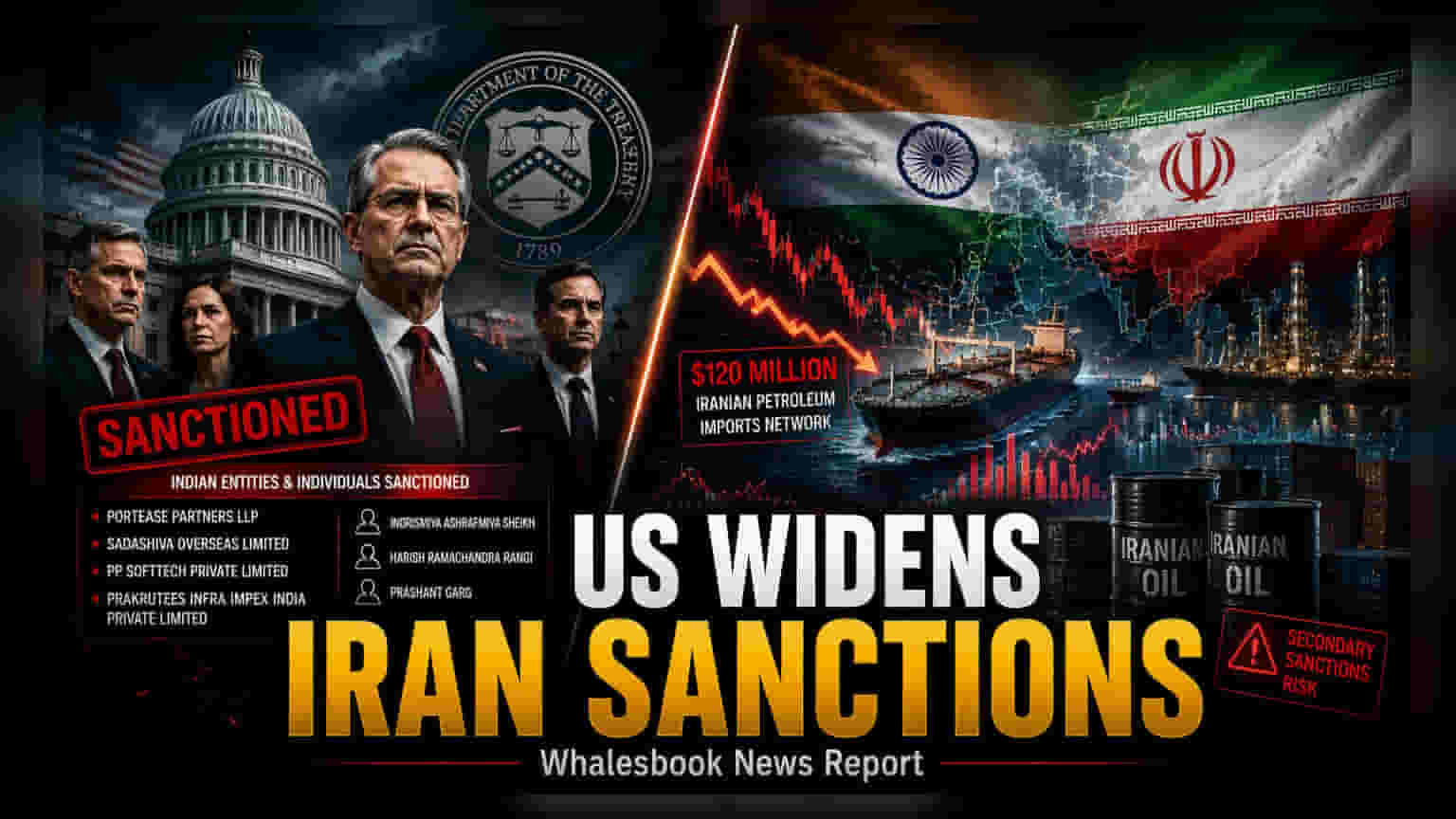
The U.S. Treasury has sanctioned four Indian companies and three individuals under its 'Operation Economic Outcast' for allegedly facilitating $120 million in Iranian petroleum trade. These designations aim to cut off revenue streams for Tehran. While the targeted entities are unlisted private firms, the move highlights increasing compliance risks for Indian businesses involved in high-risk cross-border trade.
The U.S. Department of the Treasury launched a significant enforcement campaign on August 24, 2026, designated as 'Operation Economic Outcast,' aimed at dismantling Iran’s revenue networks involving oil, petrochemicals, and shipping. As part of this action, the U.S. government placed sanctions on four Indian entities and three Indian nationals, alleging their participation in the import and movement of Iranian petroleum products valued at approximately $120 million.
The sanctioned entities include Portease Partners LLP, which the U.S. identified as a customs broker, along with Sadashiva Overseas Limited, PP Softtech Private Limited, and Prakrutees Infra Impex India Private Limited. Additionally, three Indian nationals—Indrismiya Ashrafmiya Sheikh and Harish Ramachandra Rangi, both associated with Portease Partners, and Prashant Garg, a director at PP Softtech—were named in the designation.
It is important for Indian market participants to note that these designated entities are private, unlisted companies. Consequently, there is no direct impact on the Indian stock market or listed companies on the NSE or BSE. However, the action serves as a broader signal regarding the U.S. administration's stance on international trade with high-risk jurisdictions.
For investors and Indian businesses, the primary concern lies in the potential for 'secondary sanctions.' When the U.S. targets specific entities, the goal is to cut them off from the U.S. dollar-based financial system. This effectively prohibits U.S. persons or companies from engaging in transactions with these entities. More importantly, global financial institutions often avoid dealing with sanctioned parties to maintain their own access to the U.S. banking system. This can lead to increased scrutiny for other Indian firms in the export, import, logistics, and commodity sectors that maintain trade relationships with sanctioned regions.
The U.S. Treasury’s latest move suggests a shift toward a more aggressive enforcement strategy, targeting intermediaries like customs brokers and trading firms rather than just primary producers. This strategy, as outlined by Treasury Secretary Scott Bessent, aims to disrupt the financial lifelines supporting Iran. For Indian companies involved in trade with sensitive regions, the development underscores the need for rigorous compliance and 'Know Your Customer' protocols to avoid inadvertent exposure to sanctions risk.
While the direct impact is confined to the listed entities and individuals, the broader diplomatic and trade context remains a point of interest. Relations between India and the U.S. have occasionally faced pressure over trade policy and sanctions compliance. Future updates to track include whether there will be any impact on bilateral payment processes for essential goods like tea, rice, and pharmaceuticals, or if this enforcement trend leads to heightened documentation requirements for Indian firms trading in international markets.