 Whalesbook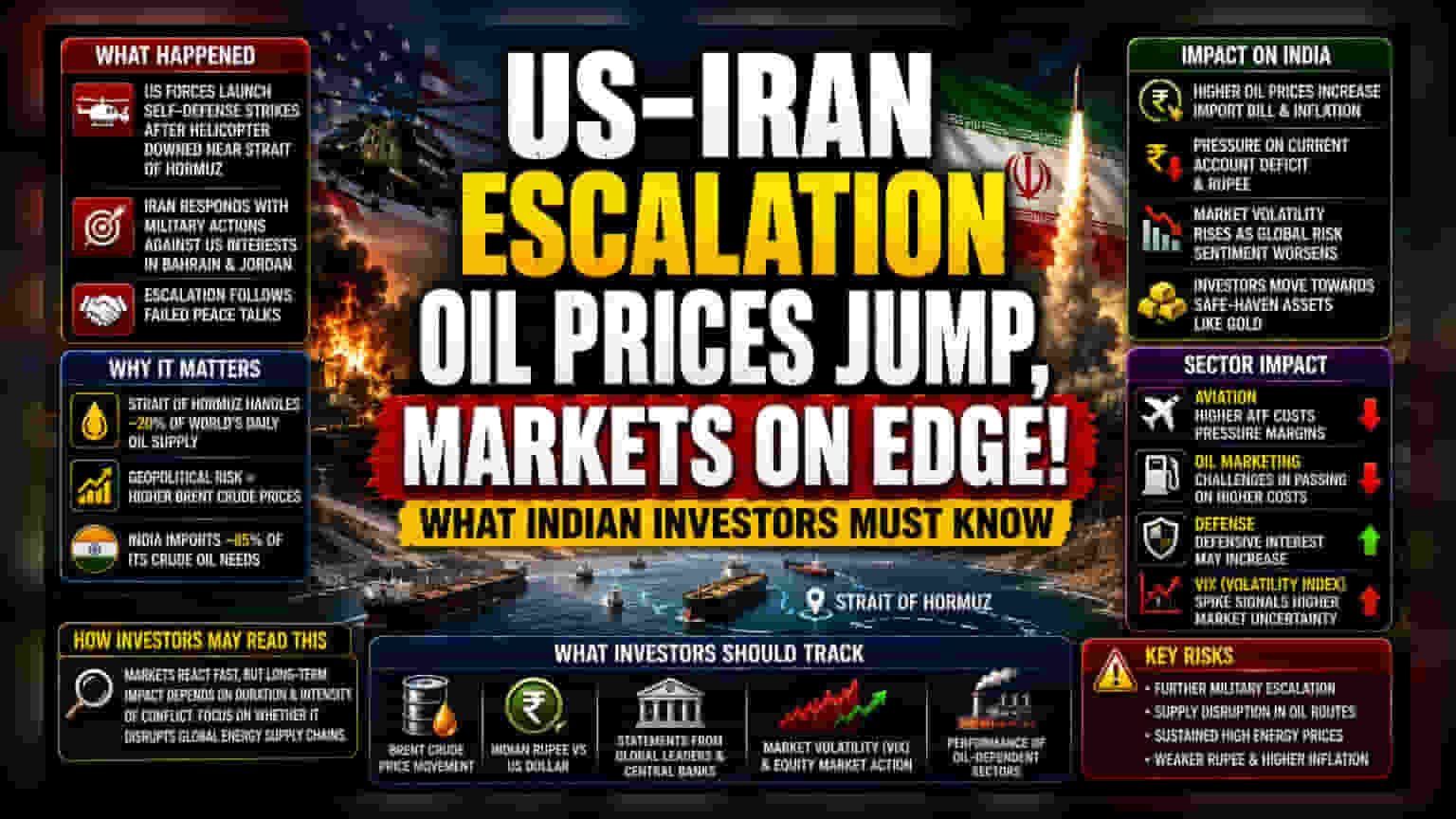


The escalation of military conflict between the US and Iran near the Strait of Hormuz has created global uncertainty. For Indian investors, the key monitorable is crude oil, as a significant portion of global energy supply flows through this region. Increased instability can pressure the Indian Rupee, affect import costs, and lead to market volatility. Investors are currently watching how this geopolitical shift influences inflation, interest rates, and specific sectors like aviation and logistics.
What Happened
Military tensions between the United States and Iran have sharply increased following a series of direct engagements. US forces initiated self-defense strikes against Iran, citing the downing of a US Army helicopter near the Strait of Hormuz. In response, Iran has reported military actions against US interests in Bahrain and Jordan. This escalation follows a period where peace negotiations were publicly discussed, marking a sudden and significant shift in the regional security situation.
Why This Matters For Indian Investors
The Strait of Hormuz is a critical maritime chokepoint, with a substantial percentage of the world's daily oil consumption passing through these waters. Any instability in this region typically drives immediate concern regarding global oil supplies. For India, which imports a vast majority of its crude oil requirements, this is a direct economic concern. When geopolitical tensions rise, Brent crude prices often see upward pressure due to supply uncertainty. For Indian investors, rising crude oil prices can lead to higher input costs for several industries, potentially impacting corporate profit margins and inflation metrics.
Impact On The Indian Economy
The Indian economy is sensitive to crude oil price movements. A sustained increase in oil prices often leads to a higher import bill, which puts pressure on the Current Account Deficit and the Indian Rupee. When the Rupee weakens against the US Dollar, it can influence import costs for various commodities and energy products. Additionally, global market uncertainty often leads to increased volatility in equity markets, as investors may reduce exposure to riskier assets and move towards safe-haven investments like gold.
Sector Context And Market Reaction
Investors typically watch specific sectors closely during such geopolitical events. Aviation companies often face immediate pressure because aviation turbine fuel costs are directly linked to crude oil prices. Similarly, oil marketing companies may face challenges depending on whether they can pass on the increased costs to consumers. On the other hand, the defense sector sometimes sees defensive interest during periods of high geopolitical tension. However, the broader market sentiment is usually dictated by the VIX, or the volatility index, which tracks investor fear. A sharp spike in the VIX often suggests that market participants are expecting wider price swings in the near term.
How Investors May Read This
While market reactions to geopolitical news can be swift and sometimes emotional, the long-term impact usually depends on the duration and intensity of the conflict. History shows that markets often experience a period of 'risk-off' sentiment, where selling pressure increases, particularly in emerging markets. Investors generally monitor whether the situation remains localized or if it threatens to disrupt global energy supply chains significantly. The focus will likely remain on whether these military actions trigger further retaliations or if diplomatic channels can effectively lower the temperature.
What Investors Should Track
Moving forward, the primary indicators for investors will be the movement in Brent crude oil prices, which serves as a benchmark for India’s energy imports. Additionally, the performance of the Indian Rupee against the US Dollar will be a key monitorable, as it reflects the impact on India's macroeconomic stability. Investors will also keep a close watch on statements from global leaders and central banks, as these may provide clues about the potential for further escalation or a path toward de-escalation. Keeping track of daily market volatility and sector-specific performance, particularly in oil-dependent industries, will be essential to understanding the unfolding impact of this situation.