 Whalesbook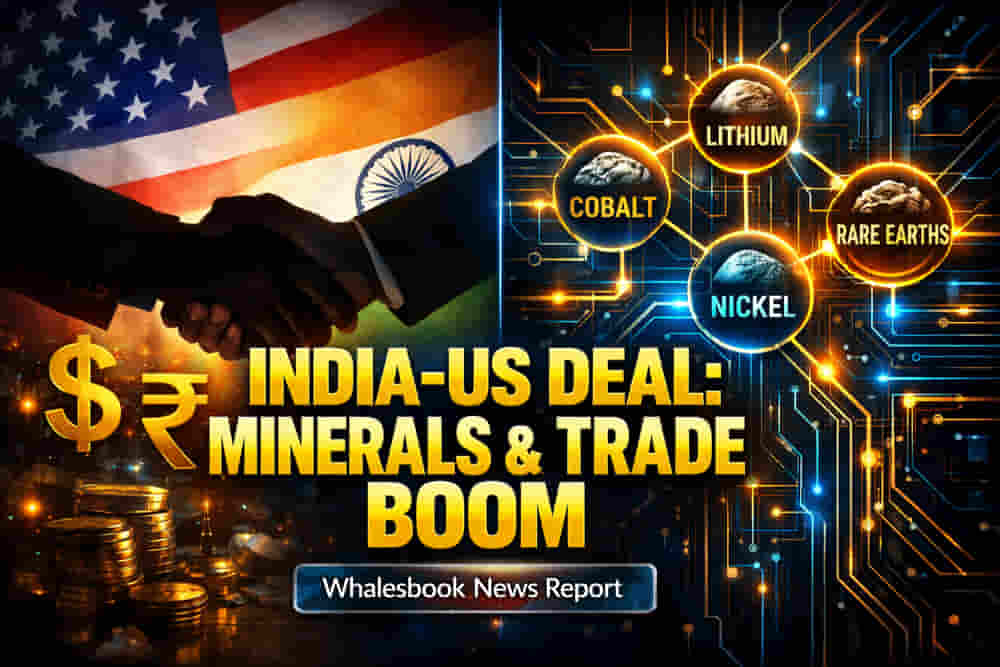
### Trade Realignment Fuels Critical Minerals Focus
In a pivotal diplomatic development, the United States and India have finalized a new trade agreement, effectively thawing months of tariff-induced friction. The pact, announced by President Donald Trump and Prime Minister Narendra Modi, slashes U.S. tariffs on Indian imports to 18%, down from previous levels that reached up to 50%. In parallel, India has committed to eliminating its own tariffs and non-tariff barriers against the U.S. to zero. This agreement is framed to unlock substantial mutual economic benefits, with India also pledging over $500 billion in purchases of U.S. energy, technology, agricultural, and coal products.
Market observers noted overwhelmingly positive initial reactions, particularly within the energy sector, and the Indian Rupee saw a sharp appreciation against the U.S. dollar. The deal, however, carries significant geopolitical weight. President Trump asserted that Prime Minister Modi agreed to cease purchasing Russian oil, a move Trump believes will contribute to ending the conflict in Ukraine. This assertion, while welcomed by Washington, faces scrutiny, with some analysts questioning the completeness of India's commitment and noting the logistical challenges of an immediate cessation of Russian crude imports. Nevertheless, the agreement is viewed as a strategic hedge for both nations, adapting to a volatile global order and navigating unpredictable trade politics.
### Global Critical Minerals Summit Addresses Supply Chain Vulnerabilities
The trade accord occurs concurrently with the inaugural Critical Minerals Ministerial hosted by the U.S. State Department, commencing February 4, 2026. Delegations from over 50 countries are convening to strengthen international cooperation on securing and diversifying critical mineral supply chains, essential for technological innovation, economic competitiveness, and national security. Secretary of State Marco Rubio is leading the summit, which aims to foster momentum for collaborative efforts to ensure access to minerals vital for clean energy transitions and advanced manufacturing.
The global demand for critical minerals, including lithium, cobalt, and rare earth elements, is surging, driven by the expansion of electric vehicles, renewable energy technologies, AI, and smart devices. This escalating demand highlights the strategic importance of supply chain resilience, particularly given China's dominant position in the processing of many key minerals, including rare earths. The U.S. and its allies are actively pursuing strategies to counter this dependence, investing in new mining projects outside China, developing recycling capabilities, and fostering international partnerships. India itself is implementing a National Critical Mineral Mission (NCMM) to boost domestic exploration, secure overseas assets, and reduce import reliance, positioning itself as a key player in building diversified, rules-based supply chains.
### Strategic Alignment and Future Trajectory
The convergence of a significant bilateral trade agreement with a global summit focused on strategic resource security underscores a broader trend of geopolitical statecraft influencing economic policy. Both nations are demonstrating a commitment to strengthening their partnership, which extends to defense industry collaboration and military ties. The U.S.-India trade deal is seen as a foundational step toward a more comprehensive bilateral trade agreement, with further negotiations anticipated to address market access and non-tariff barriers. The success of these initiatives will be closely watched as the world navigates the complex interdependencies of technological advancement, economic security, and geopolitical stability.