

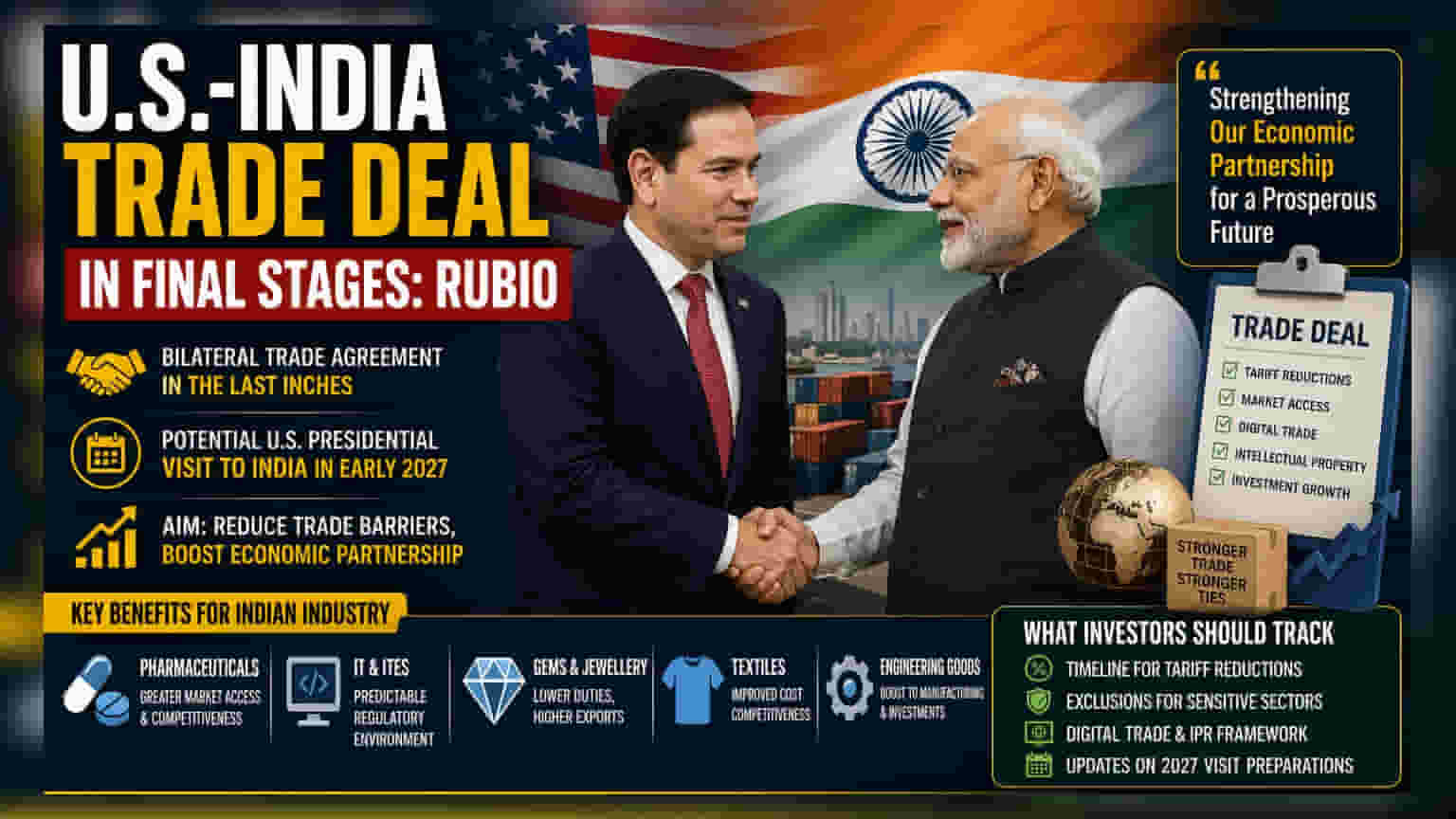
U.S. Secretary of State Marco Rubio stated that a bilateral trade agreement with India is in the final stages of negotiation, with a presidential visit planned for early 2027. This deal could significantly impact Indian export-heavy sectors, including information technology, pharmaceuticals, and manufacturing, by addressing longstanding tariff and market access issues.
What Happened
U.S. Secretary of State Marco Rubio has indicated that a bilateral trade agreement between the United States and India is in the final stages of completion. Following recent high-level diplomatic engagements, including meetings between President Donald Trump and Prime Minister Narendra Modi at the G7 Summit, Washington is now preparing for a potential presidential visit to India in early 2027. This diplomatic push aims to resolve outstanding trade friction and strengthen the economic partnership between the two nations.
The Trade Deal Progress
Negotiations regarding a comprehensive trade pact have been ongoing for some time, often characterized by complex discussions over tariffs, non-tariff barriers, and market access. Secretary Rubio’s remarks describe the current state of negotiations as being in the "last inches," suggesting that both sides are close to finalizing terms that could reduce trade costs. For years, the two nations have navigated challenges related to U.S. tariff policies on specific Indian goods and reciprocal concerns regarding market openness. A finalized agreement is expected to address these hurdles, potentially lowering duty rates and streamlining trade flows for a wide range of industries.
Why This Matters for Indian Industry
The United States remains one of India’s most significant trading partners. A formal agreement is vital for sectors that rely heavily on access to the U.S. market. Indian exports to the U.S. have historically been dominated by pharmaceuticals, technology services (IT/ITeS), gems and jewellery, textiles, and engineering goods.
Lowering trade barriers could provide a competitive edge to Indian exporters. For instance, the pharmaceutical industry, often called the “pharmacy of the world,” depends on clear regulatory pathways and predictable tariff structures to maintain its market share in the U.S. Similarly, the IT sector, which contributes a massive portion of India's services exports to the U.S., stands to benefit from a more stable and predictable regulatory environment. A successful pact could also boost investments in manufacturing under various 'Make in India' initiatives by providing greater security for long-term production planning.
Managing Trade Risks and Barriers
While the progress is positive, the trade relationship has historically faced risks, including investigative actions regarding export subsidies and periodic U.S. tariff changes on various commodities. Investors should note that trade negotiations are inherently difficult, and last-minute disagreements over specific product categories—such as agriculture or sensitive industrial goods—can delay final implementation.
Additionally, both nations maintain specific national interests that occasionally clash, such as digital trade rules and intellectual property protections. The history of negotiations shows that even when agreements are "near completion," the final text often involves difficult compromises that may not satisfy all domestic industry players equally. Maintaining competitive margins in a post-deal scenario will require companies to navigate these new regulations effectively.
What Investors Should Track Next
Investors should closely monitor official government communications for updates on the specific terms of the deal. The key monitorables include the timeline for tariff reductions, any exclusions for sensitive sectors, and the framework for digital trade and intellectual property. Furthermore, updates on the 2027 visit preparations will likely provide signals on the strength of the bilateral commitment. Analysts and the market will likely focus on whether the final agreement offers tangible duty relief or if it primarily acts as a framework for future cooperation.