

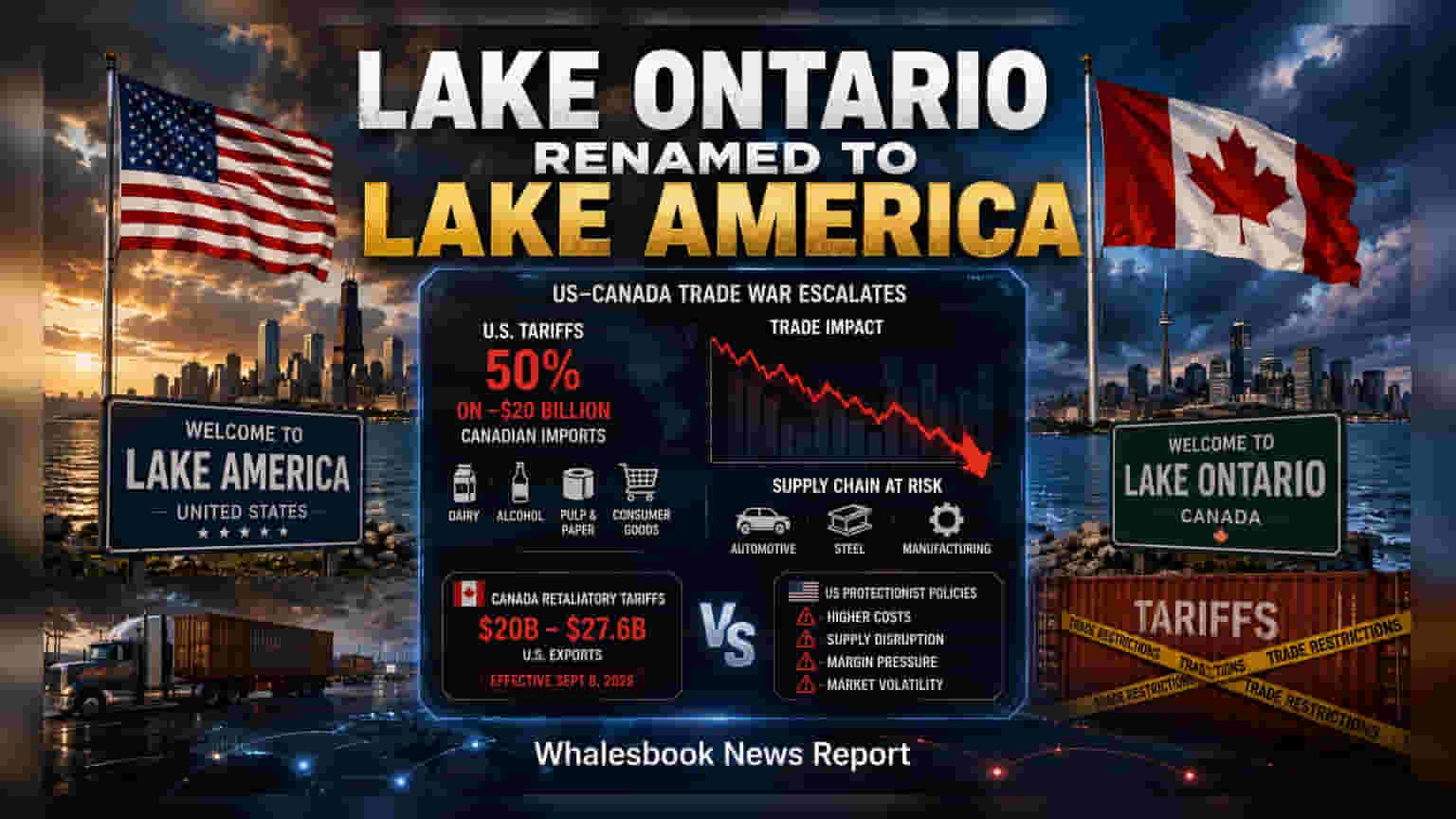
U.S. President Donald Trump has signed an executive order renaming Lake Ontario as ‘Lake America,’ signaling a sharp rise in trade tensions. The move comes alongside new 50% tariffs on $20 billion of Canadian imports, heightening risks for businesses with North American supply chain exposure as Canada prepares retaliatory measures for September.
President Donald Trump has issued an executive order to rename Lake Ontario to 'Lake America,' a move that has been met with immediate rejection by Canadian leadership and several U.S. state officials. While the renaming applies only to U.S. federal nomenclature and carries no legal authority within Canada, the decision serves as a high-profile signal of the deepening diplomatic and economic friction between the two North American neighbors.
This symbolic action coincides with a significant escalation in the trade war between Washington and Ottawa. The U.S. administration has implemented 50% tariffs on approximately $20 billion worth of Canadian imports, a aggressive policy shift that covers a broad spectrum of industries including dairy, alcohol, pulp and paper, and various consumer goods. This trade barrier is expected to cause immediate cost increases for businesses on both sides of the border that rely on integrated cross-border supply chains.
Impact on North American Trade
The trade dispute has moved beyond political rhetoric and into a phase of active economic protectionism. In response to the U.S. tariff imposition, Canadian officials have signaled that they are preparing retaliatory tariffs targeting between $20 billion and $27.6 billion worth of U.S. exports. These measures are currently scheduled to come into force on September 8, 2026. For investors and businesses with exposure to the region, this represents a significant increase in operational uncertainty.
The automotive and steel industries, which have long relied on seamless cross-border logistics, are considered particularly vulnerable to these protectionist policies. Any disruption in the supply of raw materials or components could lead to higher production costs, supply delays, and margin pressure for manufacturers operating in or sourcing from the region. The hardening stance in Washington, combined with the retaliatory cycle, raises concerns about the stability of the North American trade bloc and its impact on broader global market sentiment.
What Investors Should Monitor
While the name change is primarily a symbolic provocation, the underlying trade policy creates a volatile environment for global markets. Investors should monitor the upcoming September 8 deadline, when the Canadian retaliatory tariffs are set to take effect. Ongoing negotiations—or the lack thereof—will be the primary indicator of whether the trade war stabilizes or if it expands to include further levies on essential manufacturing sectors like steel and automobiles. Companies with heavy reliance on North American supply chains may face increased stock price volatility as analysts assess the potential hit to quarterly earnings and profit margins.