

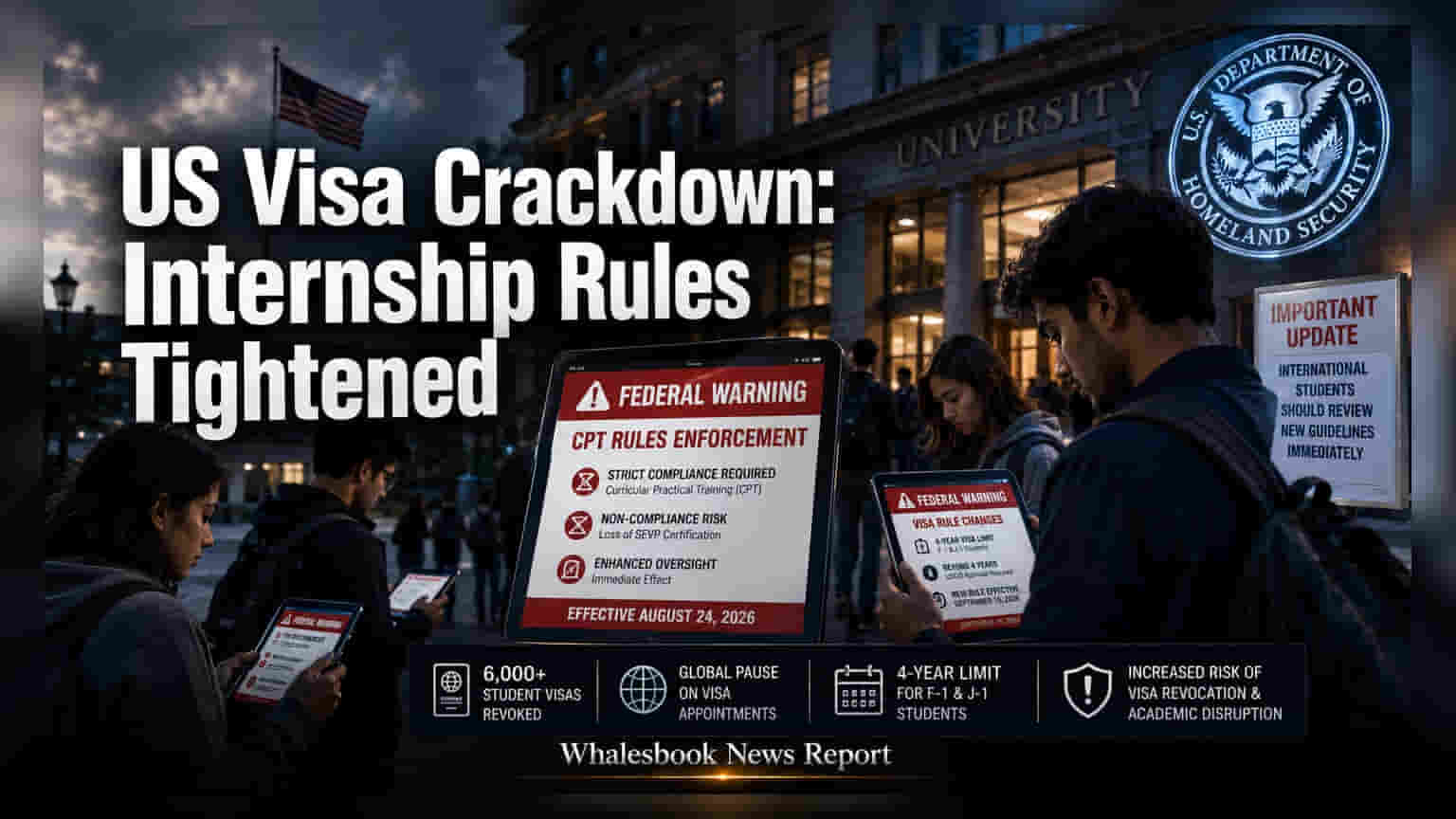
The US government has issued stricter guidelines for Curricular Practical Training (CPT) for international students, prompting major universities like UCLA and UC Berkeley to pause work authorization applications. This policy shift follows the announcement of a fixed four-year visa limit starting September 15, 2026, creating new challenges for international students and academic planning.
The US Department of Homeland Security has introduced a significant shift in how international students can access work authorizations. A memo issued by the Student and Exchange Visitor Program on August 24, 2026, requires universities to strictly adhere to regulations governing Curricular Practical Training, or CPT. The directive warns that educational institutions failing to comply with these updated standards risk losing their authority to enroll foreign students. This development has triggered an immediate response from higher education institutions across the United States.
Major universities, including the University of California, Los Angeles and the University of California, Berkeley, have responded by suspending certain CPT application processes. University officials are currently evaluating how to align their internal systems with the more restrictive federal language. This pause is intended to prevent non-compliance, but it has created immediate uncertainty for students who rely on these internships to fulfill academic requirements or gain practical experience.
The CPT restriction is part of a broader, more aggressive approach to visa oversight. Beyond the current focus on internships, a final rule is set to take effect on September 15, 2026, which will replace the previous 'duration of status' for F-1 and J-1 students with a fixed four-year admission period. Under this new system, students whose programs extend beyond four years will be required to seek specific approval from the US Citizenship and Immigration Services to continue their stay. This creates a significant administrative hurdle, particularly for doctoral and research-heavy STEM programs where studies often span longer durations.
Recent data suggests that the environment for international students has become increasingly challenging. Reports indicate that over 6,000 student visas have been revoked since the start of the current administration’s second term. Simultaneously, the US State Department has implemented a global pause on visa appointments to conduct mandatory training for consular staff, aimed at enforcing stricter screening processes.
For students and academic institutions, the primary concern is the increased risk of visa revocation and the potential for disrupted academic timelines. As universities navigate these regulatory changes, prospective and current international students may face delays in work authorization and greater difficulty in planning long-term academic goals. The immediate next steps involve monitoring how universities adjust their CPT policies following the August 24 directive and observing the implementation of the fixed four-year visa cap as the September 15 deadline approaches.