

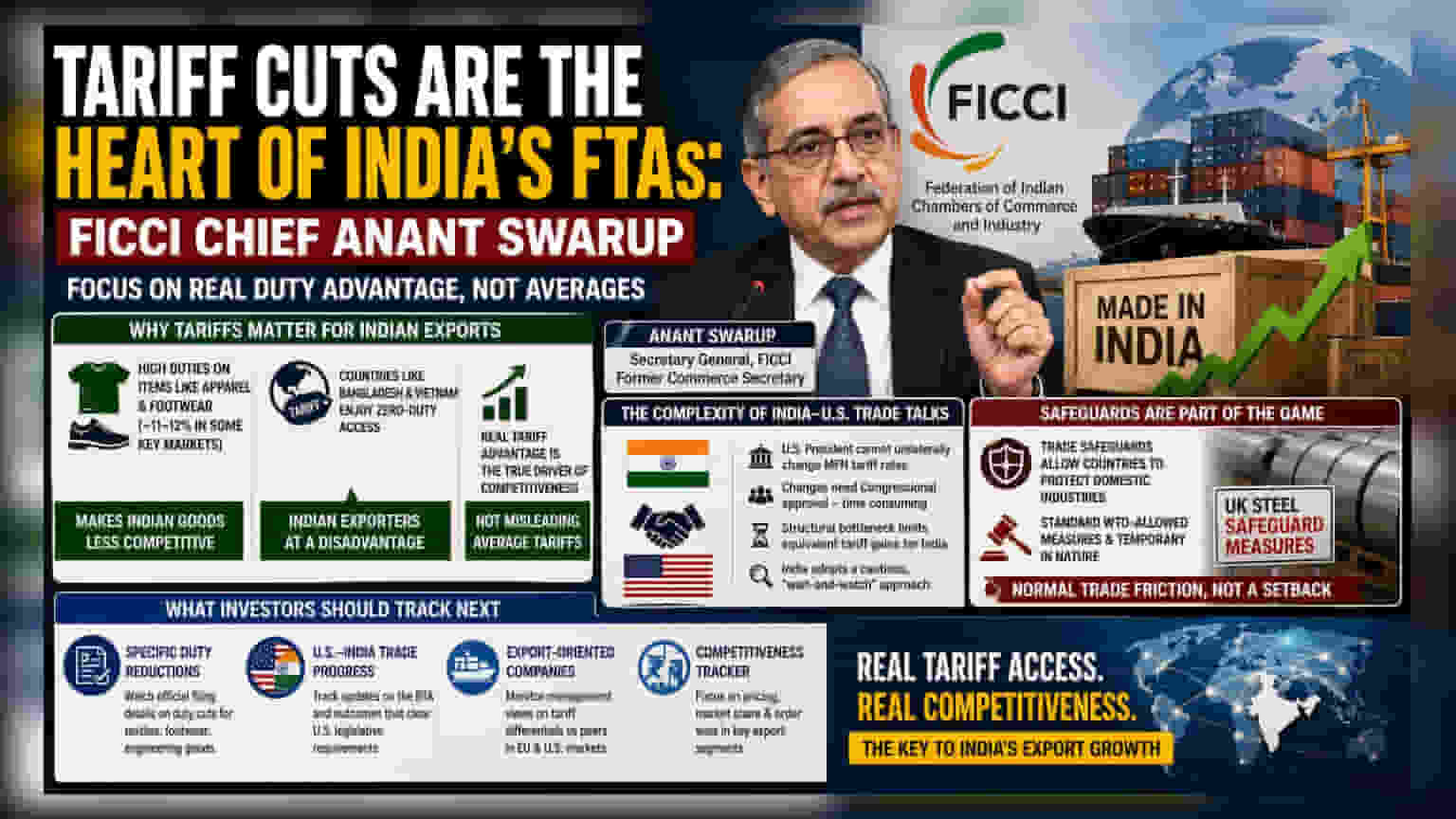
Former Commerce Ministry official and current FICCI Secretary General Anant Swarup emphasized that tariff cuts are essential for India's competitive exports, even as non-tariff barriers grow. With India and the U.S. negotiating a bilateral trade deal, Swarup highlighted the need for durable tariff advantages. For investors, this underscores the importance of watching how specific trade pacts directly impact duty structures for sectors like apparel and footwear.
What Happened
Anant Swarup, the newly appointed Secretary General of the Federation of Indian Chambers of Commerce and Industry (FICCI) and a former top official in the Department of Commerce, has stressed that tariff reductions remain a cornerstone of India's free trade agreements (FTAs). Despite the rising use of non-tariff barriers and safeguards by various nations, Swarup argues that these should not distract from the primary goal of securing genuine tariff advantages. He warned that relying on "average tariff" figures can be misleading for exporters, as high duties on specific items like apparel and footwear often remain a significant hurdle for Indian businesses when competing with countries that already enjoy zero-duty access in major markets.
Why Tariffs Matter for Indian Exports
For investors, the distinction between overall tariff averages and specific sector duties is critical. Sectors such as textiles, apparel, and footwear are labor-intensive and highly sensitive to price changes. Even a moderate tariff difference—such as the roughly 11-12% duties currently faced by Indian exporters in some key markets—can price Indian goods out of the competition. When India signs an FTA, the primary benefit for companies in these segments is the removal or reduction of these specific duties. Swarup’s perspective highlights that as long as these barriers exist, the "competitiveness" of Indian exporters is hampered, regardless of how broad the trade deal is. This is a key monitorable for companies looking to expand their footprint in the European or American markets.
The Complexity of the India-U.S. Trade Talks
Swarup also touched upon the practical challenges in current India-U.S. trade negotiations. Unlike standard FTAs, the U.S. negotiating framework is constrained by legislative procedures where the U.S. President cannot unilaterally change Most Favoured Nation (MFN) tariff rates; such changes often require Congressional approval. This creates a structural bottleneck: while India may be ready to offer market access by lowering its own import duties, it often finds it difficult to secure equivalent, durable tariff advantages in return due to U.S. internal processes. This legislative reality is a primary reason why India is currently adopting a cautious, "wait-and-watch" approach in its trade talks with Washington.
Safeguards Are Part of the Game
Regarding concerns about the UK’s recent steel safeguard measures, Swarup clarified that such actions are standard trade remedies under World Trade Organization (WTO) rules. These measures are intended to be temporary protections for domestic industries facing a sudden surge in imports. While they can be disruptive, they are part of the accepted global trade system rather than a signal that a trade agreement has failed. For investors, this means that occasional trade friction or the imposition of temporary safeguards in specific sectors should be viewed as a standard operational risk in global trade rather than a permanent setback to diplomatic or economic partnerships.
What Investors Should Track Next
Investors should monitor the progress of upcoming trade agreements, focusing on sector-specific tariff reduction lists rather than general announcements. Key monitorables include:
- Specific Duty Reductions: Watch for official filing details on duty cuts for textiles, footwear, and engineering goods in active trade negotiations.
- U.S.-India Trade Progress: Track updates on the bilateral trade agreement (BTA) and whether negotiators can find a framework that satisfies U.S. legislative requirements while providing meaningful tariff benefits to India.
- Export-Oriented Companies: Pay attention to management commentary from export-heavy firms regarding their competitive position in the EU and U.S., particularly how they view the impact of tariff differentials versus their peers in countries like Bangladesh or Vietnam.