 Whalesbook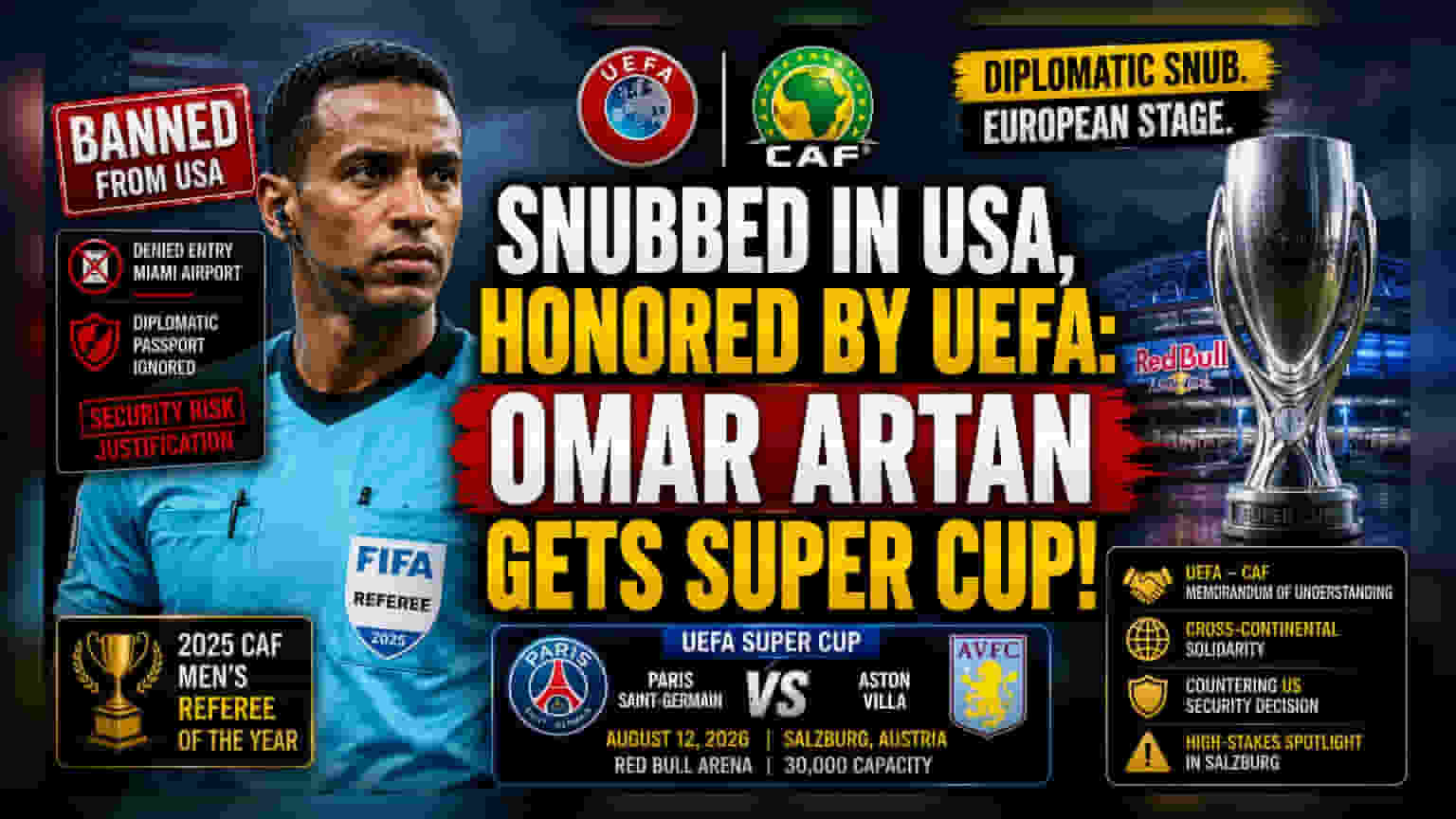


After being blocked from the 2026 World Cup by U.S. authorities, Somali referee Omar Artan has been selected to officiate the UEFA Super Cup. This move, stemming from a UEFA-CAF cooperation accord, places the 34-year-old at the helm of the August 12 clash between Paris Saint-Germain and Aston Villa in Salzburg.
The Geopolitical Officiating Shift
The appointment of Omar Artan to the UEFA Super Cup represents more than a logistical substitution; it signals a hardening of the divide between U.S. immigration policy and international sports governance. Following his refusal of entry at Miami International Airport—despite holding a diplomatic passport and official FIFA accreditation—Artan’s exclusion from the World Cup roster sparked widespread condemnation. While U.S. officials, including the White House Task Force on the World Cup, justified the denial citing security protocols, the move effectively ended his participation in the tournament. UEFA’s decision to elevate Artan to the Salzburg fixture serves as a direct, high-profile counter-narrative, repositioning him as a center-stage official just weeks after his forced departure from the U.S.
Institutional Alignment and the CAF Accord
This selection is formalized under a Memorandum of Understanding between UEFA and the Confederation of African Football (CAF). By integrating Artan into the UEFA elite circuit for the match between Paris Saint-Germain and Aston Villa, both governing bodies are reinforcing a narrative of cross-continental solidarity. The move prioritizes the referee’s career trajectory—which saw him named the 2025 CAF Men’s Referee of the Year—over the U.S. government’s security-based exclusion. This development effectively creates a bifurcated system where individuals barred from North American events may find accelerated pathways within European competition structures.
The Forensic Risk Perspective
The optics of this appointment carry significant inherent risks for UEFA’s regulatory standing. By embracing an official recently deemed a security risk by a G7 host nation, UEFA effectively challenges the credibility of U.S. entry vetting processes. Should any controversy arise during the August 12 match in Salzburg, the spotlight will inevitably return to the U.S. State Department’s original decision to exclude Artan. Furthermore, while the match at the 30,000-seat Red Bull Arena offers a prestigious stage, it remains a volatile environment for an official currently at the center of a diplomatic firestorm. Any error, perception of bias, or further administrative friction could threaten the current fragile harmony between FIFA’s global requirements and individual national security prerogatives.