

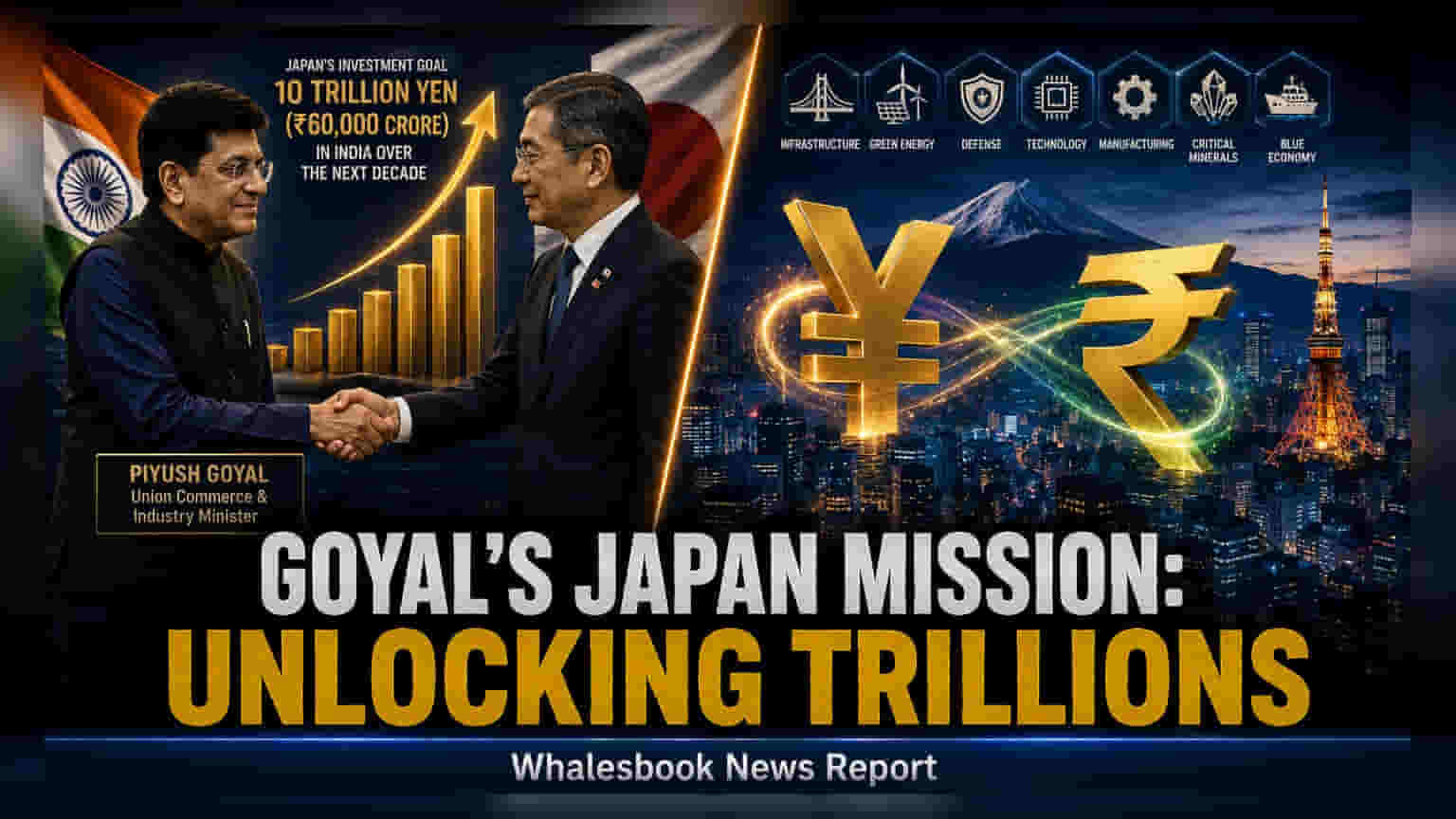
Commerce Minister Piyush Goyal will visit Japan from August 24-27, 2026, to strengthen trade ties and promote investment. With Japan targeting 10 trillion yen in Indian investments over the next decade, the trip focuses on deepening industrial and technological partnerships. Investors may track progress on long-term infrastructure projects and bilateral trade goals.
Union Commerce and Industry Minister Piyush Goyal is scheduled to travel to Japan from August 24 to August 27, 2026, to advance bilateral trade and investment cooperation. The visit aims to build on the existing 'Special Strategic and Global Partnership' between the two nations, with a focus on manufacturing, technology, and energy sectors. This visit comes at a time when Japan has set an ambitious goal of investing 10 trillion yen (approximately ₹60,000 crore) in India over the next decade.
For Indian markets, the relationship with Japan is significant due to the large presence of Japanese corporations. Japan currently ranks as the fifth-largest source of foreign direct investment in India, with established operations from companies such as Suzuki, Toyota, Honda, Sony, and Mitsubishi. These firms are central to India’s automotive and electronics supply chains, making the investment climate a critical factor for sector performance.
The government is focusing on seven key areas to attract this capital, including infrastructure, green energy, defense, and the blue economy. Projects like the Mumbai-Ahmedabad High-Speed Rail are examples of the scale of collaboration the two nations are targeting. These infrastructure projects act as a backbone for industrial growth, and their execution speed is often a focus for long-term investors.
While the prospect of increased investment is positive, the bilateral relationship also faces structural challenges. A primary concern for policymakers is the widening trade deficit between the two countries, which has grown to approximately USD 15.4 billion as of FY2026. Closing this gap is difficult without a significant increase in Indian exports to Japan. Furthermore, the operational success of this partnership depends on resolving challenges such as non-tariff trade barriers and ensuring that large-scale infrastructure projects remain on track without significant cost overruns.
Investors may monitor the outcomes of this trip, specifically any updates regarding progress on infrastructure project timelines, efforts to balance the trade deficit, and potential new commitments in the semiconductor and critical minerals sectors. As Japan remains a key partner in India’s manufacturing-led growth vision for 2047, the stability and depth of this cooperation will continue to be a factor for sectors reliant on technology transfer and foreign capital.