

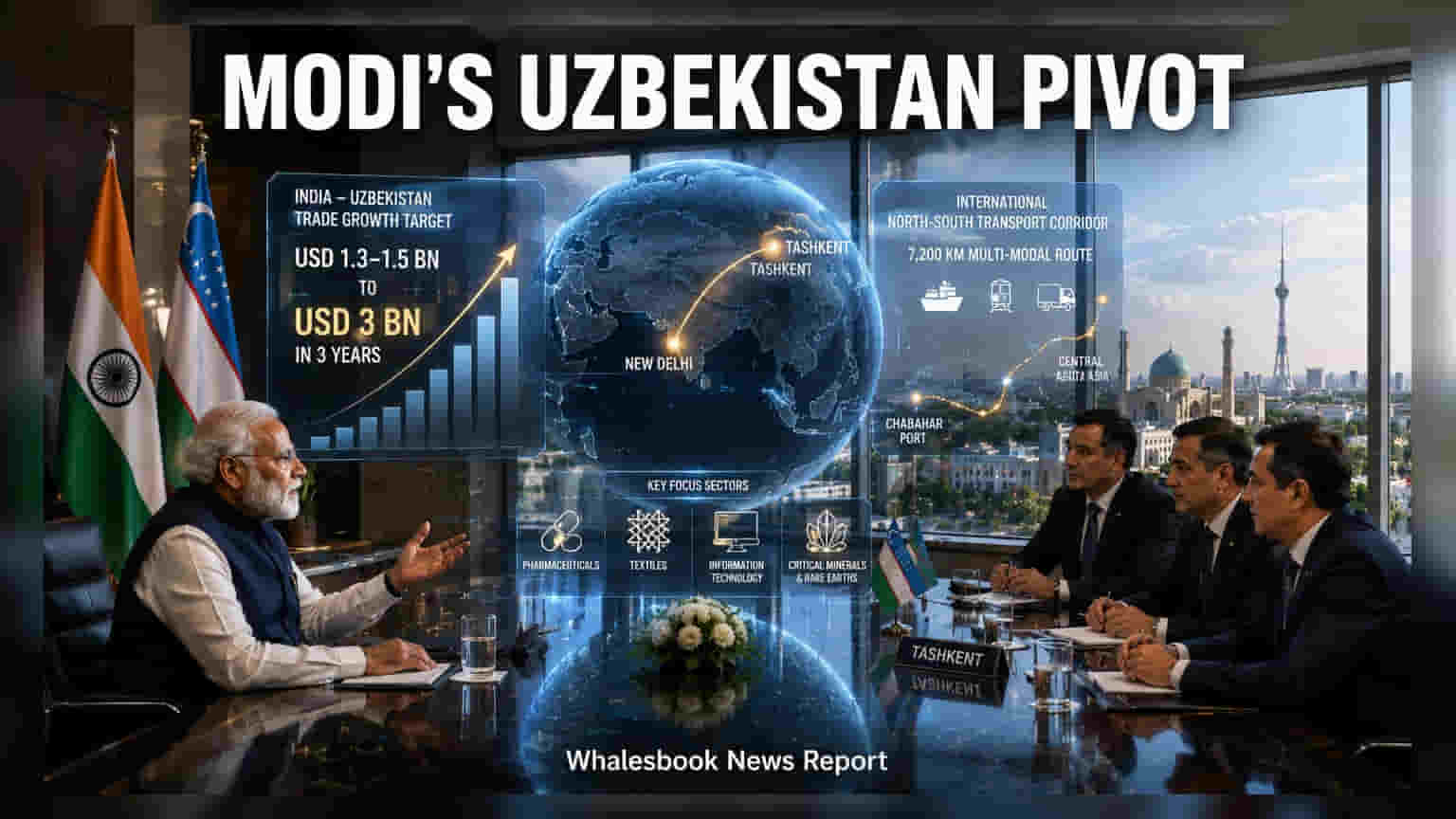
Prime Minister Narendra Modi’s state visit to Tashkent on August 29–30 seeks to double bilateral trade to USD 3 billion. The agenda focuses on sectors like critical minerals, pharmaceuticals, and digital services. Investors should monitor how the government addresses connectivity hurdles via the International North-South Transport Corridor, which remains essential for efficient trade logistics.
Prime Minister Narendra Modi is scheduled to visit Tashkent on August 29–30, 2026, for a high-level state visit aimed at accelerating economic cooperation between India and Uzbekistan. The primary objective is to transition the bilateral relationship from foundational agreements to actual commercial results, with a stated target of doubling bilateral trade to USD 3 billion from the current range of USD 1.3–1.5 billion over the next three years.
Strategic Sectors and Investment Treaty
The discussions are expected to prioritize sectors where Indian companies hold a competitive edge, specifically pharmaceuticals, textiles, and information technology. A key development for investors is the recent conclusion of a Bilateral Investment Treaty, which is designed to improve the legal framework for Indian businesses operating in the region. Uzbekistan is actively inviting foreign capital to help it move away from exporting basic raw materials toward manufacturing higher-value products. Furthermore, the country is seeking international partnerships in the critical minerals and rare earth sector, which could offer long-term opportunities for Indian industrial firms looking to diversify their supply chains.
Connectivity and Logistics Hurdles
The success of these trade ambitions is heavily linked to the International North-South Transport Corridor, a 7,200-kilometre multi-modal route designed to connect Indian ports with Central Asian markets. While this corridor is the most direct path to avoid overland transit issues through neighbouring regions, it currently faces significant logistical challenges. The route relies heavily on the stability of transit hubs like Iran’s Chabahar Port. Given the current regional volatility in the Middle East and the shifting nature of international sanction regimes, the physical movement of goods remains a bottleneck. For companies involved in exports, logistics, and shipping, the reliability of this route is a primary factor that will influence future trade costs and operational efficiency.
Execution Risk and Regional Context
While the diplomatic momentum is clear, observers note that there is often a gap between signed agreements and ground-level trade performance. Historical data shows that previous attempts to boost bilateral trade have sometimes slowed due to complex regulatory environments and limited logistical connectivity. Investors should track whether the upcoming meetings produce actionable timelines for these infrastructure projects or if they remain broad declarations of intent. The Prime Minister is also scheduled to travel to Kyrgyzstan following the Tashkent visit to attend the 26th Shanghai Cooperation Organisation Summit. This sequence of diplomatic activity highlights a broader strategy to increase India’s economic and security presence across Central Asia, though the immediate impact on corporate earnings will depend on how effectively these high-level discussions translate into simplified trade barriers and improved transport infrastructure.