

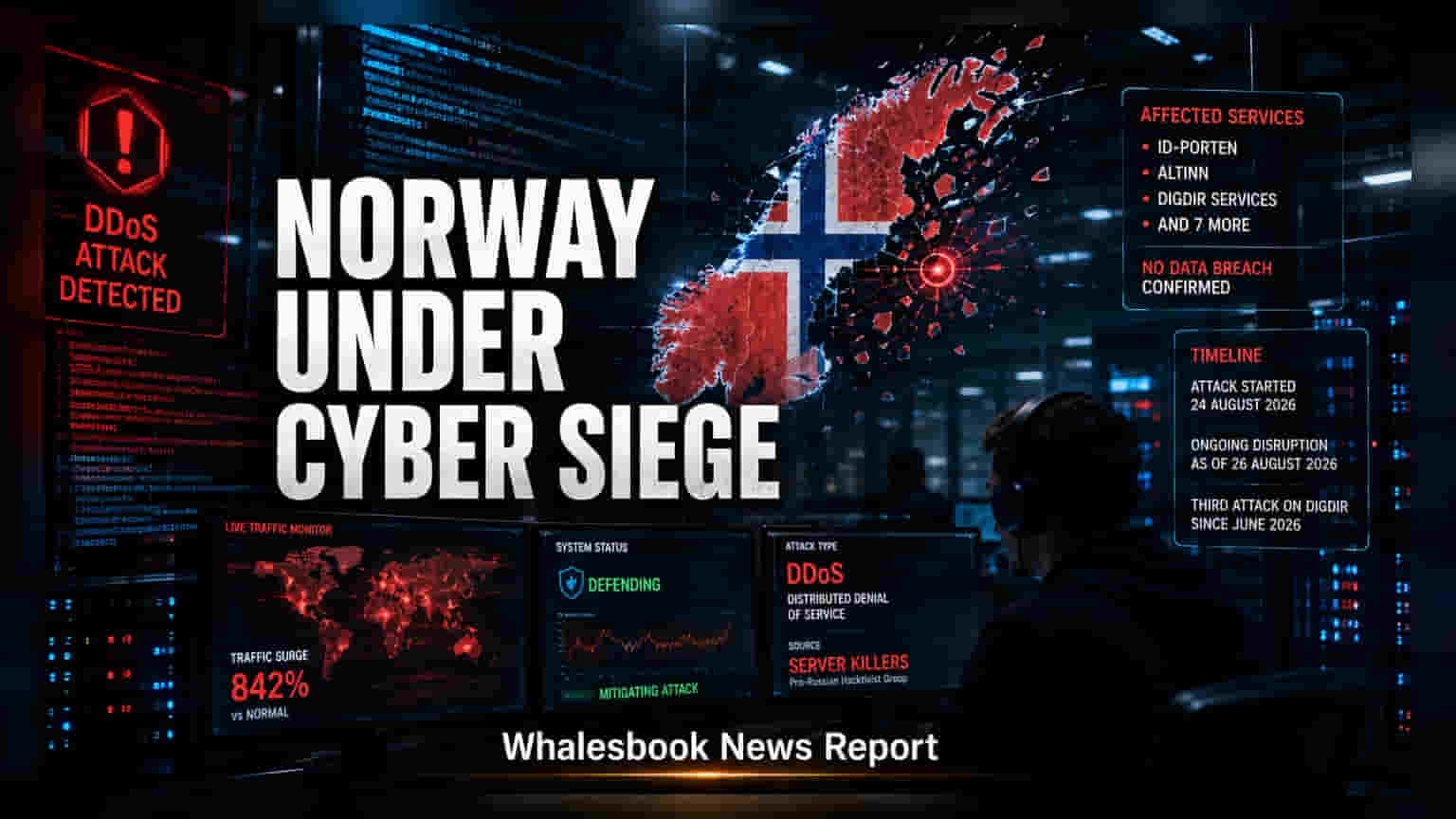
Norway’s government digital portals, including ID-porten, are facing a large-scale cyberattack following the country's $9.2 billion aid commitment to Ukraine. The pro-Russian group 'Server Killers' claimed responsibility for the disruption. While public services are impacted, authorities have confirmed there is no evidence of a data breach or compromise of sensitive information.
Norway is currently addressing a major cyberattack targeting its public digital infrastructure, which began on August 24, 2026. The incident involves a distributed denial-of-service (DDoS) attack against the Norwegian Digitalisation Agency, known as Digdir. In this type of attack, hackers overwhelm a system with excessive traffic to make it inaccessible to legitimate users. As of August 26, the disruption has affected approximately 10 public services, including the identity verification portal ID-porten and the Altinn platform used for government interactions.
The timing of the incident correlates with recent geopolitical developments. Shortly after Norway announced a $9.2 billion military and financial aid package for Ukraine, the pro-Russian hacker group 'Server Killers' claimed responsibility for the attack via a Telegram channel. The group stated that its actions were a direct response to Norway's security partnership with Kyiv. This event marks the third time the Norwegian Digitalisation Agency has faced such disruptions since June 2026, highlighting the ongoing risk to national digital infrastructure.
Despite the scale of the traffic, Norwegian authorities report that the situation is being managed and that core services remain largely functional. Crucially, the agency has confirmed there is no evidence of a security breach or the loss of personal data. The attack is being treated as an attempt to cause service interruptions and undermine public trust rather than an effort to steal information. This pattern of behavior is consistent with recent cybersecurity trends in Europe, where state-aligned actors frequently target national digital platforms to exert pressure on countries providing support to Ukraine.
The recurring nature of these incidents underscores the growing importance of cybersecurity for state-managed platforms. Government and public sector agencies across Europe are increasingly focusing on robust defense systems to mitigate risks from such synchronized attacks. For the public and stakeholders involved, the key monitorable remains the stability of digital identity and utility platforms as authorities continue to strengthen their defenses against future disruptions.