

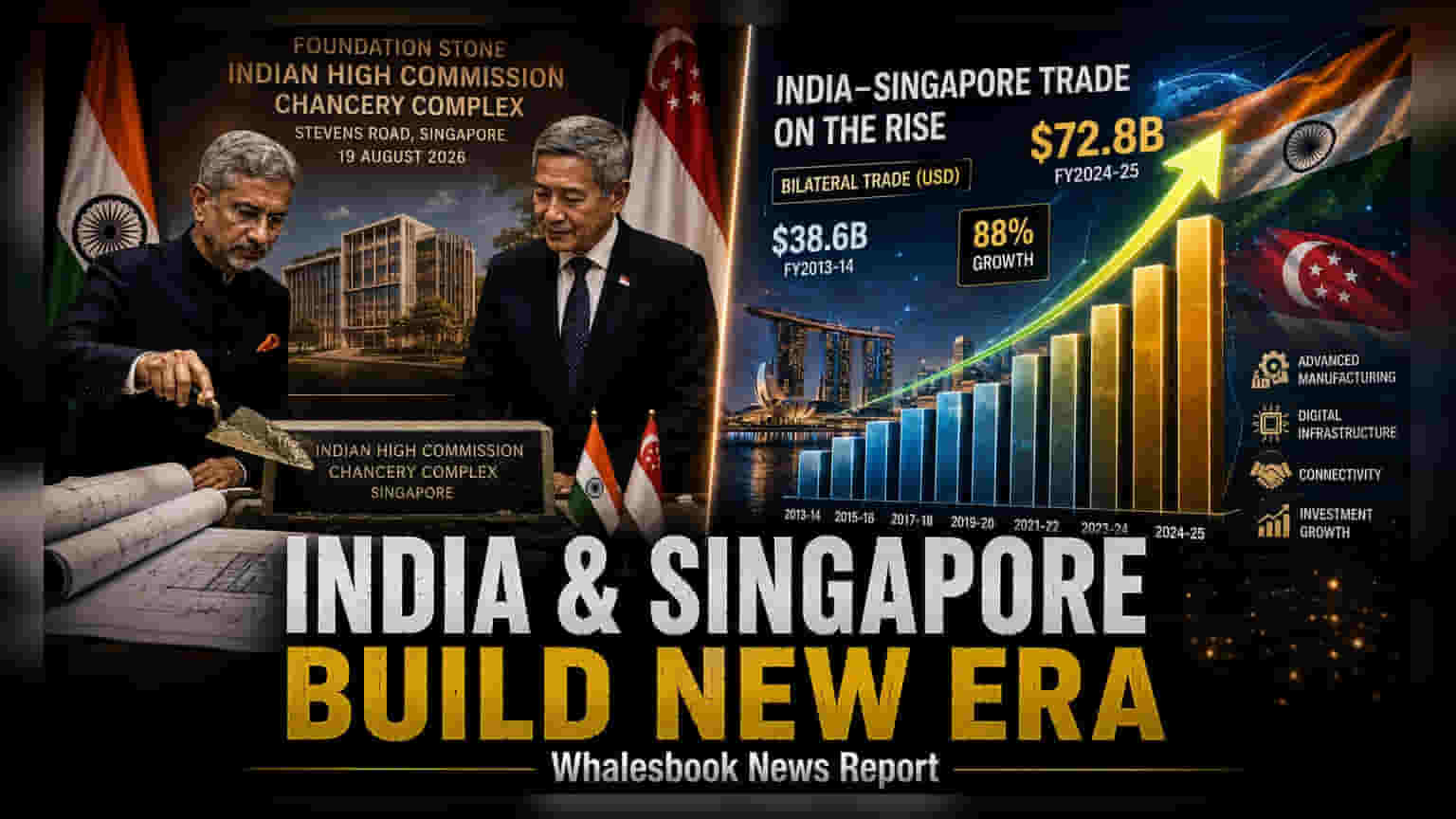
External Affairs Minister S. Jaishankar has laid the foundation stone for a new Indian High Commission chancery complex in Singapore. This diplomatic development highlights the strengthening ties between the two nations ahead of the upcoming Ministerial Roundtable. For investors, this relationship remains crucial as Singapore is a leading source of foreign direct investment into India.
On Wednesday, August 19, 2026, External Affairs Minister S. Jaishankar, along with Singapore’s Foreign Minister Vivian Balakrishnan, laid the foundation stone for the new Indian High Commission chancery complex in Singapore. Located at Stevens Road, the project marks a significant step in the ongoing diplomatic and strategic engagement between the two nations.
The development project involves the construction of a four-storey chancery building and a five-storey residential block containing 17 apartments. Situated on a site of approximately 8,700 square metres, the new facility is designed to support the growing administrative and diplomatic needs of the Indian mission in one of Asia’s primary financial hubs.
This foundation ceremony serves as a prelude to the 4th India-Singapore Ministerial Roundtable (ISMR), which is scheduled for Thursday, August 20, 2026. This high-level meeting will see participation from key Indian officials, including Commerce Minister Piyush Goyal, Finance Minister Nirmala Sitharaman, and Minister of State for Electronics and Information Technology Jitin Prasada. The dialogue is expected to focus on deepening cooperation in areas such as advanced manufacturing, digital infrastructure, and connectivity.
For market participants, the India-Singapore relationship acts as a critical barometer for cross-border economic ties. Singapore remains one of the largest sources of Foreign Direct Investment (FDI) into India, consistently contributing to capital flows across sectors like finance, technology, and real estate. The upcoming roundtable discussions are key monitorables as they often set the policy tone for bilateral trade and investment agreements.
Investors and analysts typically track these diplomatic dialogues to understand potential shifts in ease-of-doing-business policies, digital collaborations, and infrastructure investment pipelines between the two economies. While this specific infrastructure project is a diplomatic initiative rather than a corporate event, the continuity of such high-level cooperation remains a supporting factor for long-term bilateral investment sentiment.