

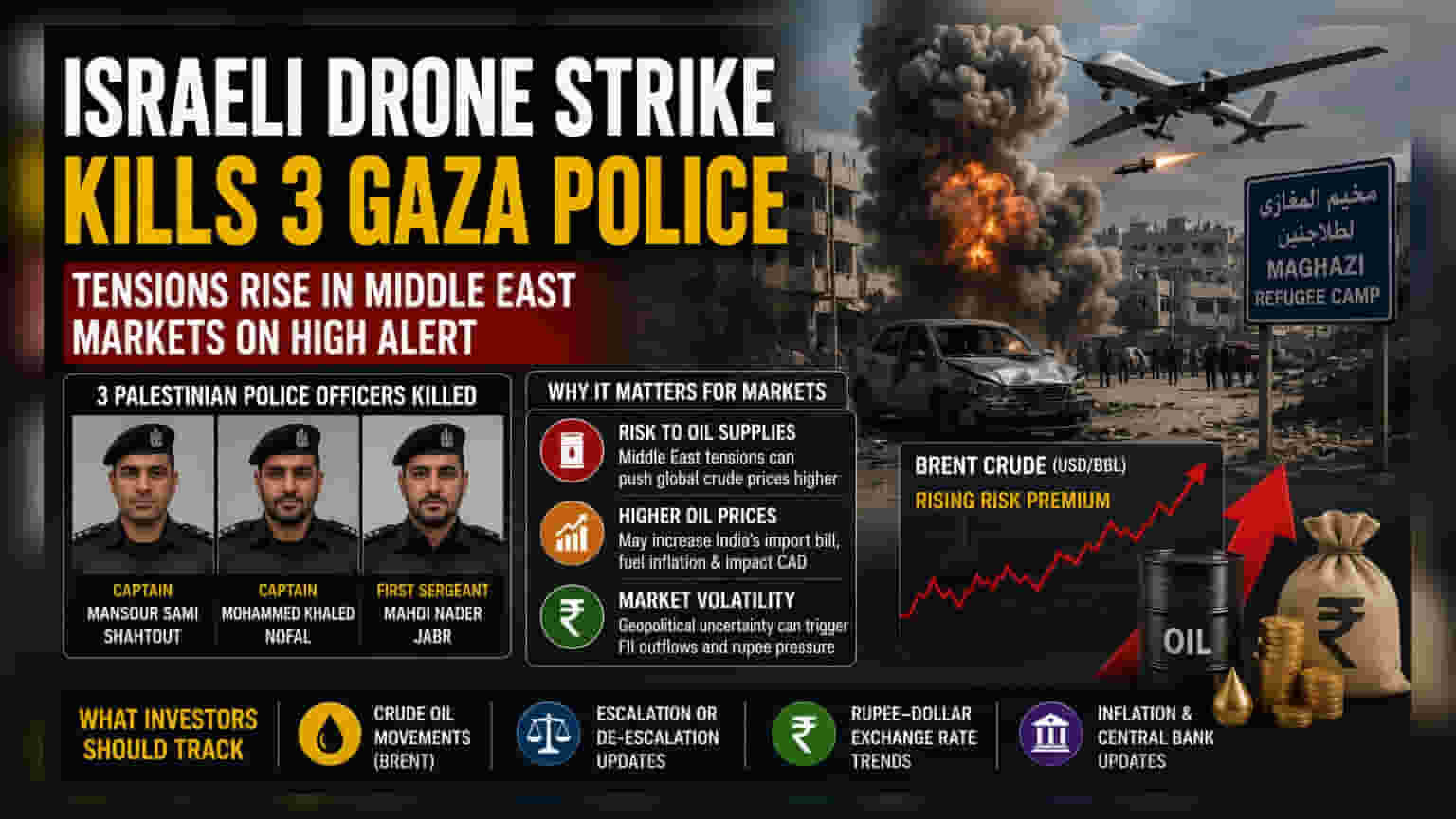
An Israeli drone strike in Gaza’s Maghazi refugee camp killed three Palestinian police officers on Friday. While this is a geopolitical development, financial markets watch such regional escalations for their potential impact on global crude oil prices and investor risk sentiment, which can indirectly influence India's import costs and inflation outlook.
What Happened
On Friday, June 26, 2026, an Israeli drone strike targeted a vehicle in the Maghazi refugee camp, located in central Gaza. The attack, which occurred near the camp entrance on Salah al-Din Street, resulted in the deaths of three Palestinian police officers. The Palestinian Ministry of the Interior and National Security identified the deceased as Captain Mansour Sami Shahtout, Captain Mohammed Khaled Nofal, and First Sergeant Mahdi Nader Jabr. The ministry condemned the incident, describing it as an attempt to cause instability in the region.
Why It Matters for Markets
For investors, the primary concern during geopolitical conflicts in the Middle East is the potential disruption to global energy supplies. The region is critical to global oil production and transit. Markets typically react to these events by pricing in a 'geopolitical risk premium.' If investors perceive that the conflict could expand or disrupt supply chains, global crude oil prices often experience upward volatility.
India is a net importer of crude oil, sourcing a significant portion of its requirements from international markets. Higher oil prices can increase the country's import bill, potentially leading to pressure on the Current Account Deficit (CAD) and fueling domestic inflation. These macro-level factors can influence monetary policy decisions and corporate profit margins, particularly for sectors that are heavy users of fuel and energy.
The Investor Link
Beyond direct commodity impacts, regional instability can influence broader market sentiment. When geopolitical uncertainty rises, foreign institutional investors (FIIs) may sometimes shift toward a 'risk-off' approach, favoring safer assets over emerging market equities. This can lead to increased volatility in the Indian stock market and the rupee-dollar exchange rate. However, the extent of this impact depends largely on the perceived scale and duration of the conflict rather than isolated incidents.
What Investors Should Track
Investors typically monitor international crude oil benchmarks, such as Brent Crude, as the first indicator of market reaction to Middle Eastern developments. Additionally, watching for any escalation or de-escalation in diplomatic efforts or military activity helps gauge whether the risk premium in global markets will persist or fade. Monitoring the rupee’s stability against the dollar and updates from central banks regarding inflation management remains a standard practice during periods of global geopolitical friction.