

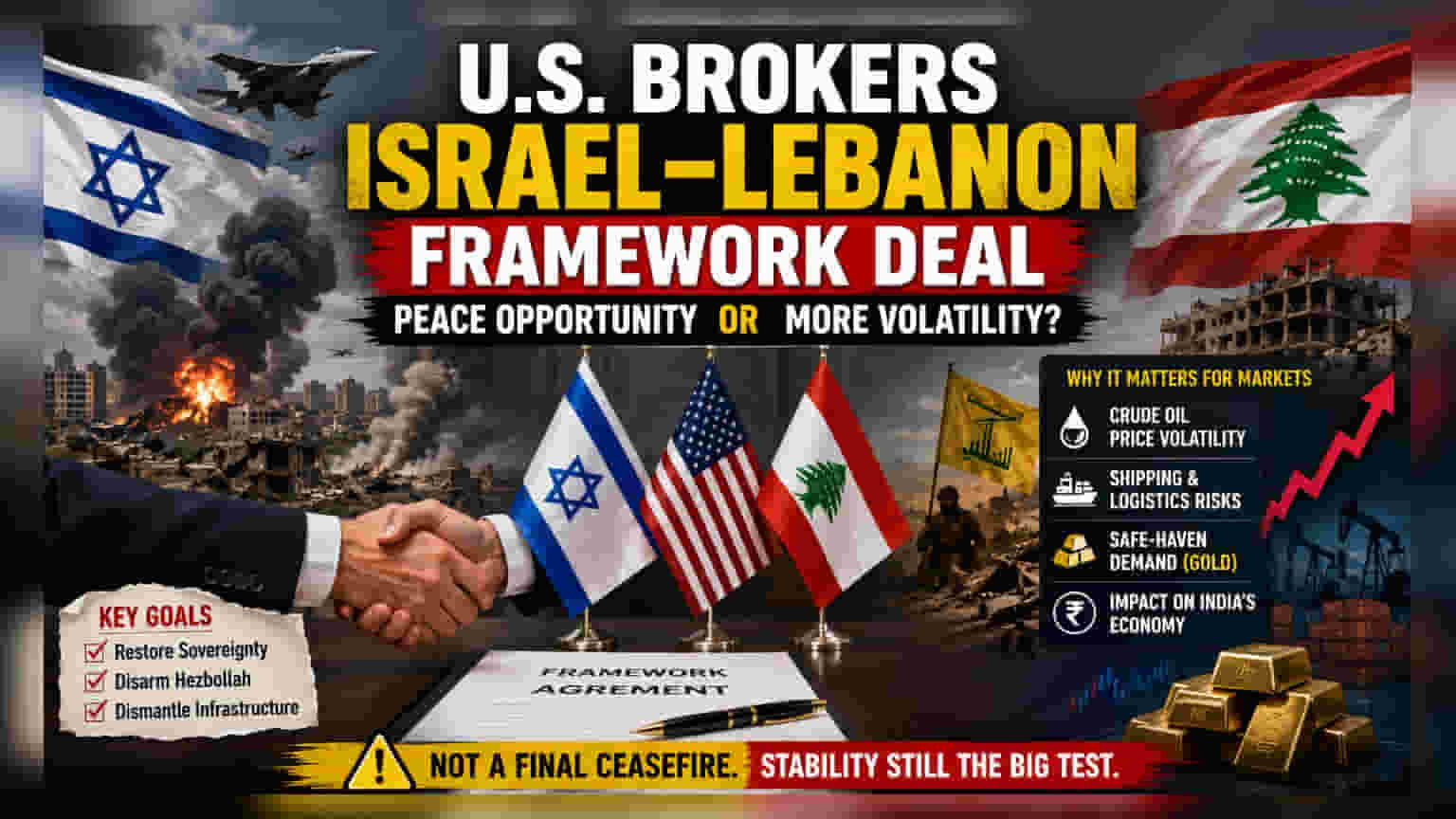
The United States has brokered a framework agreement between Israel and Lebanon aimed at restoring sovereignty and disarming Hezbollah. While the deal is being framed as an initial step, the persistence of military operations and the absence of Hezbollah from talks suggest high uncertainty. For Indian investors, the region’s stability is closely tied to global crude oil prices, shipping logistics, and inflationary risks.
What Happened
The United States has brokered a framework agreement between Israel and Lebanon. The primary stated goals of the deal are to restore Lebanese sovereignty, disarm Hezbollah, and dismantle its infrastructure in the region. U.S. Secretary of State Marco Rubio described the agreement as an initial step, while acknowledging that significant work remains to implement the terms. Despite the announcement, conflict persists on the ground, with reports of continued military activity and air raids in southern Lebanon. Hezbollah was not a party to the discussions in Washington, and there is no confirmed consensus on the specifics of an Israeli withdrawal.
Why It Matters For Global Markets
The Middle East is a critical region for global energy supplies. Instability in this area frequently impacts global crude oil prices. For the Indian economy, which imports a significant portion of its crude oil requirements, any escalation or lack of resolution in this conflict can lead to volatility in energy costs. Higher oil prices typically put pressure on the current account deficit and can lead to imported inflation, affecting the profit margins of sectors like aviation, paints, tyres, and oil marketing companies.
Impact On Indian Economic Sectors
Beyond energy, conflict in this region can disrupt maritime logistics. The route is vital for global trade, and increased military presence or security risks can lead to higher shipping freight rates and insurance premiums. Indian exporters and importers relying on these shipping lanes may face higher operating costs if the situation remains volatile. Additionally, any sustained uncertainty tends to drive global investors toward safe-haven assets like gold, which can influence domestic commodity prices and currency markets.
The Stability Test
The agreement is currently described as a framework rather than a final ceasefire. The reality on the ground includes reports of Israel maintaining operations in parts of southern Lebanon, with Israeli officials linking any withdrawal to the disarmament of Hezbollah and the security of their borders. The fact that the primary combatant, Hezbollah, was not involved in the talks and has expressed mistrust indicates that the path to a lasting peace remains complex. Investors should understand that until a tangible and verified de-escalation occurs, the geopolitical risk premium in energy and logistics markets is unlikely to dissipate.
What Investors Should Track
The most important monitorables for investors are global Brent crude oil prices and shipping freight indices. Monitoring commentary from major global oil producers and shipping logistics firms regarding route safety will provide better insight into the potential economic impact than headlines alone. Furthermore, any updates on the implementation of the trilateral Military Coordination Group mentioned in the deal will be a key signal for whether the agreement is moving toward a functional reality or remains a diplomatic framework with limited impact on the ground.