

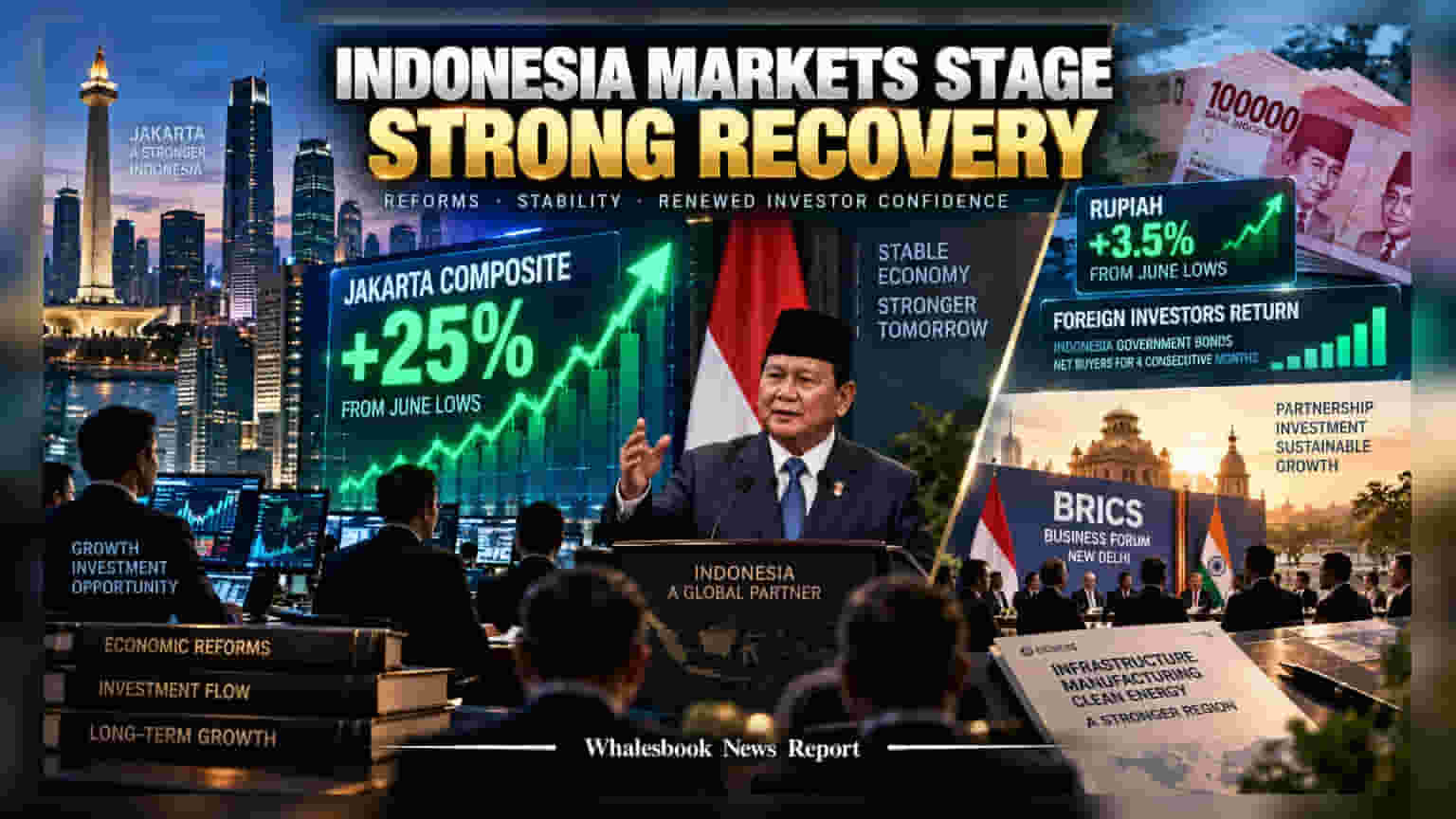
Indonesia’s financial markets have rebounded 25% from June lows, supported by fiscal discipline and four months of foreign bond buying. However, the market remains down roughly 23% year-to-date. Investors are now watching President Prabowo Subianto’s upcoming BRICS visit to New Delhi, where the focus will be on transitioning the nation into a manufacturing hub amidst persistent concerns regarding policy execution.
Indonesia's equity market and currency are witnessing a turnaround after a challenging period. The Jakarta Composite Index (JCI) has recovered 25% from its June lows, moving back into positive territory on a short-term basis. However, for investors looking at the full year, the market is still facing a 23% decline year-to-date, reflecting the volatility experienced earlier in 2026. This recent rebound follows a shift in sentiment driven by specific fiscal and regulatory measures.
The improvement is largely attributed to government actions aimed at stabilizing the economy. President Prabowo Subianto has emphasized a commitment to budget discipline, while regulators have taken steps to address transparency concerns previously highlighted by global index providers like MSCI. This has helped bolster the Rupiah, which has strengthened by over 3.5% from its record lows seen in June. Furthermore, foreign investors have returned to Indonesian government bonds, remaining net buyers for four consecutive months.
The focus is now shifting to the BRICS Business Forum in New Delhi, where President Prabowo is scheduled to attend on September 12-13. The administration is working to reposition Indonesia as a global manufacturing and production hub, aiming to move beyond its historical dependence on raw material exports. The government is highlighting existing investment relationships involving international and Indian conglomerates such as Mahindra and GMR, alongside major players in the electric vehicle supply chain like CATL and BYD.
To facilitate this growth, the government is promoting Danantara Indonesia, its sovereign wealth fund. Established in 2025, the fund has consolidated significant state-owned assets—including the acquisition of four state-owned asset managers in July 2026—to serve as a primary co-investment partner. The plan is to present this entity to global investors as a stable partner for large-scale infrastructure and sustainable development projects, potentially in collaboration with the New Development Bank.
Despite the improved sentiment, market participants remain cautious. The benchmark index is still nearly 15% lower than it was a year ago, and skepticism regarding the execution of these policies continues to temper optimism. Risks persist in the form of bureaucratic instability, potential government intervention in markets, and external pressures like high oil prices and unpredictable global monetary policy. For investors, the most critical monitorable will be whether these high-level investment partnerships and policy promises translate into tangible project execution and sustained economic growth.