

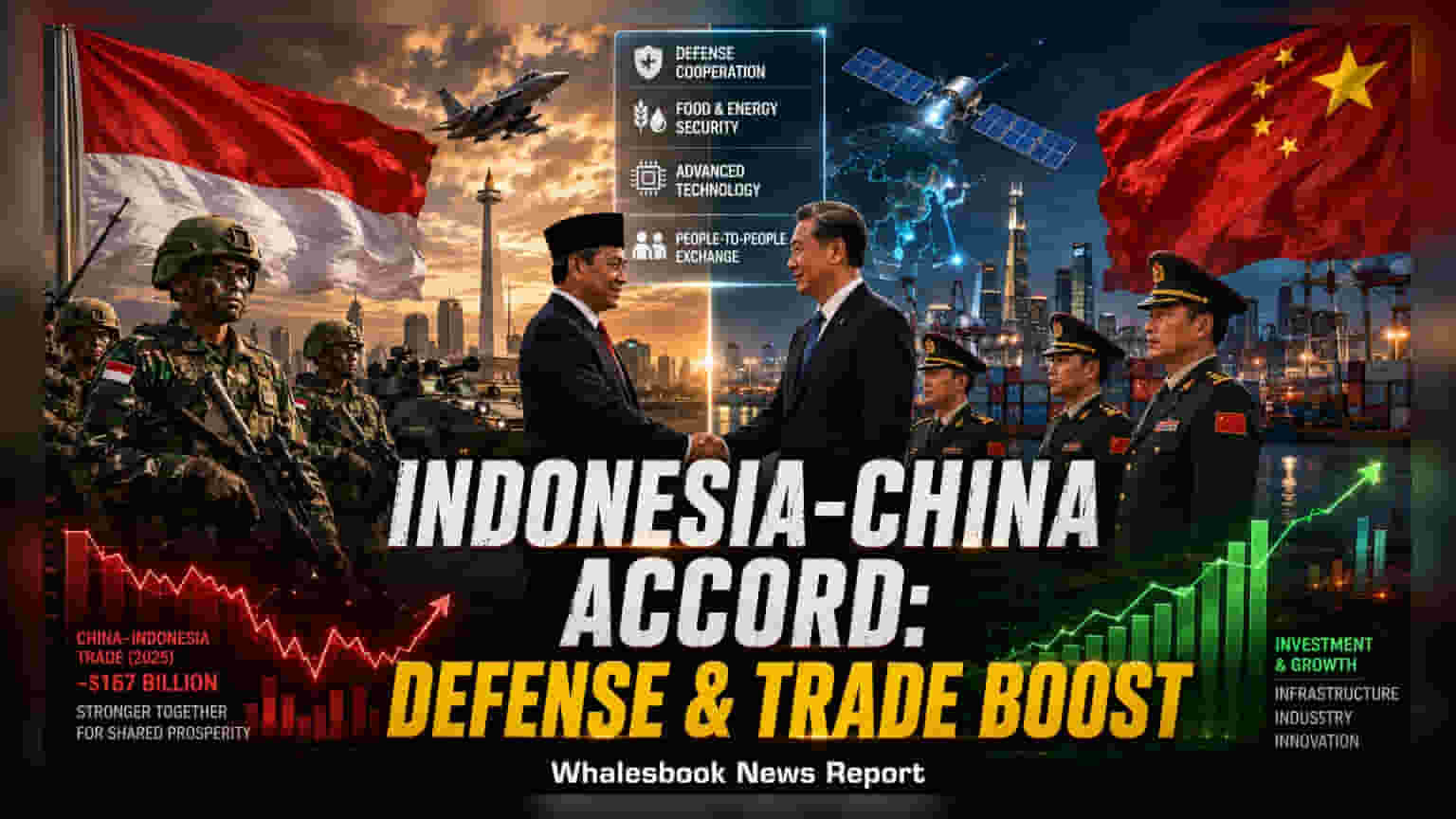
Indonesia and China have established a new high-level framework to deepen cooperation in defense, trade, and technology. The agreement aims to secure mineral and energy supply chains while fostering development in AI and satellites. Investors should watch how this shifts regional industrial policy and manages the complex geopolitical balance between global powers.
Indonesia and China have formalized a new Comprehensive Strategic Dialogue and held their second '2+2' foreign and defense ministerial meeting in Jakarta, marking a significant step in bilateral relations. The agreement focuses on strengthening ties across defense, food and energy security, and advanced technology. For the markets, this signals a deepening of the economic interdependence that has characterized the relationship between Southeast Asia's largest economy and its biggest trading partner.
The framework covers a broad spectrum of cooperation, including political, maritime, and people-to-people exchanges. A key focus is the modernization of defense capabilities and industrial development. Both nations emphasized cooperation in emerging technologies, specifically mentioning artificial intelligence and the joint development of communication satellites. This push suggests a strategic intent to move beyond traditional commodity trade into higher-value technology sectors, which could have long-term implications for industrial policy in the region.
Economic relations between the two nations have expanded rapidly, with bilateral trade reaching approximately $167 billion in 2025. China is currently the largest trading partner for Indonesia and a major source of foreign direct investment. This capital has been critical for Indonesia’s strategy to develop downstream industries, particularly in the nickel processing and electric vehicle (EV) battery supply chain. Major infrastructure projects, such as the Jakarta-Bandung high-speed railway and various renewable energy initiatives, underscore this heavy reliance on Chinese financing and technical expertise.
While the agreement highlights growth potential, it also brings specific monitorables for investors and global observers. Indonesia continues to navigate a delicate geopolitical balancing act, maintaining strong ties with Beijing while managing its relationships with other major global powers. Tensions in the South China Sea remain a recurring point of friction that can impact regional stability and shipping logistics.
Furthermore, the industrial landscape remains subject to regulatory volatility. Chinese companies operating in Indonesia have previously faced challenges related to local policy shifts, such as changes in mining royalties and adjustments to nickel production quotas. These policy decisions can create operational uncertainty for firms heavily invested in the region's extraction and processing sectors. Additionally, dependency risks persist; heavy reliance on Chinese outbound investment means that any shifts in Beijing's own regulatory environment regarding foreign capital could influence the pace and funding of future infrastructure and industrial projects in Indonesia.
As the Comprehensive Strategic Dialogue progresses, the primary focus for market observers will be the tangible implementation of these agreements. Investors may track future developments in satellite and AI technology partnerships, as well as any updates regarding the stability of mineral export policies, which remain vital for both the local economy and international supply chains.