 Whalesbook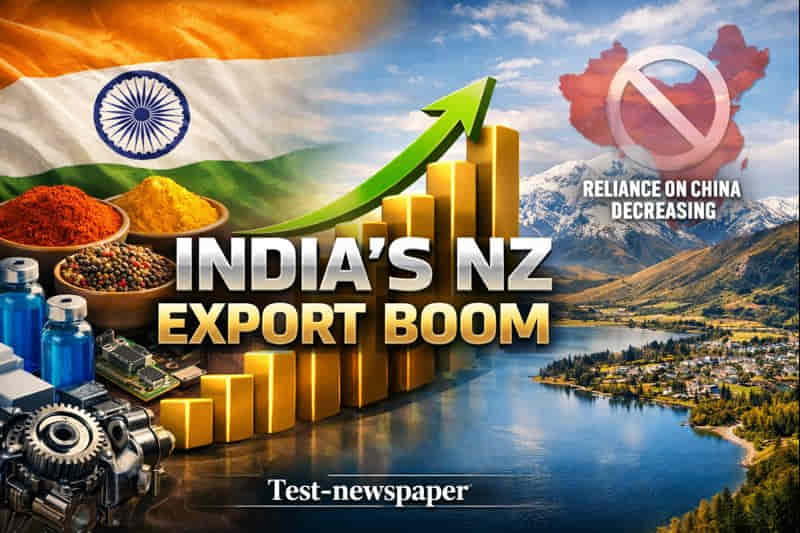
India Poised for Major Export Gains in New Zealand
Indian businesses are poised to tap into a substantial market in New Zealand, potentially worth billions of dollars, while simultaneously aiding Wellington in its strategic goal of reducing dependence on China. A recent report by the think tank GTRI identifies significant untapped export opportunities across numerous sectors, from agriculture and pharmaceuticals to electronics and automotive components. This comes as New Zealand continues to import a vast majority of its goods from China.
The Core Issue
New Zealand's import landscape is heavily dominated by China, which supplied over $10 billion worth of goods in 2024-25, dwarfing India's $711 million share. With total annual imports reaching $50 billion, GTRI believes India is strategically positioned to capture a larger slice of this market, especially given the existing bilateral free trade agreement. This presents a dual opportunity: for India to expand its export footprint and for New Zealand to diversify its supply chains.
Untapped Potential Across Sectors
The report details promising avenues for Indian exporters. In processed foods, New Zealand imports around $250 million annually, with India currently supplying only $6.5 million, a fraction of China's $21 million share. Similar gaps exist in food preparations, where India's global exports are substantial, yet its New Zealand share is minimal.
Commodities and Manufacturing
Significant under-penetration is also noted in refined petroleum products, a sector where India is a global powerhouse but supplies New Zealand merely $2.3 million out of its $6.1 billion annual imports. Aluminium oxide, industrial chemicals, and pharmaceuticals also show large import figures for New Zealand with marginal Indian contribution compared to China.
Apparel and Technology
Even in sectors where India has established global competitiveness, like women's woven apparel and telecom equipment, the penetration in New Zealand remains low. India's global apparel exports are $3 billion, but its share in New Zealand's $179 million import market is only $9.8 million, far behind China's $112 million. The electronics and automotive sectors exhibit similar patterns, with India supplying only a small fraction of New Zealand's import needs.
Challenges and Way Forward
GTRI founder Ajay Srivastava points out that in many of these product categories, Chinese competition is minimal or India has a clear competitive edge. The primary challenge for India now lies in effectively leveraging the bilateral free trade agreement. This requires a concerted effort involving targeted export promotion strategies, cooperation on standards, facilitation of regulatory processes, and robust logistics support to bridge the existing gaps.
Impact
This development could lead to substantial growth for Indian export-oriented companies, boosting foreign exchange earnings and creating employment. For New Zealand, it signifies a move towards greater supply chain resilience and economic diversification. Investors in sectors identified by GTRI, such as agriculture, pharmaceuticals, textiles, and electronics, may see increased opportunities. An impact rating of 7/10 is assigned due to the significant economic potential and strategic implications for both nations.
Difficult Terms Explained
- Bilateral Free Trade Agreement: An agreement between two countries to reduce or eliminate trade barriers like tariffs and quotas, making it easier for businesses to trade goods and services between them.
- GTRI (Global Trade Research Initiative): An independent think tank that analyzes global trade trends and policies to provide research and recommendations.
- Imports: Goods or services brought into a country from another country for sale.
- Exports: Goods or services sent to another country for sale.
- Supply Chain: The entire process of producing and delivering a product or service, from raw materials to the final customer.
- Tariffs: Taxes imposed by a government on imported goods.
- Quotas: Limits set by a government on the quantity of a particular good that can be imported.