 Whalesbook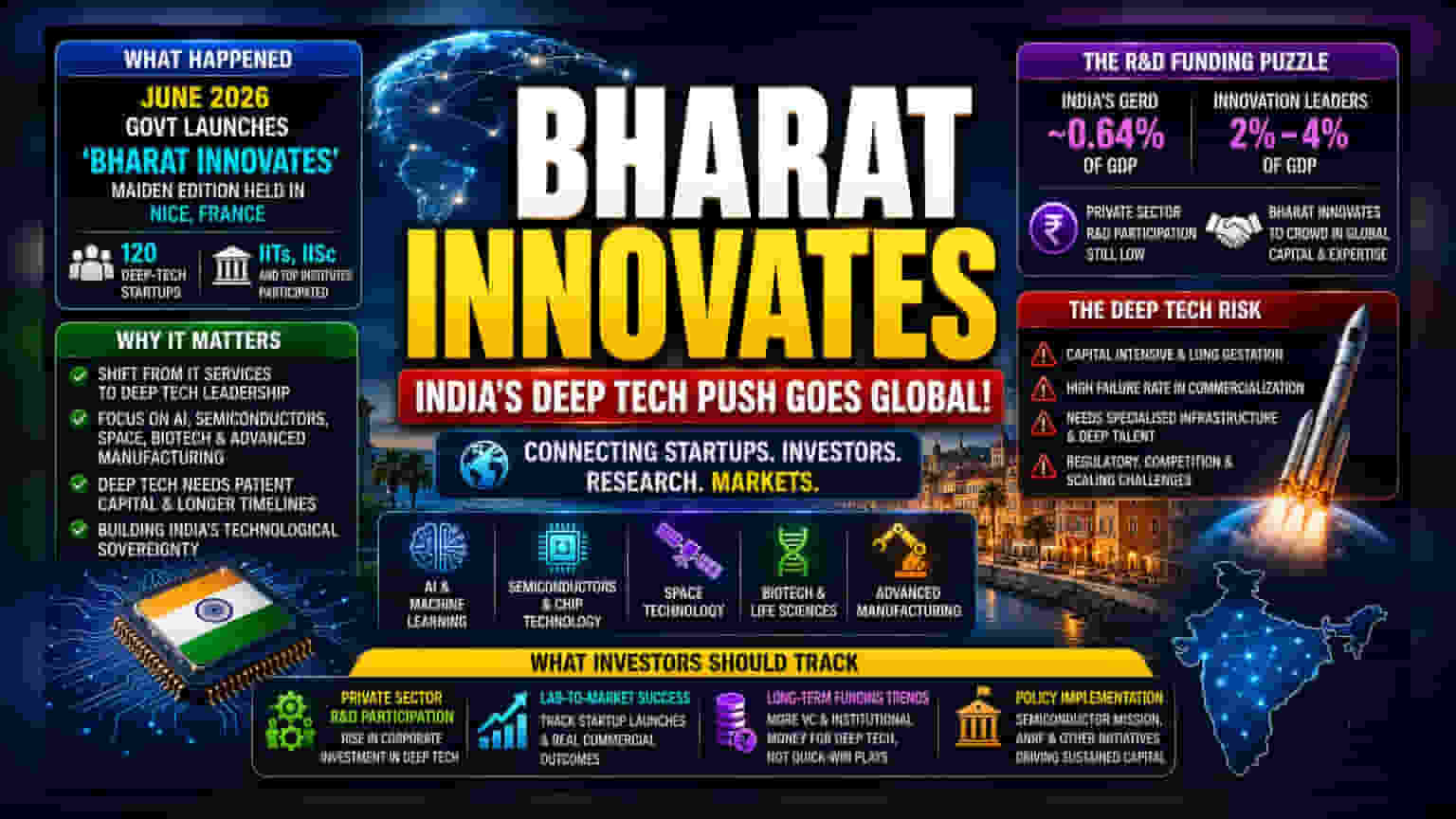


India launched the 'Bharat Innovates' platform in France, showcasing 120 deep-tech startups to global investors. The initiative marks a strategic move to pivot from basic manufacturing to high-value technology creation. For investors, this signals a long-term focus on sectors like AI, semiconductors, and biotech, though success will depend on bridging the gap between research and commercialization.
What Happened
In June 2026, the Indian government launched 'Bharat Innovates,' a high-profile platform designed to connect India's deep-tech ecosystem with global markets, investors, and research institutions. The maiden edition took place in Nice, France, bringing together 120 selected deep-tech startups, alongside premier Indian academic institutions like the IITs and IISc. The platform acts as a global accelerator, aiming to help these startups move from lab-scale prototypes to market-ready products through partnerships with international capital and industry leaders.
Why This Matters For Investors
For the Indian investment landscape, this represents a structural pivot. Traditionally, India's tech sector has been dominated by IT services—a model built on incremental innovation and labor-based value. 'Bharat Innovates' highlights a push toward 'Deep Tech'—sectors that involve foundational research such as Artificial Intelligence (AI), semiconductors, space technology, biotechnology, and advanced manufacturing.
This shift is important because deep-tech companies operate differently from software-as-a-service (SaaS) or IT services firms. They are typically more capital-intensive, have longer development cycles, and require 'patient capital'—investment that does not demand immediate, short-term returns. Investors who look at these sectors need to adjust their expectations for profitability, as commercializing these technologies often requires years of R&D before reaching scale.
The R&D Funding Puzzle
One of the critical monitorables for this initiative is India's Research and Development (R&D) expenditure. Data consistently shows that India’s Gross Expenditure on R&D (GERD) hovers around 0.64% of GDP. This is significantly lower than the 2% to 4% range seen in innovation-led economies like the US, South Korea, or China.
Government officials and policy experts have emphasized that achieving developed nation status by 2047 will require a substantial increase in this spending. The success of the 'Bharat Innovates' mission will hinge on whether this public push can effectively crowd in private sector capital. Historically, the private sector's contribution to India's R&D has been lower than in other major economies, and this platform is clearly designed to invite global partners to help fill that funding and expertise gap.
The Deep Tech Risk
While the goal of technological sovereignty—owning the intellectual property and the underlying research—is ambitious, it comes with specific risks. Deep-tech ventures are inherently risky due to the complexity of the science involved and the long timeframes required to bring products to market.
There is also the execution risk. Building a semiconductor or biotech startup requires not just money, but highly specialized infrastructure and a steady pipeline of talent. Investors should consider that not all startups in these fields will succeed. The transition from an innovative idea to a mass-market product is where many deep-tech ventures struggle. Companies and the broader sector must navigate regulatory environments, compete with established global players, and overcome the challenge of scaling complex manufacturing processes.
What Investors Should Track
Investors may monitor a few key indicators to gauge the success of these initiatives over the coming years:
- Private Sector R&D Participation: Watch for changes in how much the private sector contributes to total R&D spending in India. Increased corporate investment in deep tech is a strong signal of commercial viability.
- Lab-to-Market Success: Track the progress of institutional partnerships formed through platforms like 'Bharat Innovates.' Success is measured not by the number of agreements signed, but by how many startups successfully launch scalable, commercial products.
- Long-Term Funding Trends: Look for an increase in venture capital and institutional funding specifically allocated to long-gestation, deep-tech categories, rather than short-term consumer tech plays.
- Policy Implementation: Developments in government missions (such as the Semiconductor Mission or the Anusandhan National Research Foundation) will be key indicators of how much sustained capital is flowing into the ecosystem.