 Whalesbook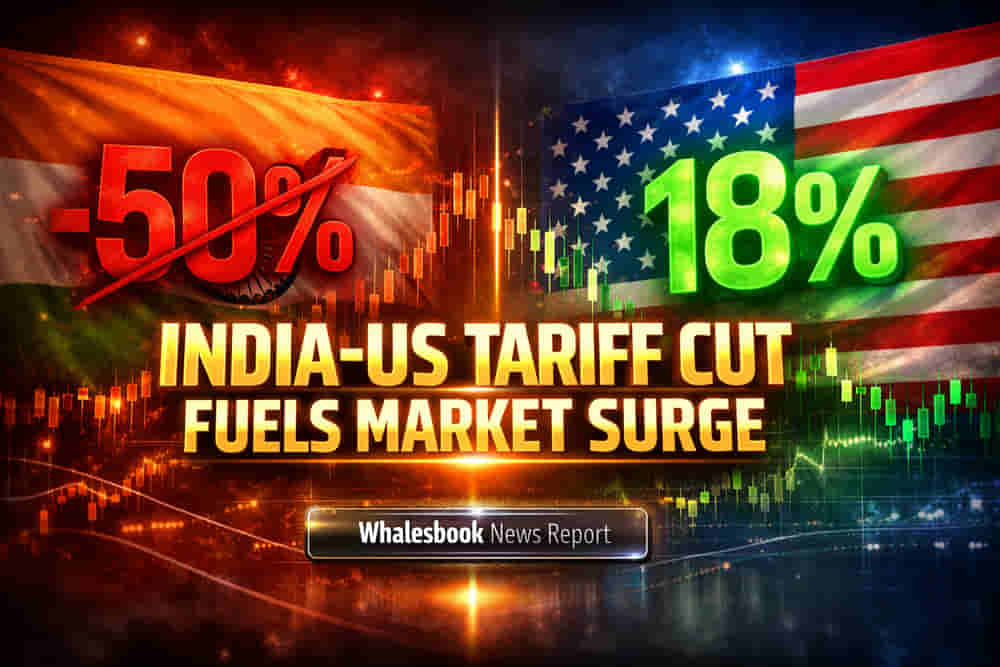
1. THE SEAMLESS LINK (Flow Rule):
The announcement of a reduced US tariff on Indian goods, bringing the rate down from a punitive 50% to 18%, has catalyzed a robust market rally, with benchmark indices and market capitalization experiencing substantial gains. This tariff rollback addresses a critical uncertainty that had previously weighed on export-heavy industries, fostering renewed optimism for businesses and investors alike. The pact is being interpreted not merely as a reduction in trade friction but as a strategic realignment, enhancing India's competitive standing on the global stage and supporting its ambition to become a manufacturing hub.
The Strategic Rebalancing: Beyond Tariff Relief
The core impact of the India-US trade agreement extends beyond the immediate reduction of tariffs. The move is a clear indicator of a strategic pivot, aimed at rebalancing global trade relationships and bolstering supply chain resilience in an increasingly uncertain geopolitical climate [2, 35]. For sectors such as textiles, leather, gems and jewellery, and marine exports, the 18% tariff rate provides a much-needed competitive edge, particularly when compared to regional peers whose tariffs can range from 20-30% [9]. The US accounts for approximately 20% of India's merchandise exports, making this tariff adjustment pivotal for sustained growth [2]. Industry leaders like CII President Rajiv Memani highlighted that the deal removes a significant "tariff overhang," bolstering India's growth narrative and aligning with 'Make in India' objectives [2, 10]. Amit Kalyani of Bharat Forge noted that the agreement provides "building blocks" to scale the strategic relationship, offering clarity for long-term engagement with customers and positioning Indian manufacturing capabilities for high-end technology alignment [2]. The broader market capitalization saw an addition of over ₹12 lakh crore in a single session, with the Sensex and Nifty indices surging approximately 2.5% [3, 17]. The rupee also strengthened against the dollar [2, 7, 17].
Sectoral Resilience and Emerging Opportunities
The immediate beneficiaries are the labour-intensive sectors that bore the brunt of previous tariffs. The gems and jewellery sector, for instance, saw exports plummet by up to 60% for cut and polished diamonds in the preceding nine months due to high duties [1, 2]. A reduction to 18% is a significant reprieve, with hopes for a potential 0% duty on loose diamonds and gemstones to further boost the sector [1]. Similarly, textile and apparel stocks experienced sharp surges, with many hitting upper circuit limits [3, 12]. The defence sector anticipates a scaling up of its strategic relationship with India's manufacturing capabilities in components and subsystems complementing US technological strengths [1, 2]. Companies in the capital goods and industrial sectors with existing US exposure are also set to benefit from improved price competitiveness [9]. While the direct impact on the earnings of large listed corporates might be limited according to some analysts, the deal is crucial for privately held MSMEs and low-margin manufacturers [11]. The agreement also seeks to encourage India to reduce purchases of Russian oil, potentially pivoting towards US energy exports, a move that could significantly alter global energy dynamics [2, 29].
The Road Ahead: Implementation and Future Outlook
While the market has reacted positively, analysts emphasize that the long-term benefits hinge on the effective implementation of the deal and the smooth resolution of any remaining details, famously encapsulated by Nilesh Shah's sentiment that "devil is always in the details" [1, 4, 7, 36]. The agreement comes on the back of other trade pacts, including with the EU and UK, strengthening India's global economic positioning [2, 26]. For multinational firms operating in India, the deal offers reduced tariff risk, greater policy certainty, and improved investor sentiment [2]. The reduction in tariffs from 50% to 18% brings India's rates in line with its peers, such as Vietnam (20%) and Southeast Asian countries (19%), enhancing its attractiveness as an alternative manufacturing hub to China [7]. The potential boost to India's GDP growth is estimated to be around 0.2 to 0.3 percentage points this year, pushing it closer to 7% [7]. Analysts foresee this pact complementing India's broader trade strategy, which includes diversification and forging new FTAs [2]. The sector now looks towards sustained growth driven by these improved trade conditions and India's strengthening position in global supply chains.