

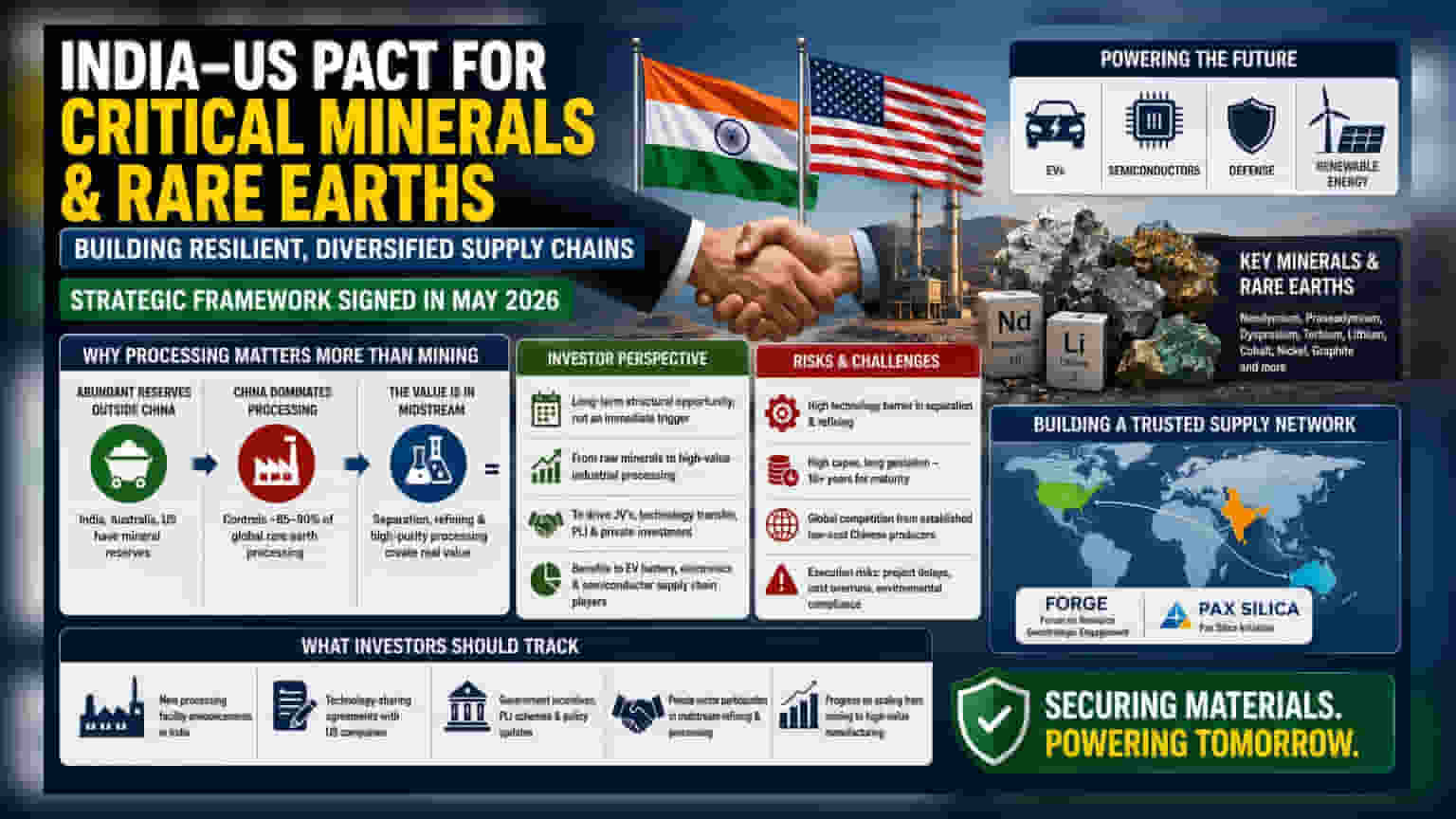
India and the US signed a framework in May 2026 to secure critical mineral supply chains, moving beyond simple mining to focus on local processing and technology development. This shift aims to reduce long-term dependence on Chinese refining capacity for materials vital to EVs, defense, and electronics. Investors should note that building this industrial ecosystem is a long-term, capital-intensive effort rather than an instant business win.
What Happened
In May 2026, India and the United States signed a strategic framework dedicated to the mining, processing, and recycling of critical minerals and rare earths. The agreement aims to build resilient, diversified supply chains for materials that are essential for modern technology, including electric vehicles (EVs), semiconductors, defense equipment, and renewable energy infrastructure. This pact is part of a broader shift in geopolitical and industrial strategy, building on earlier initiatives such as the Forum on Resource Geostrategic Engagement (FORGE) and the Pax Silica initiative, to create a trusted network of supply that is less vulnerable to single-source monopolies.
Why Processing Matters More Than Mining
For decades, the global rare earth market has been defined by a significant structural imbalance. While countries like India, Australia, and the US possess natural mineral reserves, they have lacked the advanced, large-scale industrial infrastructure required to refine these raw materials into usable, high-purity components. China currently dominates this sector, controlling a massive share of global processing and refining capacity.
This is not merely about owning the ground where minerals are found; it is about the complex, multi-stage chemical processes required to separate and refine these elements. Establishing these facilities requires specialized technology, significant capital expenditure, and strict environmental compliance. Consequently, securing raw material access is only the first step. The true strategic goal of the India-US framework is to develop the "midstream" capacity—the ability to process, separate, and manufacture components domestically—which is where the real value and competitive advantage lie.
The Investor Perspective
For Indian investors, this framework represents a long-term structural change rather than an immediate financial catalyst for the mining sector. The transition from raw material extraction to high-value industrial processing is complex and takes time. Mining projects, from initial exploration to full-scale operational maturity, often require a decade or more to develop.
The framework is likely to encourage investment from both public sector undertakings (PSUs) and private players looking to enter the EV and electronics component space. Investors should watch for government policy updates, production-linked incentives (PLI), and joint ventures that facilitate technology transfers from the US. The economic benefit will likely accrue to companies that can successfully bridge the gap between mining and high-value manufacturing, such as those in the EV battery supply chain or semiconductor material space.
Risks And Challenges
Investors should be aware of the inherent risks in this sector. First, the technology barrier is high; establishing world-class separation and refining facilities requires expertise that is currently concentrated in a few global hubs. Second, the cost of capital for these greenfield projects is significant, and the long gestation periods mean cash flows will not be immediate. Third, there is intense global competition, and the domestic industry must ensure that its output is cost-competitive compared to established, large-scale Chinese producers who benefit from decades of economies of scale. Execution risk, including project delays and cost overruns, remains a primary concern for any new large-scale industrial initiative.
What Investors Should Track
Moving forward, the success of this strategic partnership will depend on concrete operational developments. Investors may track the announcement of new processing facility projects, updates on technology-sharing agreements between Indian and US firms, and any specific government incentives that target the midstream refining segment. Monitoring the progress of private sector participation in critical mineral refining will be essential to gauge whether India can effectively climb the value chain and move beyond being a mere supplier of raw minerals.