 Whalesbook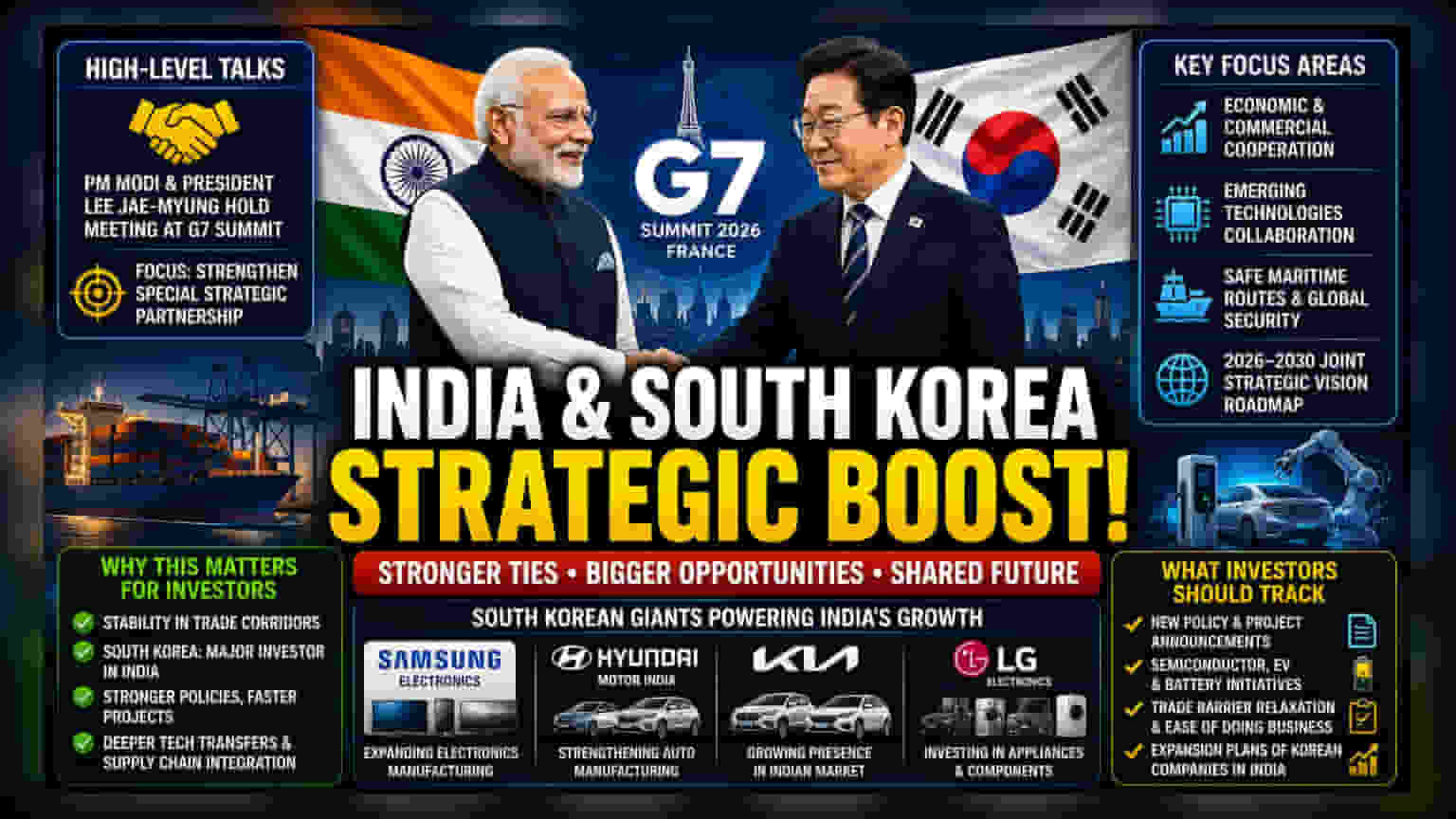


Prime Minister Narendra Modi and South Korean President Lee Jae-Myung have agreed to enhance economic and technology cooperation at the G7 Summit. This diplomatic alignment highlights the expanding trade relationship between the two nations, impacting key sectors like electronics, manufacturing, and supply chain infrastructure where South Korean corporations have a major footprint in India.
What Happened
Prime Minister Narendra Modi and South Korean President Lee Jae-Myung held high-level discussions on the sidelines of the G7 Summit in France. The two leaders focused on strengthening the Special Strategic Partnership between India and South Korea, with a specific emphasis on expanding collaboration in economic, commercial, and emerging technology sectors. This meeting builds upon an earlier agreement established during President Lee’s visit to India in April, which set a roadmap for the 2026-2030 period. Beyond trade, the dialogue also addressed global security issues, including the importance of safe maritime routes for international commerce.
Why This Matters For Investors
For investors, this diplomatic move is significant because it reinforces the stability and potential growth of trade corridors between India and South Korea. South Korea is one of the largest investors in the Indian manufacturing sector. Stronger bilateral ties often translate into smoother regulatory environments, faster project approvals, and deeper technology transfers. As India continues to focus on becoming a global manufacturing hub, the alignment with South Korean expertise in electronics, automobiles, and industrial machinery is a critical factor for long-term growth in these sectors.
The Corporate Landscape
Several large South Korean conglomerates have deep roots in India, making the success of this strategic partnership vital for their Indian operations. Companies like Samsung, Hyundai Motor India, Kia, and LG Electronics have significant manufacturing footprints in the country. Increased cooperation in emerging technologies—such as semiconductors, electric vehicle (EV) batteries, and advanced electronics—could lead to further capital investments by these companies in India. Investors often monitor these diplomatic developments to gauge whether Korean firms will increase their capacity or introduce newer product lines in the Indian market.
Strategic Focus Areas
The commitment to the 2026-2030 Joint Strategic Vision highlights a long-term interest in deepening the integration of supply chains. South Korea is a leader in advanced manufacturing, and India’s push for indigenous production capabilities creates a natural synergy. Discussions on maritime security also reflect the sensitivity of global trade routes, such as the Strait of Hormuz, to Indian and Korean economic interests. Any disruption in these vital shipping lanes can impact input costs for manufacturing companies that rely on global supply chains for raw materials and components.
What Investors Should Track
Investors may monitor the progress of specific projects or policy updates that stem from this strategic partnership. Key monitorables include any new announcements regarding semiconductor manufacturing, EV supply chain incentives, or further relaxation of trade barriers. Additionally, observing the operational updates and expansion plans of South Korean companies listed in or operating within India can provide clues about the actual impact of these diplomatic ties on the ground. The next important step will be seeing how the government translates these high-level commitments into practical business policy and ease-of-doing-business improvements in the coming quarters.