

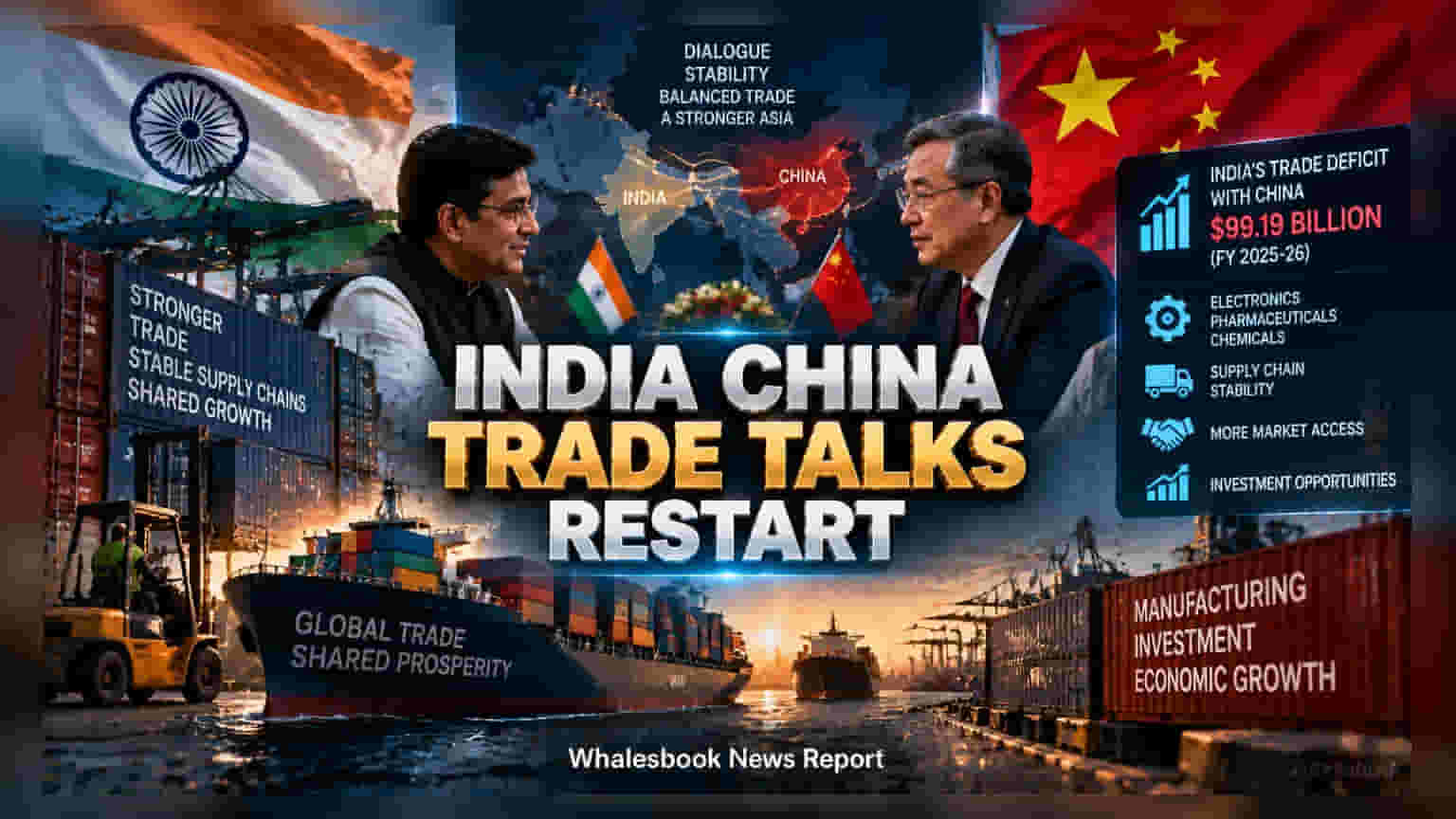
India and China have resumed trade discussions to address structural imbalances and supply chain concerns. For investors, the key focus remains the $99.19 billion trade deficit and the heavy reliance on Chinese imports for critical sectors like pharmaceuticals and electronics.
India and China have officially resumed trade discussions, marking a shift in bilateral economic engagement after a significant break. Commerce and Industry Minister Piyush Goyal and Chinese Commerce Minister Wang Wentao held initial talks on September 12, 2026, to discuss structural trade imbalances and supply chain stability. These meetings follow broader bilateral engagements, including discussions held on the sidelines of the recent BRICS Summit.
The central issue driving these discussions is India’s trade deficit with China, which reached $99.19 billion in the 2025-26 fiscal year. For the Indian economy, this gap highlights a heavy dependence on Chinese goods across several critical manufacturing and consumption sectors. While the resumption of talks is viewed as a confidence-building step, the discussions are currently in their preliminary stages with no immediate structural changes announced.
For investors, the outcome of these talks carries implications for several industries. Sectors such as pharmaceuticals, electronics, and chemicals continue to rely significantly on Chinese imports for essential components, including Active Pharmaceutical Ingredients (APIs) and raw materials. Any shift in trade policy, such as changes in tariffs or supply chain logistics, could influence the cost structures and raw material availability for companies in these fields. While India is aggressively pushing for self-reliance through various production-linked incentive (PLI) schemes, the immediate transition remains dependent on existing supply chains.
Another critical area for investors to monitor is the regulatory framework surrounding Foreign Direct Investment (FDI). India currently enforces strict rules requiring government approval for investments from countries that share land borders, a policy that significantly limits Chinese capital participation in Indian businesses. Investors should watch to see if these trade dialogues lead to any changes or clarifications in how this policy is implemented, as it remains a key factor for corporate strategy and capital expenditure.
Geopolitical sensitivity remains an ever-present factor that could influence the stability and progress of these negotiations. Furthermore, the broader macroeconomic environment, including global market volatility and foreign institutional investor (FII) flows, will continue to play a larger role in market sentiment than these trade talks alone. The success of this engagement will be measured by concrete steps toward market access and a reduction in trade friction, rather than the initial dialogue itself. Investors should track future exchange filings and government updates for any specific policy shifts, supply chain adjustments, or changes in import-export norms that may impact listed companies in high-dependency sectors.