

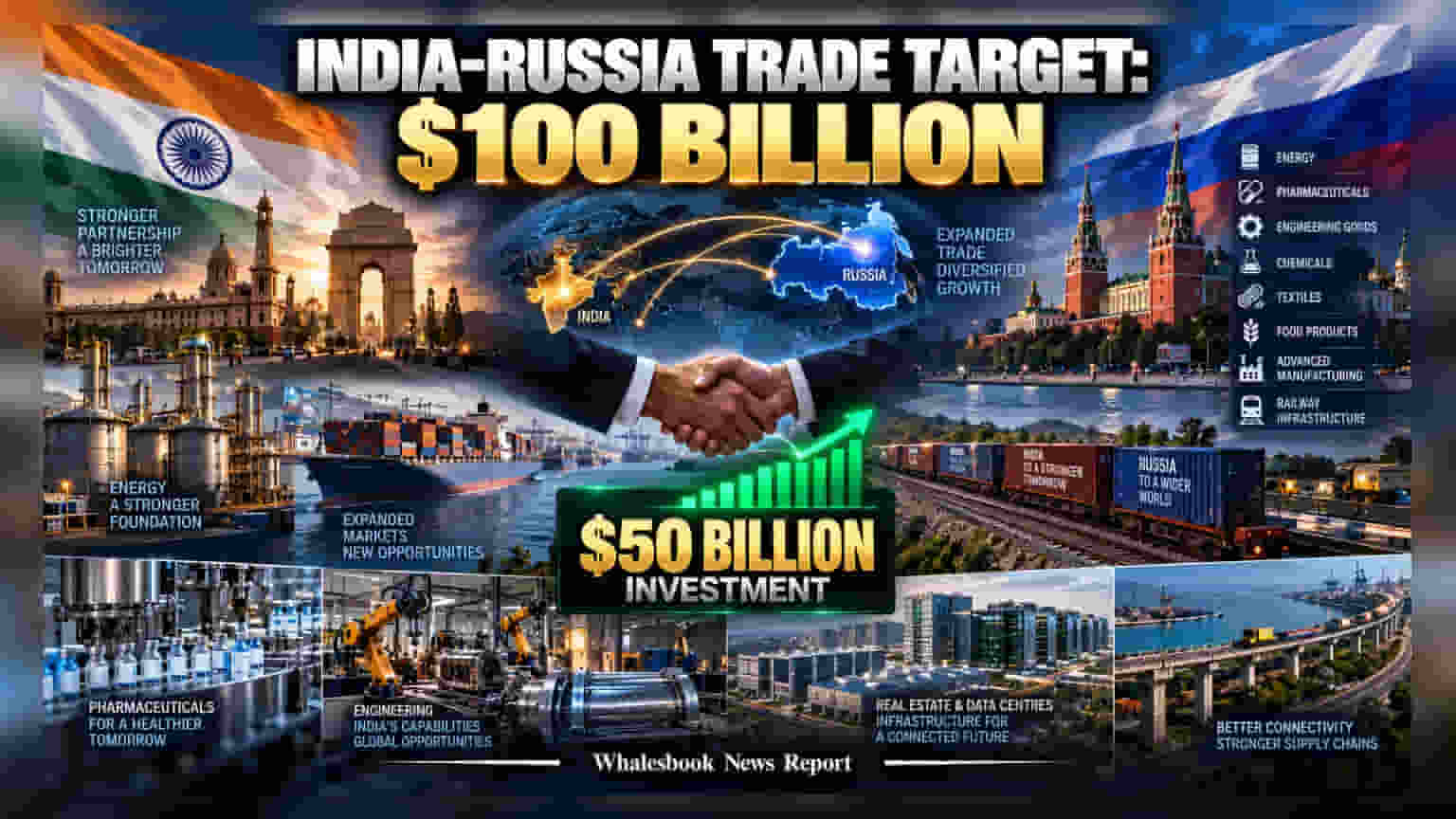
India and Russia aim for $100 billion in bilateral trade and $50 billion in investments by 2030. Achieving this requires moving beyond heavy energy reliance toward sectors like pharma, engineering, and technology.
India and Russia have reaffirmed their commitment to reach $100 billion in bilateral trade and $50 billion in two-way investments by 2030. Commerce Minister Piyush Goyal and Russian Minister of Industry and Trade Anton Alikhanov discussed this roadmap at the INNOPROM India 2026 event held in New Delhi.
The current bilateral trade, which reached approximately $60 billion in FY26, presents a significant structural challenge. A major portion of this—over 80%—is driven by Russian crude oil exports to India. For both nations, reaching the 2030 target requires bridging a $40 billion gap through a major push in non-energy commerce.
To achieve this growth, the government is focusing on diversifying the export basket. Indian sectors such as pharmaceuticals, engineering goods, chemicals, textiles, and food products are seen as key areas for expansion. For Indian businesses and MSMEs, this shift could open new market access, provided that companies can overcome existing logistical constraints and trade barriers.
Beyond just trade volume, the two countries are tracking 40 priority investment projects spanning advanced manufacturing, mining, energy, and railway infrastructure. To facilitate this capital flow, officials are fast-tracking a new bilateral investment treaty, which is expected to provide greater legal certainty and stability for investors on both sides.
Another critical hurdle for businesses is payment and logistics. With global sanctions impacting trade routes and financial messaging systems, both nations are actively working on localized currency settlement mechanisms to bypass traditional payment frictions. Furthermore, transport infrastructure projects like the International North-South Transport Corridor and the Chennai-Vladivostok Maritime Corridor are being prioritized to improve supply chain efficiency.
Investors and businesses should monitor the progress of the ongoing free trade negotiations with the Russia-led Eurasian Economic Union. While these negotiations aim to lower tariffs and simplify market entry, the real-world benefit for Indian exporters will depend on the final tariff terms and how effectively the new logistics corridors are operationalized.
The primary risk for this ambitious target remains the concentration of trade in energy. If the energy market faces significant volatility or if non-energy exports fail to scale at the necessary double-digit pace, the 2030 target may prove difficult to reach. The next major monitorables will be the finalization of the investment treaty and the tangible progress in non-oil export growth figures in upcoming quarters.