

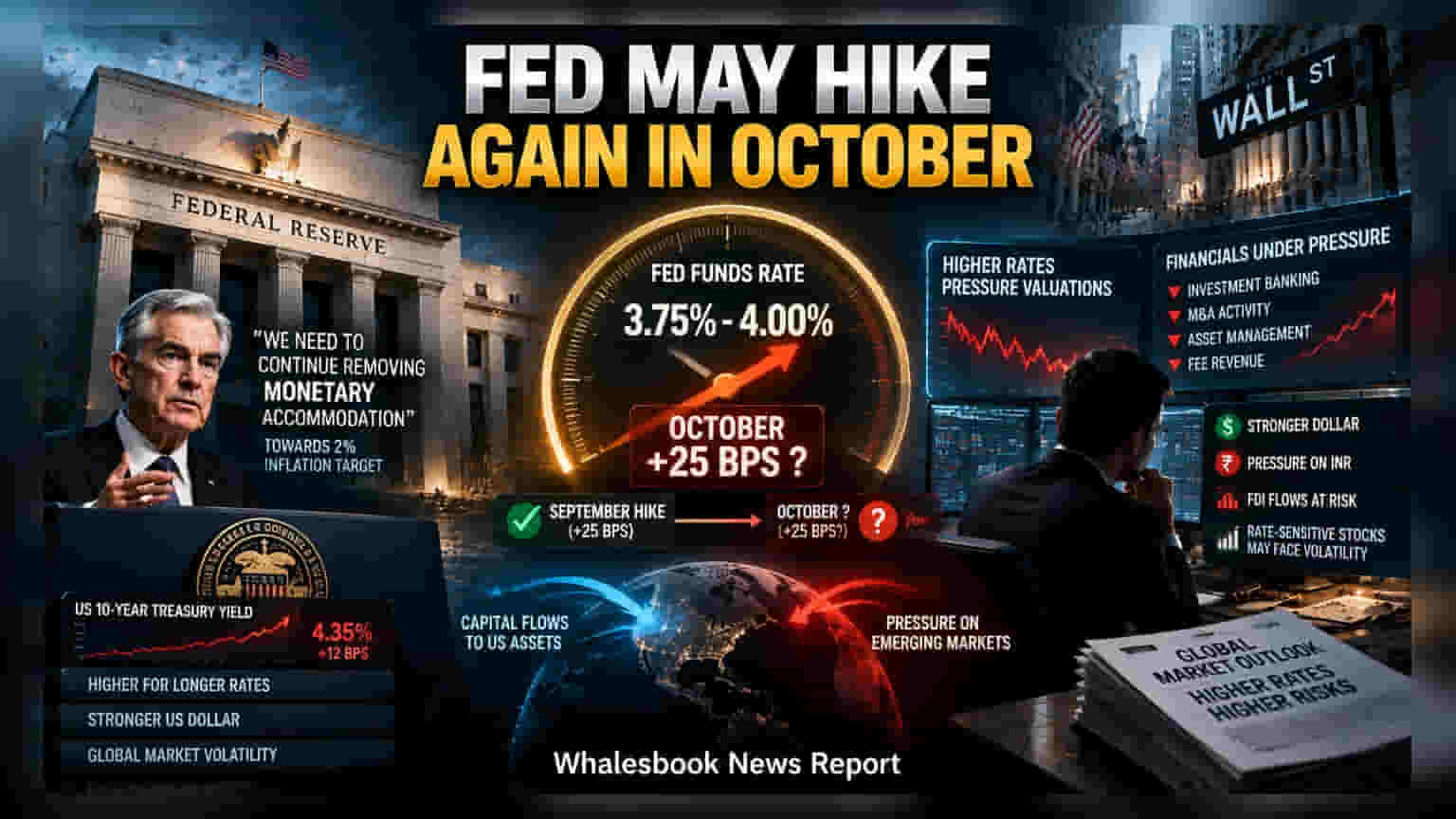
Goldman Sachs has updated its outlook, now projecting a 25-basis-point interest rate hike by the US Federal Reserve in October. This follows the Fed's recent decision to lift rates to a 3.75%-4.00% range. The shift in policy expectations may influence global liquidity, emerging market currency flows, and equity valuations, as higher borrowing costs often weigh on corporate financial performance.
Goldman Sachs has revised its forecast for US monetary policy, now expecting the Federal Reserve to implement another 25-basis-point interest rate hike in October 2026. This change in stance comes immediately after the Fed raised benchmark rates to a range of 3.75%-4.00% on September 16. The brokerage firm noted that the Fed’s recent policy signals were more hawkish than anticipated, citing an elevated median rate path and comments from Fed leadership regarding the need to continue removing monetary accommodation to reach the 2% inflation target.
The shift in outlook is significant for financial markets because it suggests that US borrowing costs could stay higher for a longer period. For Goldman Sachs, which acts as a bellwether for the financial sector, this environment presents structural risks. The bank's shares declined by approximately 3.96% on September 16, reflecting investor concerns about how a prolonged high-interest-rate environment might impact the broader financial industry.
From an institutional perspective, higher interest rates serve as a double-edged sword. While they can support net interest income, they also create pressure on investment banking and asset management divisions. When borrowing costs rise, corporate deal-making, mergers and acquisitions, and debt underwriting volumes often slow down, which can hurt the fee-based revenue that firms like Goldman Sachs rely on. Additionally, higher yields on US Treasury bonds make equities less attractive by comparison, creating downward pressure on valuations across global stock markets.
For Indian investors, the news carries implications for capital flows. When US interest rates rise, global capital often moves toward US dollar-denominated assets, which are seen as safer and offer higher yields. This can create a stronger dollar, leading to depreciation pressure on the Indian rupee and potentially reducing the flow of foreign institutional investment into emerging markets like India. Furthermore, rate-sensitive growth stocks may face volatility as global discount rates increase, making future earnings look less valuable in current terms.
Investors may monitor incoming inflation data and official commentary from the Federal Reserve, as these will determine whether the October hike proceeds as predicted. The primary monitorable for Indian markets will be the behavior of foreign portfolio flows and the stability of the rupee in response to shifting global yield expectations.