

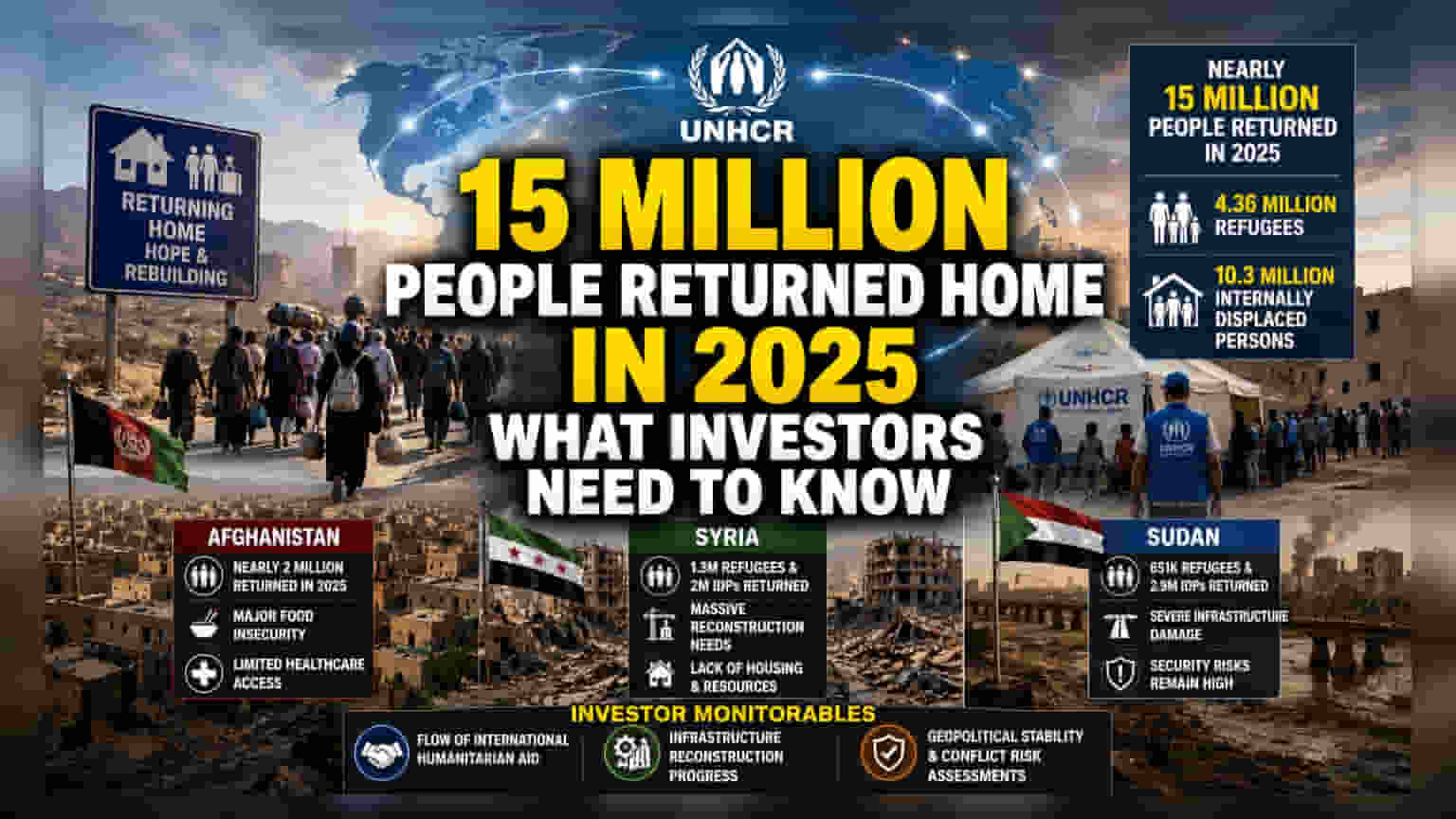
A record 15 million displaced people returned to their homelands in 2025, with major shifts in Afghanistan, Syria, and Sudan. For global investors, these migration patterns serve as indicators for regional stability, potential infrastructure needs, and long-term economic risks. Understanding these trends is critical for assessing the geopolitical landscape and supply chain reliability in frontier markets.
What Happened
In 2025, the world witnessed a significant shift in forced displacement, with nearly 15 million people returning to their home countries, according to data from the UNHCR. This figure includes 4.36 million refugees and 10.3 million internally displaced persons (IDPs). While this movement marks a rare decline in overall global displacement numbers, the reintegration process for these individuals presents deep economic and humanitarian challenges. For the investment community, these shifts act as a barometer for regional stability, impacting supply chains, trade routes, and the potential for long-term economic recovery in post-conflict zones.
Geopolitical And Economic Implications
For investors monitoring emerging and frontier markets, large-scale population returns provide insight into regional security. While the return of populations can eventually stabilize local markets and labor pools, the immediate reality often involves high economic volatility, inadequate infrastructure, and supply chain disruptions. Geopolitical risk assessments must now account for the strain on local resources in regions where millions are returning to areas lacking basic services, healthcare, and stable employment opportunities.
Afghanistan’s Economic Transition
Afghanistan experienced an abrupt movement of nearly two million returning citizens in 2025. This was largely triggered by shifting immigration policies in neighboring countries. From an economic perspective, the reintegration of such a large population into an economy already facing severe hardship poses significant stability risks. Recent reports indicate that a vast majority of households struggle with food security and a lack of medical access. This creates a challenging environment for any commercial activity, as the focus remains heavily on basic survival and humanitarian aid rather than sustainable growth.
Syria’s Reconstruction Challenges
Following the political transition in late 2024, Syria saw approximately 1.3 million refugees and two million IDPs return home in 2025. While security conditions have reportedly improved for many, the economic hurdles are immense. Rebuilding essential infrastructure requires substantial capital and political stability. Investors and international agencies monitoring the region note that while the physical return of the population is a step toward normalcy, the lack of housing and functional resource networks continues to dampen economic recovery efforts.
Sudan’s Infrastructure Deficits
Sudan’s return trends in 2025, involving 651,000 refugees and 2.9 million IDPs, highlight the severe degradation of infrastructure. Key states like Khartoum, Gezira, and Sennar have faced damage to essential services and contamination from unexploded ordnance, which complicates any potential for rapid industrial or commercial development. The decision to return for many was driven by desperation rather than economic opportunity, which suggests that the region remains highly vulnerable to further instability.
Investor Monitorables
Investors tracking these regions should focus on three specific indicators: the flow of international humanitarian aid, which often acts as the primary driver of the local economy in these areas; the progress of basic infrastructure reconstruction, such as power, water, and transport networks; and geopolitical stability reports that track the risk of renewed conflict. Future investment feasibility in these territories will rely heavily on the restoration of state-level service delivery and the mitigation of long-term security threats.