 Whalesbook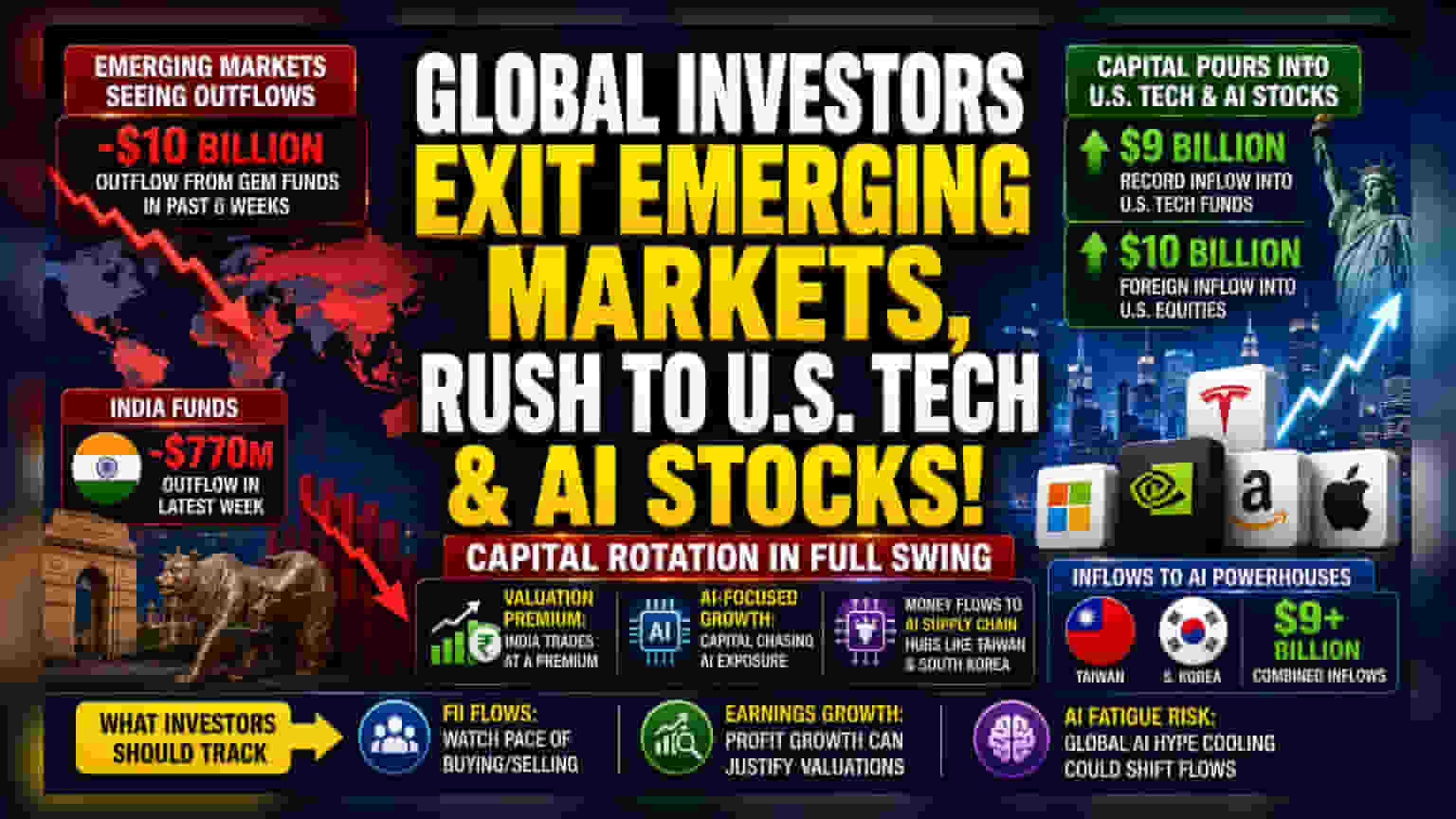


Global investors are rotating capital away from emerging markets, including India, to chase AI-linked opportunities in the US. This shift has triggered significant outflows from India-focused funds. Investors should understand why this capital migration is happening and whether it indicates a change in market momentum or a temporary valuation-driven correction.
What Happened
Global investment patterns are undergoing a major shift. Recent data indicates that investors are trimming their exposure to emerging market funds to pivot toward US technology and artificial intelligence (AI) stocks. Over the past six weeks, global emerging market (GEM) funds have seen roughly $10 billion in redemptions. India has not been immune to this trend, with India-focused funds witnessing an outflow of approximately $770 million in the latest tracked week alone.
The Shift Toward US Tech
While capital is leaving several emerging markets, it is not disappearing from the market entirely. Instead, there is a clear trend of capital reallocation. Investors are moving money into what they perceive as the core beneficiaries of the AI revolution, primarily listed in the United States. US technology-focused funds recently attracted a record $9 billion in inflows, while broader US equities saw $10 billion in foreign investments. This suggests that global capital is currently prioritizing direct exposure to the AI supply chain and software leaders over the broader, diversified exposure typically found in emerging market funds.
Why India Is Facing Outflows
One of the primary drivers of this capital rotation is the search for relative value and AI-specific growth. For a long time, Indian markets have traded at a valuation premium compared to many other emerging markets. When global investors rebalance their portfolios to chase AI-led growth, they often trim exposure to markets that are perceived as more expensive or less directly connected to the immediate AI boom.
Interestingly, the data shows that this is not a broad exit from all emerging markets. Investors are being selective. While India and China have seen outflows, markets like Taiwan and South Korea—which are globally recognized hubs for AI hardware, semiconductors, and electronic supply chains—have attracted over $9 billion in combined inflows. This highlights that foreign investors are essentially voting with their money, choosing markets they believe have a more direct or significant role in the global AI infrastructure race.
The Historical Context
Financial analysts, including those at Elara Capital, have noted that India's recent performance relative to other emerging market funds has reached record lows over both one-year and three-year periods. In market history, such extreme underperformance often serves as a signal. It can either precede a period of volatility or act as a precursor to an inflection point where valuations adjust and interest returns. Whether the current trend represents a long-term structural change or a temporary rotation driven by short-term AI hype remains the key question for market participants.
How Investors May Read This
For long-term investors in India, this news provides a lesson in global capital flow. When global risk appetite shifts toward specific themes like AI, foreign institutional money can move rapidly to follow the trend. The current outflows are not necessarily a reflection of India’s internal economic health, but rather a reflection of where global investors are chasing the highest perceived growth in the immediate term.
What Investors Should Track
Investors should closely monitor the following factors in the coming weeks and months. First, watch the trend in foreign institutional investor (FII) flows to see if the pace of selling accelerates or stabilizes. Second, track upcoming corporate earnings growth. If Indian companies can deliver profit growth that justifies their current market valuations, the valuation gap that currently encourages capital flight may narrow. Finally, observe if the global 'AI fatigue' spreads further. If investors continue to trim exposure to AI infrastructure globally, it could change the entire dynamic of how capital moves across international borders.