 Whalesbook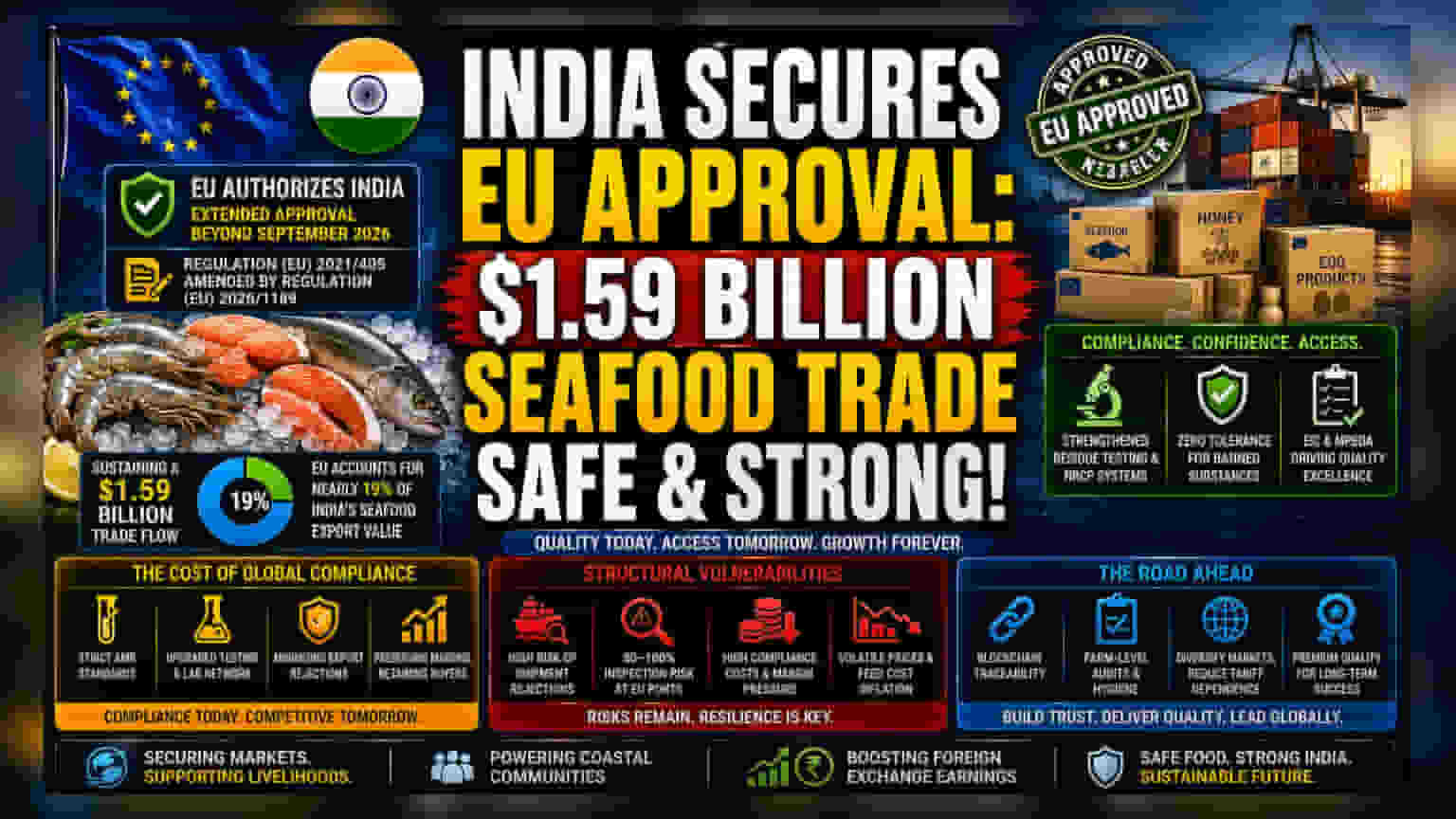


Sustaining the European Export Corridor
The European Union’s decision to authorize India as an approved exporter for aquaculture, honey, and egg products beyond September 2026 provides immediate stability to a $1.59 billion annual trade flow. This development follows a period of heightened uncertainty, during which India’s prior omission from the EU’s authorized lists—stemming from concerns over antimicrobial resistance (AMR)—threatened to sever a key revenue stream for Indian processors. The current approval, facilitated by an amendment to Regulation (EU) 2021/405 through Commission Implementing Regulation (EU) 2026/1189, validates the aggressive quality control measures and institutional oversight spearheaded by the Export Inspection Council and the Marine Products Export Development Authority.
The Cost of Global Compliance
Maintaining access to this high-value market requires more than just diplomatic engagement; it demands technical operational excellence. The EU’s AMR framework mandates that exported animal-origin products must be entirely free from banned pharmacologically active substances and growth-promoting antibiotics. Indian exporters have been compelled to overhaul their National Residue Control Programme (NRCP) and post-harvest testing infrastructure to meet these standards. Historically, the sector has struggled with sporadic export rejections due to antibiotic residues, which historically incentivized buyers to shift procurement to competitors like Vietnam or Thailand. The current regulatory win indicates that these internal compliance mechanisms have reached a threshold acceptable to the European Commission, effectively neutralizing the immediate risk of a trade suspension that could have depressed margins for domestic aquaculture operators.
Structural Vulnerabilities and Risks
The reliance on external regulatory approval highlights a inherent fragility in the seafood export model. Even with this authorization, the industry faces persistent downward pressure from strict surveillance at European ports. If rejections rise, the EU may increase inspection frequencies—potentially reaching 50% to 100% of shipments—which would significantly escalate logistical costs and erode profitability. Furthermore, while the EU currently accounts for nearly 19% of India’s seafood export value, the sector’s historical volatility demonstrates that dependence on centralized regulatory bodies is a major strategic risk. Companies within this space must contend with the high operational costs of maintaining EU-approved facility standards, which can create margin compression if global seafood prices fluctuate or if feed-cost inflation persists.
Future Outlook
With the European market secured, the focus shifts toward maintaining the traceability and hygiene standards now codified as a prerequisite for trade. The industry is expected to emphasize blockchain-based traceability and rigorous farm-level auditing to satisfy future EU scrutiny. As Indian exporters work to diversify their market footprint to mitigate regional tariff impacts, the stability of the European channel serves as a foundational pillar, supporting employment and foreign exchange earnings across the coastal belt. However, long-term success will rely on the industry's ability to evolve beyond minimal compliance, moving toward a premium-market strategy that prioritizes absolute residue-free production to insulate against future regulatory shifts.