

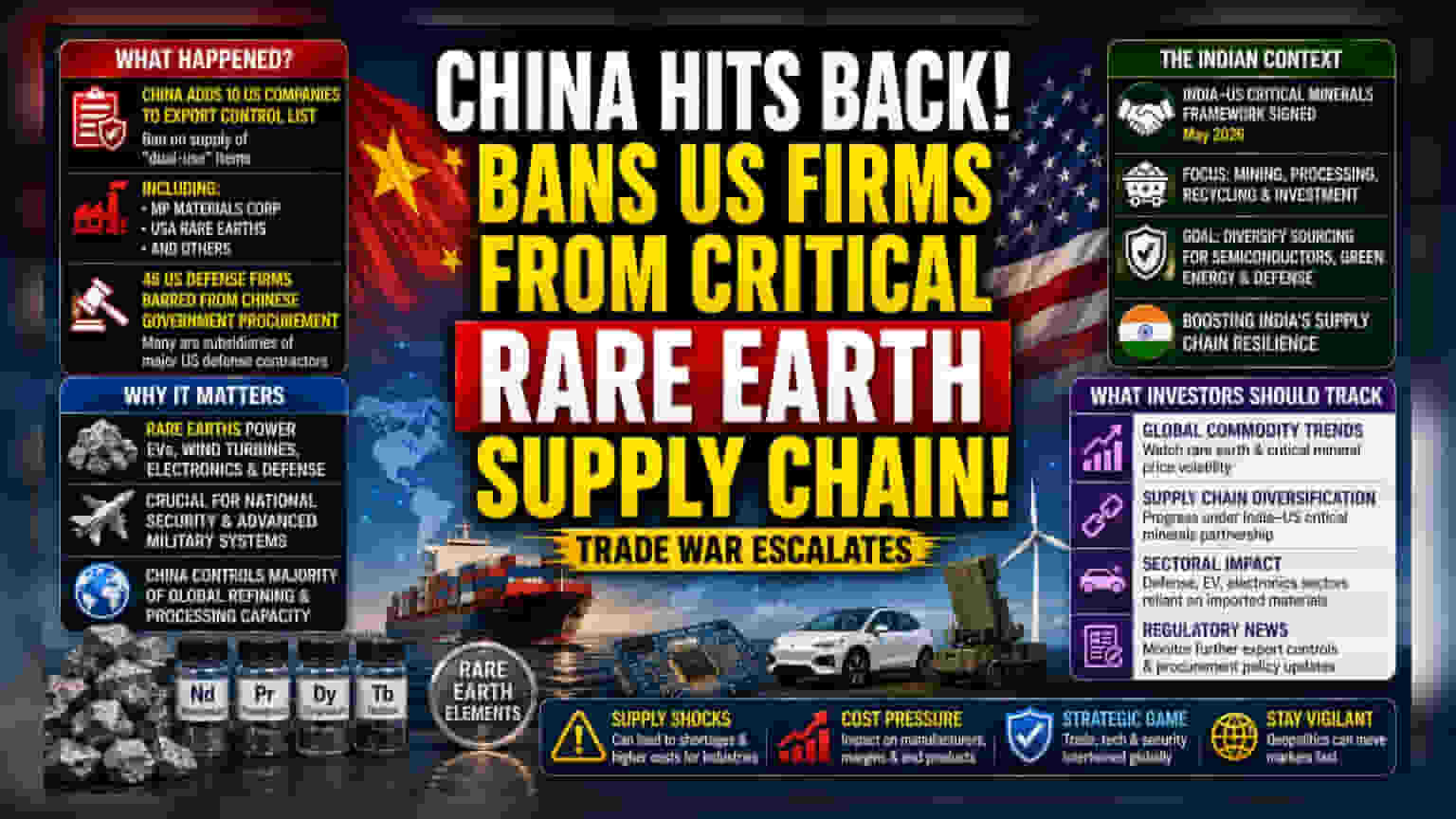
China has barred 10 US companies, including rare-earth miners, from accessing 'dual-use' exports, citing national security concerns. This move escalates ongoing trade tensions between the two powers. For Indian investors, the event highlights the global shift in supply chains for critical minerals, a sector where India is actively seeking to reduce dependency on Chinese supplies.
What Happened
China’s Ministry of Commerce has added 10 United States-based companies to its export control list, prohibiting Chinese firms from supplying them with "dual-use" items. These are products, technologies, or raw materials that have both civilian and military applications. The list includes prominent companies such as rare-earth mine operator MP Materials Corp and magnet manufacturer USA Rare Earths. In a parallel move, China’s Ministry of Finance has barred 46 companies—many of which are subsidiaries of major US defense contractors—from participating in Chinese government procurement.
Why This Matters For Supply Chains
This restriction targets the rare earth supply chain, which is essential for modern technology. Rare earth elements are critical components in manufacturing high-tech goods, including electric vehicle motors, wind turbines, advanced electronics, and defense hardware like fighter jets and radar systems. China currently holds a dominant position in the global refining and processing of these minerals. By controlling the flow of these materials and related technology, these export curbs act as a strategic lever in the broader US-China trade conflict.
The Indian Context
For Indian investors and businesses, this escalation underscores the importance of supply chain resilience. India has been working to reduce its reliance on Chinese imports for critical minerals and defense components. In May 2026, India and the United States signed a bilateral framework aimed at securing critical mineral supply chains, focusing on mining, processing, recycling, and investment. This partnership is designed to diversify sourcing for essential industries, including semiconductors, green energy, and defense, which are key pillars of India’s economic growth strategy.
Managing Business Risks
When major economies engage in trade friction, the ripple effects can impact global commodity prices and logistics. Increased controls on "dual-use" goods can lead to supply shortages or higher costs for manufacturers in the tech and defense sectors. While the direct impact of these specific Chinese sanctions is primarily on the named US entities, the move serves as a reminder to investors that global trade policies are increasingly intertwined with national security.
What Investors Should Track
Investors may monitor the following to understand the broader impact:
Global Commodity Trends: Watch for volatility in the prices of critical minerals and rare earths, as trade restrictions often influence supply and demand dynamics.
Supply Chain Diversification: Updates on India’s progress under the recently signed US-India critical minerals pact will be important, as this directly affects the long-term cost and availability of raw materials for domestic manufacturers.
Sectoral Impact: Trends in the defense, electric vehicle, and electronics sectors, which rely heavily on these imported materials, may be influenced by how quickly companies can adapt to new supply chain constraints.
Regulatory News: Further updates from government authorities on export controls or procurement policies can influence market sentiment regarding trade-exposed companies.